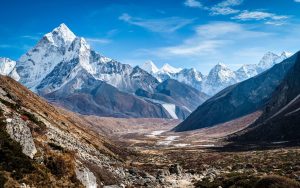
Introduction to 200 Hour Yoga Teacher Training in Nepal
You’ve probably had the same three tabs open for a week now. One school promises “authentic Himalayan yoga.” Another has 800 reviews and a price so low it makes you nervous. A third looks beautiful but tells you almost nothing about what you’ll actually be doing for 22 days straight.
That’s the real problem with researching a 200 hour yoga teacher training (YTT) in Nepal: everyone says “transformative,” “authentic,” and “life-changing,” and none of it tells you whether you’ll come home with a certification that’s actually recognized, a teacher who can actually explain an L5-S1 disc issue, or a month you’ll regret.
This guide is built to answer the questions you’re actually sitting with — not “why is yoga great,” but things like: is Nepal even the right country for this, how do you tell a serious school from a guesthouse with a yoga mat, what does $1,200–$1,600 actually buy you, what’s the visa situation, and what does a random Tuesday in week two really feel like. We’ll also walk through what a 200-hour curriculum is legally and academically supposed to contain, so you can hold any brochure up against a real standard instead of marketing language.
Quick Answer: 200 Hour Yoga Teacher Training in Nepal at a Glance
| Typical duration | 21–25 days, residential |
| Typical cost | US $1,100 – $1,800 (tuition, shared/private room, 3 meals a day) |
| Certification | RYT 200 through Yoga Alliance (US) once the host school is a Registered Yoga School (RYS 200) |
| Main hubs | Kathmandu Valley (Budhanilkantha, Boudhanath, Pharping) and Pokhara |
| Visa needed | Nepal tourist visa on arrival — 30-day visa costs US $50, covers most 22-day courses |
| Best months | March–May and September–November (dry, mild); avoid peak monsoon (June–August) if you can |
| Core curriculum hours | Asana/pranayama practice, philosophy, anatomy & physiology, teaching methodology, ethics/lifestyle, practicum — split according to Yoga Alliance’s five educational categories |
| Who it suits | Practitioners with at least 6–12 months of regular practice; complete beginners should expect a demanding, not impossible, course |
Keep this table as your yardstick. Now let’s unpack every line of it.
Why Nepal, Specifically, for a 200 Hour Yoga Teacher Training
Everyone knows India — Rishikesh, mainly — as the default answer to “where do I do yoga teacher training.” Nepal is often treated as India’s quieter cousin, which undersells it badly.
Yoga’s philosophical backbone — Patanjali’s Yoga Sutras, the concept of dharma, the ethics of ahimsa and non-attachment — developed across a shared cultural and religious landscape that includes the Kathmandu Valley, not just the Ganges plains. Nepal is also the birthplace of Siddhartha Gautama (the Buddha), born in Lumbini in what is now southern Nepal, and Buddhist philosophy is deeply woven into how many Nepali teachers frame meditation, breath, and the mind — which matters if your training includes meditation and yogic philosophy hours, as every accredited 200-hour program must.
There’s also a practical, less romantic reason schools in Nepal can be genuinely competitive: the Kathmandu Valley sits at roughly 1,400 meters, ringed by hills and, on a clear day, distant Himalayan peaks, without the crowding, noise, and tourist saturation that parts of Rishikesh now deal with during peak season. Training centers set slightly outside the main city — in areas like Budhanilkantha, at the northern edge of Kathmandu near Shivapuri National Park — trade nightlife and constant tourist traffic for actual quiet, which turns out to matter a great deal when you’re trying to hold a 6:30 a.m. pranayama practice or sit still through a two-hour philosophy lecture.
None of that makes Nepal automatically “better” than India. It makes it a legitimate, distinct option with its own character, and for a specific kind of student — someone who wants fewer distractions, a slower pace, and a stronger emphasis on the classical and devotional side of yoga alongside the physical — it’s often the better fit.
Nepal vs. India (Rishikesh) for 200-Hour YTT
| Nepal (Kathmandu Valley / Pokhara) | Rishikesh, India | |
|---|---|---|
| Atmosphere | Quieter, fewer schools per square kilometer, slower pace | Dense concentration of schools, more nightlife and tourist infrastructure |
| Cost | Broadly similar, often slightly lower | Broadly similar, occasionally cheaper at budget schools |
| Cultural emphasis | Strong Hindu-Buddhist blend, Himalayan Buddhist influence | Strongly Hindu, Ganges-centered spiritual tradition |
| Logistics | Fly into Kathmandu (TIA); onward travel to Pokhara is short domestic flight or 6-8 hour drive | Fly into Delhi, then bus/train/car to Rishikesh (5-7 hours) |
| Visa | Visa on arrival for most nationalities | e-Visa required in advance for most nationalities |
| Natural setting | Himalayan foothills, valley views, national park proximity | Ganges riverbank, foothills of the Himalayas |
Both are valid. If you’re weighing the two, the honest answer is: pick based on the specific school and curriculum, not the country’s reputation alone.
What a 200-Hour YTT Actually Has to Contain
This is the part almost every article on this topic skips, and it’s the part that actually protects you from wasting a month of your life.
A 200-hour Registered Yoga School (RYS 200) — the internationally recognized designation issued by Yoga Alliance, a US-based nonprofit that sets voluntary but widely respected standards for the yoga teaching profession — is required to build its curriculum around five educational categories. Individual schools choose how they weight the hours within those categories, which is exactly why two “200-hour” programs can feel completely different:
- Techniques, Training, and Practice — the physical and technical core: asana (postures), pranayama (breathwork), kriyas (cleansing techniques), mudra, chanting, and meditation, taught both as personal practice and as something you learn to demonstrate and cue.
- Teaching Methodology — how to actually run a class: sequencing logic, verbal and physical cueing, class management, working with different bodies and skill levels, and the practical, less glamorous mechanics of standing in front of a room.
- Anatomy and Physiology — both physical anatomy (joints, muscles, the skeletal and nervous systems as they relate to asana and injury prevention) and the more subtle “energy anatomy” of yogic tradition (chakras, nadis, prana).
- Yoga Philosophy, Lifestyle, and Ethics — classical texts such as Patanjali’s Yoga Sutras and often the Hatha Yoga Pradipika, along with the yamas and niyamas (yogic ethical restraints and observances) and how they translate into a teacher’s conduct and a student’s daily life.
- Practicum — supervised, hands-on teaching practice, where you actually lead segments of class, receive feedback, and observe your peers doing the same.
If a program’s brochure only talks about asana and “daily yoga practice” without clearly breaking out philosophy, anatomy, teaching methodology, and supervised practicum hours, that’s a signal to ask harder questions before you book — not necessarily a dealbreaker, but a gap worth clarifying directly with the school.
How a typical 200 Hour Yoga Teacher Training in Nepal curriculum breaks down by hours
| Subject Area | Typical Hours | What It Actually Covers |
|---|---|---|
| Practice (asana, pranayama, kriya, meditation) | 90–100 | Daily guided practice sessions, technique refinement, breath control, cleansing techniques |
| Philosophy & yogic texts | 15–20 | Yoga Sutras of Patanjali, Hatha Yoga Pradipika, origins and history of yoga |
| Anatomy & physiology | 15–20 | Musculoskeletal anatomy, injury-aware alignment, subtle-body (energy) anatomy |
| Teaching methodology | 10–15 | Sequencing, cueing, voice projection, class management, group dynamics |
| Practicum (supervised teaching) | 15–20 | Leading practice segments, peer feedback, observation |
| Yogic lifestyle & ethics | 8–10 | Yamas/niyamas, sattvic diet, daily yogic living |
| Mantra, chanting & the three yogas | 5–10 | Sanskrit chanting, karma yoga (service), bhakti yoga (devotion), jnana yoga (knowledge) |
| Q&A, self-study & assessment | 10–15 | Group discussion, reflection, written and practical evaluation |
These figures are representative of how Nepal-based Yoga Alliance-registered schools typically structure a 200-hour program — actual hour counts vary slightly by school, so always ask for the specific breakdown before you commit.

Which Yoga Style Will You Actually Learn?
“200-hour YTT” tells you the hour count, not the style, and this is where a lot of trainees end up disappointed after the fact — they pictured one kind of practice and got another. Nepal-based schools generally teach one of a few core traditions, sometimes blended:
- Hatha Yoga — the slower, foundational style most 200-hour programs are built around, emphasizing precise alignment, held postures, and breath awareness. If your goal is a strong technical base you can build any teaching style on top of later, Hatha-centered programs are usually the safest starting point.
- Ashtanga Yoga — a more physically demanding, sequence-based practice (the Primary Series being the most common entry point), built on a fixed order of postures linked by breath (vinyasa). Better suited to trainees who already have a consistent, more athletic practice.
- Vinyasa Yoga — breath-synchronized, flowing movement between postures, less rigid in sequencing than Ashtanga but still dynamic. Popular in Western studios, so useful if you plan to teach in a gym or boutique studio environment afterward.
- Yin Yoga — long-held, passive postures targeting connective tissue rather than muscle, often taught as a specialty add-on rather than the core of a 200-hour foundation.
Many Nepal schools, including Nepal Yoga Institute, build their core 200-hour program around Hatha as the foundational technical base while introducing elements of Ashtanga and other traditional practices, then offer separate, dedicated Ashtanga or Hatha-specialized trainings for students who want to specialize further after their foundation.
If a specific style is your priority — say, you specifically want to teach Vinyasa in a Western gym setting — ask the school directly which style forms the backbone of their asana curriculum before you book, rather than assuming from the marketing copy.
How to Actually Vet a School (Before You Wire a Deposit)
This is the section that separates a genuinely useful guide from a listicle. Here’s what actually matters, in order.
1. Confirm the Yoga Alliance registration directly, not just via a badge on the website. Any school can put a logo on their homepage. Search the school’s name on Yoga Alliance’s own directory to confirm the registration is current and matches the exact hours (RYS 200) you’re signing up for.
2. Ask who is actually teaching, and check their credentials. A school run by one Experienced Registered Yoga Teacher (E-RYT, meaning 500+ hours of training and a minimum number of taught hours logged with Yoga Alliance) who personally leads philosophy and anatomy sessions is a very different experience from a rotating cast of guest teachers you’ve never heard of. Ask for teacher bios and years of teaching experience before you book.
3. Get the daily schedule in writing. A real 200-hour month is structured and demanding — usually 6-7 hours of scheduled activity a day, six days a week. If a school is vague about the actual daily timetable, that’s often because it changes constantly, which tells you something about how organized the program is.
4. Ask about class size. Somewhere between 10 and 16 trainees per cohort tends to be the sweet spot — large enough to create a group dynamic and peer-teaching practice, small enough that the lead teacher can actually correct your alignment and remember your name.
5. Clarify exactly what’s included in the price. Tuition, accommodation type (shared vs. private room), number of daily meals, airport pickup, and course materials (manual, books) should all be spelled out. “All-inclusive” means different things to different schools.
6. Read reviews on a platform the school doesn’t control. Testimonials on a school’s own site are curated by definition. Cross-check on TripAdvisor, Google Reviews, or Yoga Alliance’s own review system where possible.
7. Ask what happens if you don’t complete all 200 hours. Illness, family emergencies, and injuries happen. A transparent school will have a clear policy — sometimes the option to complete remaining hours online or at a later date — rather than a vague “no refunds, no exceptions.”
A Day in the Life: What 22 Days Actually Looks Like
Nobody tells you this part honestly, so here it is: a residential 200-hour YTT is not a retreat. It’s closer to a very intense, very early-rising academic semester compressed into three weeks, with your body as the main subject.
Across serious residential schools, the shape of the day tends to follow the same broad logic, because it mirrors the traditional structure of an ashram-style training day: an early start (typically before 7 a.m.) built around cleansing practices and pranayama, a longer morning asana session before breakfast, theory classes (philosophy, anatomy, teaching methodology) filling the midday hours, an afternoon block for meditation or workshop-style learning, a second, shorter evening asana practice, and a self-study period after dinner where trainees review notes and often work on chant memorization or practicum prep.
Most schools give one full day off per week, typically Sunday, which is when trainees usually do a short hike, visit a nearby heritage site or temple, or simply sleep in for the first time in six days.
Exact start times, meal windows, and the order of sessions vary by school and by month — some shift the evening practice earlier in winter when it gets dark sooner, for instance — so treat the shape above as the template and ask any school you’re considering for their specific hour-by-hour timetable before you book. (You can see Nepal Yoga Institute’s exact day-by-day schedule on our 200-hour program page.)
By around day 10, most trainees hit a wall — physically tired, mentally saturated with new philosophy vocabulary, homesick in a low-grade way. This is normal and, according to teachers who run these programs repeatedly, almost predictable. It’s also usually the point where things click, sequencing starts to feel intuitive rather than memorized, and the group bonds start to solidify. Knowing that dip is coming — and that it passes — makes it considerably easier to sit with.
What It Actually Costs (And What “Included” Should Mean)
Prices across Nepal-based 200-hour programs generally land between roughly $1,100 and $1,800 for a 21-25 day residential course. At the lower end, expect shared rooms and simpler facilities; toward the higher end, private rooms, more established schools, or additional extras like excursions or spa access become more common.
A representative, transparent cost structure looks like this:
| Item | Typically Included? |
|---|---|
| Tuition (200 hours of instruction) | Yes |
| Accommodation (shared room, standard) | Yes |
| Three meals daily (often vegetarian/sattvic) | Yes |
| Course manual/materials | Usually |
| Yoga Alliance registration processing | Usually, after successful completion |
| Airport pickup | Sometimes — confirm |
| Private room upgrade | Extra cost |
| Flights to/from Nepal | No — book separately |
| Visa fee | No — paid directly to Nepal immigration |
| Excursions/sightseeing beyond the standard day off | Sometimes extra |
A typical deposit structure is a non-refundable reservation payment (commonly around $150–$250) made at booking, with the balance due on arrival or orientation day. Always get the cancellation and refund policy in writing before you pay the deposit — this is the single most common source of dispute between students and schools after the fact.
Best Time of Year to Train in Nepal
Nepal has four fairly distinct seasons, and they matter more for a YTT than you’d expect, since you’ll be doing intensive outdoor and studio practice daily.
- March – May (spring): Generally considered one of the best windows. Mild daytime temperatures, clearer mountain visibility earlier in the season, and rhododendrons in bloom at higher elevations.
- June – August (monsoon): Hot, humid, and wet, with heavy afternoon rain common, particularly in the Kathmandu Valley and Pokhara. Not impossible for training — indoor practice continues regardless — but outdoor excursions and hikes on the weekly day off become less reliable.
- September – November (autumn): Widely regarded as the best season in Nepal overall — clear skies, stable weather, comfortable temperatures, and the best mountain visibility of the year, coinciding with major festivals like Dashain and Tihar.
- December – February (winter): Cold, especially at higher elevations and in the early mornings when pranayama and cleansing practices happen — mornings can be genuinely chilly indoors if a facility isn’t well-heated, so ask about heating before booking a winter course.
If mountain views and comfortable hiking on your day off matter to you, aim for autumn first, spring second.
Visa, Flights, and Getting There
Most nationalities can obtain a Nepal tourist visa on arrival at Tribhuvan International Airport (Kathmandu) or at land border crossings. As of current published rates, a 15-day visa costs US $30, a 30-day visa costs US $50, and a 90-day visa costs US $125, all payable in cash (USD is easiest) or via the online prepayment system before you land. Since a standard 22-day course runs longer than the 15-day visa but comfortably within 30 days, most trainees should apply for the 30-day visa on arrival rather than the shorter option.
A few practical notes that repeatedly trip up first-time visitors:
- Fill out the online arrival form in advance through Nepal’s official immigration portal to skip the airport queue — it’s valid for 15 days from submission, so don’t do it too far ahead of your flight.
- Bring a passport-sized photo and a passport valid for at least six months beyond your arrival date.
- Citizens of a small number of countries are not eligible for visa on arrival and must arrange a visa through a Nepali embassy or consulate beforehand — check your specific nationality before assuming visa-on-arrival applies to you.
- If your school is in Kathmandu, you’ll fly into Tribhuvan International Airport directly. If it’s in Pokhara, you’ll either take a roughly 25-minute domestic flight or a 6-8 hour drive from Kathmandu, depending on the school’s location and your budget.
What to Pack
Beyond the obvious (yoga mat — though many schools provide one, so check first — and comfortable practice clothes), a few items genuinely matter for a Nepal-based training specifically:
- Layered clothing — mornings and evenings can be cool even in warmer months, especially at higher elevations like Budhanilkantha or Pharping
- A lightweight rain layer if training during or near monsoon season
- A journal — between philosophy lectures, self-study blocks, and practicum feedback, you will be taking far more notes than you expect
- Basic toiletries and any personal medication, since pharmacies outside central Kathmandu can be inconsistent
- A headlamp or small flashlight — useful for early 6:30 a.m. starts and occasional power fluctuations, which still happen periodically outside the main tourist areas
- An open mind about food — most residential schools serve a sattvic (vegetarian, yogic) diet, and dietary restrictions should be flagged with the school well before arrival
Life During the Training: Food, Culture, and the Day Off
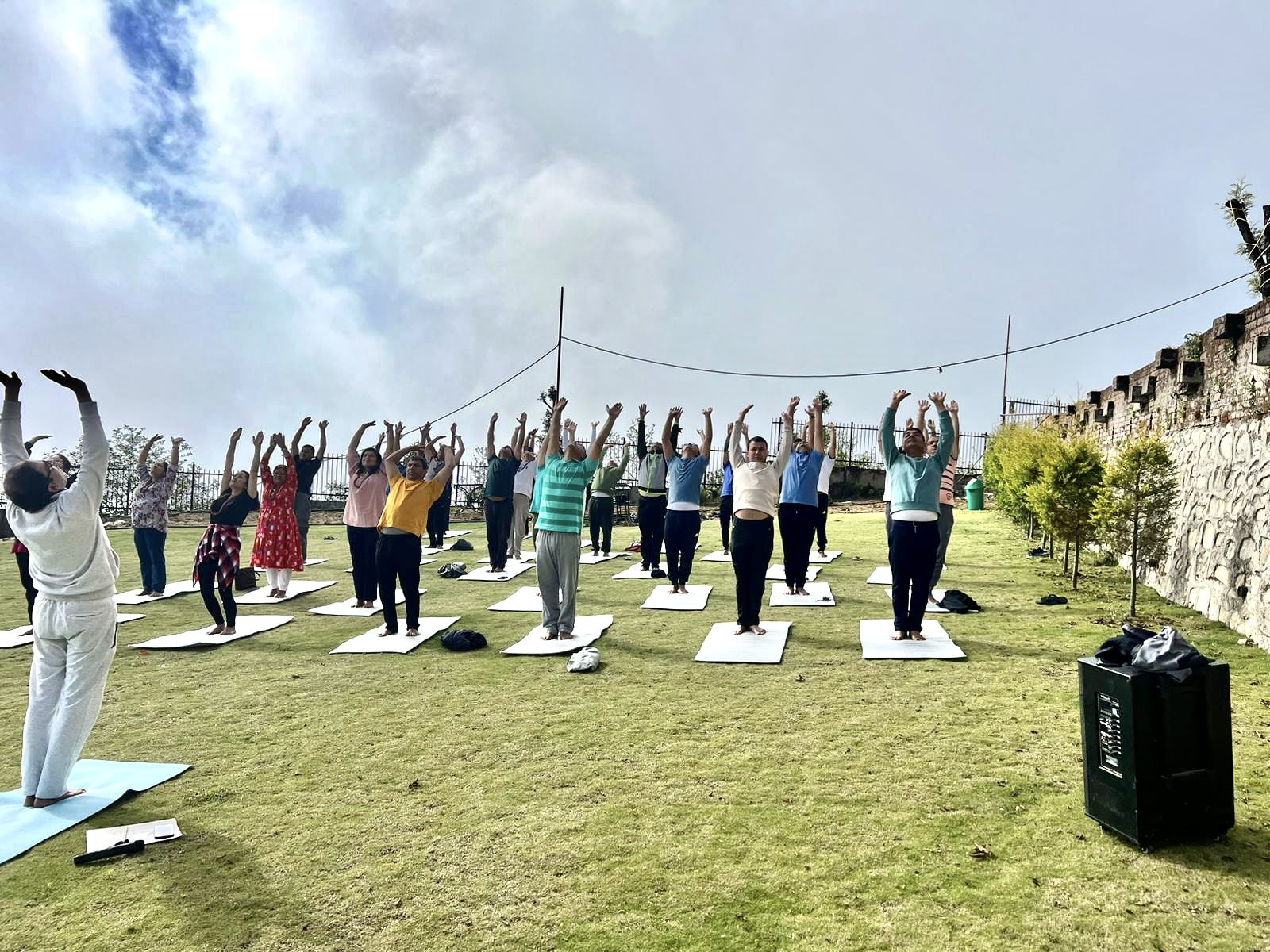
Meals at most residential schools are vegetarian, often strictly sattvic — meaning food chosen to support a calm, clear mind, avoiding heavy, processed, or overly stimulating ingredients (garlic and onion are sometimes limited for this reason in more traditional programs). Expect dal bhat (lentils and rice, Nepal’s staple meal), seasonal vegetables, herbal teas, and simple, freshly prepared food rather than restaurant-style variety. If you have significant dietary restrictions, raise them with the school before you book, not after you land.
The weekly day off is where a lot of the “why Nepal” case actually gets made. Common options, depending on the school’s location, include:
- A short hike into the surrounding hills or toward Shivapuri National Park if you’re near Budhanilkantha
- A visit to Boudhanath Stupa, one of the largest Buddhist stupas in the world and a UNESCO World Heritage Site, or Pashupatinath Temple, a major Hindu pilgrimage site
- Exploring Kathmandu’s Durbar Square heritage sites
- Simply resting — which, by week two, most trainees genuinely need
Many schools also build in an element of karma yoga (selfless service) — sometimes a visit to a local school, orphanage, or community organization — which tends to be one of the more quietly memorable parts of the month for trainees, even though it’s rarely mentioned in marketing copy the way “mountain views” is.
After the Training: What RYT 200 Actually Gets You
Completing a Yoga Alliance-registered 200-hour program makes you eligible to register as an RYT 200 (Registered Yoga Teacher, 200-hour) with Yoga Alliance — you’ll typically need to apply and pay a separate registration fee directly to Yoga Alliance after your school submits your completion. It’s worth being clear-eyed about what this credential is and isn’t: Yoga Alliance is a voluntary, nonprofit registry, not a government licensing body, and no law requires it to teach yoga in most countries.
In practice, though, it’s become the de facto standard that studios, gyms, and retreat centers look for when hiring, which is why most serious trainees pursue it regardless of the legal technicality.
From there, the typical paths are:
- Teaching locally or internationally — studios and gyms in most countries treat RYT 200 as the baseline qualification for hiring
- Continuing to RYS 300 — an advanced 300-hour training that, combined with your 200-hour foundation, qualifies you for the RYT 500 designation
- Specializing — many teachers go on to shorter specialty trainings (prenatal, yin, children’s yoga, yoga therapy) once they have the 200-hour foundation
- Teaching without formal employment — private clients, online classes, or community classes, where the credential functions more as a trust signal than a legal requirement
Common Mistakes First-Timers Make
- Booking the cheapest option without checking accreditation. A low price is sometimes just a low price — but it’s sometimes also a sign of an unregistered “school” cutting corners on required curriculum hours.
- Assuming “beginner-friendly” means easy. Most schools do accept complete beginners, but the course intensity doesn’t scale down much for you — you’ll simply be working harder than your more experienced classmates in the early days.
- Not budgeting for anything beyond tuition. Flights, visa fees, travel insurance, and the deposit for your RYT 200 registration with Yoga Alliance after the course are all separate costs that catch people off guard.
- Skipping travel insurance. A month of intensive physical practice, unfamiliar food, and altitude is exactly the scenario travel insurance exists for.
- Not clarifying the refund policy before paying a deposit. This is the single most common source of post-booking frustration, and it’s entirely avoidable by asking one direct question upfront.
A School Worth Knowing: Nepal Yoga Institute and Retreat
If you’re looking at Kathmandu Valley specifically, Nepal Yoga Institute and Retreat is a Yoga Alliance USA-registered school based in Budhanilkantha, on the northern edge of Kathmandu near Shivapuri National Park — roughly 22 km from Tribhuvan International Airport and about 24 km from the Thamel tourist district, which places it firmly in the “quiet hills, not city center” category discussed earlier in this guide. Teachers are Experienced Registered Yoga Teachers (E-RYT) through Yoga Alliance USA, courses are kept small (capped at 14 students), and the school also runs longer-format Ashtanga- and Hatha-focused trainings for students who want to specialize after their foundational 200 hours.
Run it against the vetting checklist above and it holds up: verifiable accreditation, a capped class size, named E-RYT teachers, and a location that matches the “fewer distractions” case this guide makes for training outside a dense tourist hub.
For the exact curriculum hour breakdown, current dates, pricing, and daily schedule, see our 200-Hour Yoga Teacher Training page directly — that’s the page to check before you book, since program details are the kind of thing that gets updated and a guide like this one won’t always catch a mid-year change.
Frequently Asked Questions about 200 Hour Yoga Teacher Training in Nepal
1. Do I need prior yoga experience to join a 200-hour YTT in Nepal? Most schools accept complete beginners, though at least a few months of regular practice makes the physical intensity considerably more manageable. If you’re brand new, look for schools that explicitly welcome beginners and ask how they support students who are still learning basic alignment.
2. Is Nepal Yoga Teacher Training internationally recognized? It is, provided the school is registered with Yoga Alliance as an RYS 200 (Registered Yoga School). The certification you receive — RYT 200 — is recognized by studios and gyms globally, since it’s an international, not country-specific, credential.
3. How much does a 200-hour YTT cost in Nepal? Typically between US $1,100 and $1,800 for a 21-25 day residential course, including tuition, shared accommodation, and three meals a day. Private rooms and additional excursions usually cost extra.
4. How long does the course take? Most Nepal-based 200-hour programs run 21 to 25 days, delivered as an intensive residential course rather than spread over weeks or months.
5. What’s the best time of year to do a YTT in Nepal? September through November and March through May generally offer the most stable weather and best mountain visibility. June through August (monsoon) is hot and wet; December through February is cold, especially in the early mornings.
6. What visa do I need, and how much does it cost? Most nationalities can get a Nepal tourist visa on arrival. A 30-day visa, which comfortably covers a standard 22-day course, costs US $50 as of current published rates. Always confirm your specific nationality’s eligibility before you travel.
7. Is the food during training vegetarian? Almost always, yes. Most residential schools serve a sattvic (yogic, plant-based) diet designed to support mental clarity during intensive practice. Flag any dietary restrictions with the school before you arrive.
8. Can I really become a certified yoga teacher in just 22 days? You can complete the foundational 200-hour certification in that timeframe — that’s the internationally standard length for an RYT 200. “Certified” here means you’ve met the baseline education requirement to register with Yoga Alliance; genuine teaching skill, like any craft, continues to develop with actual classroom experience afterward.
9. What’s the difference between doing YTT in Nepal versus Rishikesh, India? Both offer accredited options. Nepal tends to be quieter with fewer schools concentrated in one area, a stronger Buddhist-Hindu blend in its philosophical framing, and visa-on-arrival access for most nationalities. Rishikesh has a denser concentration of schools and a strongly Hindu, Ganges-centered spiritual tradition.
10. Will I get injured doing that much physical practice every day? Some soreness and fatigue, particularly in the first 7-10 days, is close to universal. Serious injury is uncommon at reputable schools that build in proper anatomy education and encourage students to modify poses, but it’s worth confirming a school has teachers trained to recognize and correct unsafe alignment before you book.
11. Do I need travel insurance? It’s strongly recommended, given the combination of intensive physical activity, travel to a country with variable medical infrastructure outside major cities, and the simple reality that a month abroad carries more risk than a weekend trip.
12. What happens after I finish — do I need to pay Yoga Alliance separately? Yes, typically. Your school submits your completion, but registering your RYT 200 status directly with Yoga Alliance usually involves a separate application and fee paid to Yoga Alliance itself, distinct from your course tuition.
13. Can I extend my stay in Nepal after the course to travel or trek? Yes — a 30-day visa gives you roughly a week of buffer after a 22-day course, and tourist visas can be extended at immigration offices within Nepal if you want to stay longer for trekking or sightseeing.
14. Is one school’s 200-hour training “better” than another’s if they’re both Yoga Alliance registered? Registration confirms a school meets the minimum curriculum standard — it doesn’t guarantee teaching quality, class size, facilities, or fit for your learning style. That’s exactly why checking teacher credentials, class size, daily schedule, and independent reviews (not just testimonials on the school’s own site) matters as much as the accreditation itself.
Before You Book the 200 Hour Yoga Teacher Training in Nepal

A 200-hour yoga teacher training in Nepal is genuinely one of the more demanding, immersive things you can do in three weeks — not a retreat with a yoga class attached, but a structured education in a discipline with a few thousand years of history behind it, taught in a place that’s been part of that history the whole time.
The schools that do it well are transparent about their curriculum hours, upfront about costs, and staffed by teachers you can actually research before you arrive. Use the checklist above, ask the direct questions, and choose the program — wherever it ends up being — on those merits rather than on whichever site has the prettiest photos of the Himalayas.