Yoga is one of the simplest, best-studied ways to bring stress down, and you don’t need to be flexible or experienced to use it. The poses that help most are slow, low to the ground and paired with long, easy exhales. Practised for 10 to 15 minutes a day, they shift the body out of “fight or flight” and towards rest.
This guide gives you eight beginner-friendly poses, three calming breathing practices and a 15-minute routine you can do at home. It also covers what the research actually shows, how to stay safe, and when stress needs more than a yoga mat.
Why Yoga Helps With Stress
When you’re stressed, your body switches on the stress response: the sympathetic nervous system speeds up your heart and breathing, and the hormone cortisol rises. That response is useful in a crisis. The problem is when it stays switched on for weeks, through work pressure, worry and poor sleep.
Yoga works on that system from two directions. Slow movement and stretching release the muscle tension that stress builds up, especially in the neck, shoulders, jaw and hips. And slow breathing, particularly long exhales, signals the parasympathetic (“rest and digest”) nervous system to take over.
The research supports this, with honest limits:
- A 2017 meta-analysis of 42 randomised controlled trials found that practices including yoga postures were linked to lower cortisol, lower ambulatory blood pressure and lower resting heart rate, compared with active control groups. The authors noted that the programmes studied varied a lot.
- The US National Center for Complementary and Integrative Health summarises a 2020 review of 12 studies (672 participants) in healthy adults that found benefits on perceived stress in every study.
- A 2022 meta-analysis of more than 200 studies found that voluntary slow breathing raises heart rate variability, a marker of parasympathetic activity, during practice, straight after one session and after longer programmes.
What yoga isn’t is a treatment for diagnosed anxiety disorders or depression on its own. The same NCCIH summary notes that yoga may help with anxiety symptoms but has little evidence of benefit for people with diagnosed anxiety disorders. Think of it as a powerful daily tool, not a replacement for medical care when you need it.
Signs Your Body Is Holding Stress
Stress doesn’t only live in your thoughts. Before you start, it helps to notice where it shows up in your body, because those are the places to soften during practice.
| Where you feel it | What it often looks like | Poses that help most |
|---|---|---|
| Jaw and face | Clenched teeth, a furrowed brow, grinding at night | Child’s pose, savasana, humming breath |
| Neck and shoulders | Shoulders creeping towards the ears, stiffness when turning the head | Cat–cow, standing forward fold |
| Breath | Short, shallow breaths high in the chest; frequent sighing | Long exhale breathing, reclining bound angle |
| Belly | A tight or “knotted” stomach, poor digestion | Child’s pose, reclining bound angle |
| Lower back and hips | Aching after long hours sitting | Supported bridge, seated forward bend |
| Sleep | Trouble falling asleep, waking with a racing mind | Legs up the wall, long savasana in the evening |
Take a minute to scan from head to toe before each session. You’ll start to notice tension earlier in daily life too, which is half the battle.
What Makes a Yoga Pose Calming
Not every pose relaxes you. A fast sun salutation or a strong arm balance can leave you energised, which is great some days but not when you’re wound up. Calming poses usually share a few qualities:
| Quality | Why it helps | Example |
|---|---|---|
| Close to the ground | Less effort to stay balanced, so the body can let go | Child’s pose, reclining poses |
| Forward bending | Turns attention inward and encourages slow exhales | Standing and seated forward folds |
| Supported | Props take the weight, so muscles can release | Supported bridge, legs up the wall |
| Held for 1–3 minutes | Gives the nervous system time to settle | Restorative holds |
| Paired with long exhales | Exhaling slowly is one of the quickest ways to slow the heart | Any pose, breathing out longer than in |
Before You Start: A Few Safety Notes
- Move gently and never push into pain. A stretch should feel like a stretch, not a sharp or pinching pain.
- Use props freely. A folded blanket, cushions, a firm pillow and a wall are all you need.
- Breathe through your nose if you can, slowly and without strain.
- Check with a doctor first if you are pregnant, have high blood pressure, glaucoma, a recent injury or surgery, or a back or neck condition. Each pose below notes when to skip or modify it.
- Practise on an empty or light stomach, ideally two hours after a large meal.
8 Calming Yoga Poses for Stress Relief
Do these in order for a complete practice, or pick two or three when time is short. Each includes how to do it, how long to stay, and how to adapt it.
1. Child’s Pose (Balasana)
- Kneel on a mat or rug with your big toes touching and your knees as wide as is comfortable.
- Sit back towards your heels and fold forward, resting your forehead on the floor, a block or a cushion.
- Rest your arms alongside your body, palms up, or stretch them forward.
- Let your belly soften against your thighs and breathe slowly into your back.
Hold: 1–3 minutes.
Why it calms: Resting your forehead and folding forward turns your attention inward. Many people feel their breath slow almost straight away, and the rounded back gently stretches the muscles that tighten under stress.
Make it easier: Put a cushion between your heels and hips, or a bolster or pillows lengthwise under your chest.
Skip or modify if: you have a knee injury. In pregnancy, keep the knees wide and support the chest so there’s no pressure on the belly.
2. Cat–Cow (Marjaryasana–Bitilasana)
- Come onto your hands and knees, wrists under shoulders and knees under hips.
- As you breathe in, let your belly sink, lift your chest and gaze slightly forward (cow).
- As you breathe out, round your back towards the ceiling and let your head hang (cat).
- Move slowly with your breath, letting each exhale be a little longer than each inhale.
Hold: 6–10 slow rounds.
Why it calms: Linking a simple movement to the breath gives a busy mind something to follow. It also loosens the spine, neck and shoulders, where stress tension tends to collect.
Make it easier: Pad your knees with a folded blanket, or do the same movement seated on a chair with hands on your knees.
Skip or modify if: you have a wrist problem (use fists or forearms instead) or a neck injury (keep the head in line with the spine).
3. Standing Forward Fold (Uttanasana)
- Stand with your feet hip-width apart and knees generously bent.
- Fold forward from the hips and let your upper body hang over your legs.
- Hold opposite elbows and let your head and neck relax completely.
- Sway gently side to side if it feels good, then stay still and breathe.
Hold: 30 seconds to 1 minute. Roll up slowly, one vertebra at a time, with your head coming up last.
Why it calms: Hanging upside down with a soft neck releases the back of the body and quietens the mind. The bent knees keep it gentle on the lower back.
Make it easier: Keep the knees well bent, or rest your hands on blocks or a chair seat.
Skip or modify if: you have high blood pressure, glaucoma, a disc problem or get dizzy easily. A half fold with hands on a table is a safe alternative.
4. Legs Up the Wall (Viparita Karani)
- Sit sideways next to a wall with one hip touching it.
- Swing your legs up the wall as you lie back, so your body forms an L shape.
- Shuffle your hips as close to the wall as is comfortable; a little gap is fine.
- Rest your arms out to the sides, palms up, and close your eyes.
Hold: 3–5 minutes, or longer if comfortable.
Why it calms: Many teachers consider this the single best pose for stress. It needs almost no effort, the legs are supported and the body is completely still. It’s especially good in the evening or after long hours on your feet.
Make it easier: Place a folded blanket under your hips, or rest your calves on a sofa or chair seat instead of the wall.
Skip or modify if: you have glaucoma or uncontrolled high blood pressure, or are in later pregnancy. Lie with your calves on a chair instead.
5. Reclining Bound Angle (Supta Baddha Konasana)
- Lie on your back and bring the soles of your feet together, letting your knees fall open.
- Support each outer thigh with a cushion or rolled blanket so there’s no strain in the hips.
- Rest one hand on your belly and one on your chest.
- Feel the belly rise as you breathe in and soften as you breathe out.
Hold: 2–5 minutes.
Why it calms: The open, supported shape lets the hips and belly release, and the hands give you a direct sense of your breath slowing down.
Make it easier: Lie back over a bolster or two firm pillows placed lengthwise along your spine.
Skip or modify if: you have a groin or knee injury; add more support under the thighs or simply lie with knees bent and feet flat.
6. Supported Bridge (Setu Bandhasana)
- Lie on your back with knees bent and feet flat, hip-width apart, close to your hips.
- Press into your feet and lift your hips.
- Slide a yoga block, a firm cushion or a folded blanket under your sacrum, the flat bone at the base of the spine.
- Lower your weight onto the support and let your arms rest by your sides.
Hold: 1–3 minutes, then lift your hips, remove the support and lower down slowly.
Why it calms: A gentle, supported backbend opens the chest, which tends to collapse when we’re tense or tired, without the effort of an active backbend.
Make it easier: Use a lower support, such as a folded blanket, or skip the support and simply rest with knees bent.
Skip or modify if: you have a neck injury; keep the support low and never turn your head while in the pose. Our guide to backbends covers this family of poses in more detail.
7. Seated Forward Bend (Paschimottanasana)
- Sit on the edge of a folded blanket with your legs straight out in front of you.
- Bend your knees as much as you need to, then fold forward from your hips.
- Rest your hands wherever they land, on your shins, ankles or a strap around your feet.
- Let your head drop and focus on long, slow exhales.
Hold: 1–2 minutes.
Why it calms: Seated forward bends are traditionally taught as calming and introspective. Folding in, with the eyes closed, makes it easy to tune out and settle.
Make it easier: Rest your chest on a bolster or pillows on top of your thighs, and keep the knees well bent.
Skip or modify if: you have a disc problem or sciatica. Keep the back long and the fold small, or skip it.
8. Corpse Pose (Savasana)
- Lie flat on your back, legs slightly apart, arms a little away from your body, palms up.
- Place a cushion under your knees if your lower back is uncomfortable, and cover yourself with a blanket.
- Close your eyes and let your whole body become heavy.
- Stop controlling the breath. Simply notice it, and let thoughts come and go.
Hold: 5–10 minutes.
Why it calms: This is where the practice lands. Lying completely still after movement gives the nervous system time to absorb the effects of everything before it. Don’t skip it.
Make it easier: Lie on your side with a pillow between your knees if lying on your back is uncomfortable.
Skip or modify if: you’re in later pregnancy (lie on your left side instead).
Three Breathing Practices That Calm You Faster
If you only have two minutes, breathing alone can take the edge off stress. All three of these are done sitting comfortably. Cross-legged pose (Sukhasana) works well: sit on a folded blanket, cross your shins with each foot under the opposite knee, and keep your spine tall. A chair is just as good.
1. Long exhale breathing
Breathe in through your nose for a count of four, then out through your nose for a count of six to eight. Keep it smooth and quiet, never forced. Continue for two to five minutes. If counting feels stressful, simply let each exhale be a little longer than each inhale.
2. Alternate nostril breathing (Nadi Shodhana)
- Rest your left hand on your knee. Bring your right thumb to your right nostril and your ring finger to your left nostril.
- Close the right nostril and breathe in through the left.
- Close the left nostril, release the right and breathe out through the right.
- Breathe in through the right, then close it and breathe out through the left. That’s one round.
- Continue for 5–10 rounds, slowly and without holding the breath.
3. Humming bee breath (Bhramari)
Breathe in through your nose. As you breathe out, keep your lips closed and make a steady, low humming sound like a bee, letting the sound continue to the end of the exhale. Repeat five to seven times, then sit quietly. Many people find the vibration surprisingly soothing. It’s closely related to the hum at the end of Om; our guide to Om chanting explains that practice.
A note on breath-holding: some yoga breathing practices include holding the breath. Beginners, and anyone who is pregnant or has high blood pressure or heart problems, should skip breath retention and learn it from a teacher.
Setting Up a Calm Space at Home
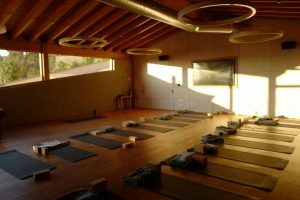
Your surroundings make a bigger difference than most people expect. You don’t need a yoga studio, just a corner that feels a little separate from work and screens.
- Choose a quiet spot with enough floor space to lie down, ideally near a clear wall for legs up the wall.
- Gather your props once: a mat or rug, two firm cushions or a bolster, a folded blanket and something to cover yourself with in savasana. Keeping them together makes it easier to start.
- Dim the lights in the evening, or practise near a window in the morning.
- Keep it warm. The body cools quickly when you’re still, and being cold makes it hard to relax.
- Use sound carefully. Silence, soft instrumental music or a recording of singing bowls can all help, but anything with lyrics tends to pull your attention away.
- Same time, same place. Practising in the same spot at the same time builds a cue, and after a few weeks just sitting down there starts to feel calming.
A 15-Minute Yoga Routine for Stress
This sequence uses the poses above in an order that gradually slows you down. Do it in the evening to unwind, or in the morning before a demanding day.
| Time | Practice | Focus |
|---|---|---|
| 0:00–2:00 | Seated long exhale breathing | Arrive; lengthen the out-breath |
| 2:00–3:30 | Cat–Cow (8 rounds) | Move with the breath |
| 3:30–5:00 | Child’s pose | Rest the forehead; breathe into the back |
| 5:00–6:00 | Standing forward fold | Soft knees, heavy head |
| 6:00–7:30 | Seated forward bend | Long exhales |
| 7:30–9:00 | Supported bridge | Open the chest |
| 9:00–12:00 | Legs up the wall | Complete stillness |
| 12:00–15:00 | Savasana | Let go of all effort |
Have 20–25 minutes? Add reclining bound angle before savasana and extend savasana to 10 minutes.
A 5-Minute Desk Version
Stress rarely waits until you’re home. If you’re at work, try this in your chair:
- Feet flat, spine tall. Take five long exhale breaths (about 1 minute).
- Seated cat–cow. Hands on knees; arch forward as you breathe in, round back as you breathe out. Eight rounds.
- Shoulder rolls and neck release. Roll the shoulders back five times, then drop your right ear towards your right shoulder for five breaths, and repeat on the left.
- Seated forward fold. Feet wide, fold forward over your thighs and let your arms and head hang for five breaths.
- Close your eyes for the last minute and simply notice your breath.
Morning or Evening: When to Practise
Both work, but they do slightly different jobs.
- Morning practice sets your baseline for the day. A short routine before you check your phone helps you start calm rather than reacting from the first email.
- Evening practice clears the day out of your body. Legs up the wall, forward folds and a long savasana are especially good before bed, and many people find they fall asleep more easily.
- In the moment, two minutes of long exhales or humming breath is often enough to stop stress from building.
The best time is the one you’ll actually keep. Pick one slot and protect it.
If your schedule is unpredictable, tie the practice to something you already do every day: after brushing your teeth at night, or before your first cup of tea. Linking a new habit to an old one is one of the simplest ways to make it stick, and on busy days even five minutes still counts.
Common Mistakes That Make Yoga Less Relaxing
- Treating it as a workout. Pushing for deeper stretches keeps you in effort mode. For stress, ease matters more than range.
- Rushing between poses. The calming effect builds during the holds. Two poses held well beat ten done quickly.
- Holding your breath. Many people hold their breath when a stretch gets intense. If you notice it, back off and breathe out slowly.
- Skipping savasana. It feels like doing nothing, but it’s where the practice settles in.
- Practising with notifications on. Put your phone in another room. Even 15 uninterrupted minutes can feel like a holiday.
- Expecting instant results. Some calm comes in the first session, but the bigger changes in how you handle stress build over weeks of regular practice.
How Long Before You Feel a Difference?
Most people feel calmer after a single session, especially after legs up the wall and savasana. Longer-term changes take regular practice. Studies on stress usually run programmes over several weeks, often with sessions two or three times a week plus home practice.
A realistic plan for a beginner:
| Weeks | Practice | What to notice |
|---|---|---|
| 1–2 | The 15-minute routine 3–4 times a week; long exhale breathing daily | How you feel straight after practice |
| 3–4 | Daily practice, 15 minutes; add alternate nostril breathing | Sleep, tension in the shoulders and jaw |
| 5–8 | Daily practice, 15–25 minutes; join a class or retreat if you can | How quickly you recover after a stressful moment |
A simple habit helps: rate your stress from 1 to 10 before and after each session for a few weeks. Seeing the numbers drop is motivating, and it shows you which poses work best for you.
Pairing Yoga With Other Stress Tools
Yoga works best as part of a wider routine. A few things that combine well with it:
- Meditation and mindfulness. Even five minutes of sitting after your yoga practice extends the calm. Our guide to mindfulness is a good place to start.
- Walking outdoors. Time in green space is restful in its own right, and it pairs naturally with a short practice.
- Regular sleep and less caffeine late in the day. Yoga calms the nervous system; caffeine at 4 pm works against it.
- Talking to someone. A friend, a counsellor or a group. Yoga helps the body cope, but it doesn’t remove the causes of stress.
When Yoga Isn’t Enough
Ordinary stress usually eases with rest, movement and support. Seek help from a doctor or mental health professional if:
- Stress, worry or low mood lasts for weeks and gets in the way of work, relationships or sleep.
- You have panic attacks, constant anxiety or feel unable to cope.
- You notice physical symptoms such as chest pain, palpitations or breathlessness. Get these checked promptly.
- You have thoughts of harming yourself. Contact local emergency services or a crisis line straight away.
Yoga can still be part of your recovery alongside professional care. If anxiety is your main concern, our guide to yoga for anxiety management focuses on that specifically.
A Deeper Reset: Stress Management in Nepal
Sometimes a 15-minute routine isn’t enough, and you need time away to properly reset. That’s what our stress management programmes at Nepal Yoga Institute are designed for.
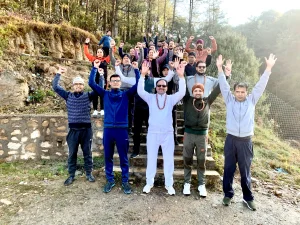
Our ashram sits in Budhanilkantha, at the quiet northern edge of the Kathmandu Valley below Shivapuri Nagarjun National Park. Days follow a gentle rhythm of yoga, breathing practice and meditation, with simple vegetarian meals, forest walks and plenty of rest. For those who want it, the programme can include sessions with a counsellor. You can read more about our psychological counselling.
- The five-day stress management package is a focused reset for people with limited time.
- Our guide to the stress management programme in Nepal explains what a longer stay looks like and who it suits.
- To see the setting, read about our yoga ashram in Nepal.
You don’t need any yoga experience to join. If you’ve wondered whether yoga will be too difficult, our honest answer to “Is Hatha yoga hard?” may reassure you.
Frequently Asked Questions About Yoga for Stress Relief
1. Which yoga pose is best for stress?
Many teachers would choose legs up the wall (Viparita Karani). It needs almost no effort, supports the whole body and is easy to hold for several minutes. Child’s pose and savasana are close behind.
2. How long should I do yoga for stress relief?
Even 10–15 minutes a day helps. Regularity matters more than length: a short daily practice usually does more than one long session a week.
3. Can yoga reduce cortisol?
Research suggests it can. A 2017 meta-analysis of 42 randomised trials linked practices that included yoga postures with lower evening and waking cortisol. Results varied between programmes, so it’s best seen as one helpful part of managing stress.
4. Is yoga good for stress if I’m a complete beginner?
Yes. The most calming poses are also among the simplest. Use props, move slowly and skip anything that causes pain.
5. What type of yoga is best for stress?
Gentle Hatha, restorative and yin-style practices tend to suit stress best because they’re slow and include longer holds. Fast, vigorous styles are better for energy than for calm.
6. Should I do yoga in the morning or at night for stress?
Both work. Morning practice sets a calmer baseline for the day; evening practice helps you unwind and sleep. Choose the time you can keep consistently.
7. Can breathing exercises alone relieve stress?
Yes. Slow breathing with long exhales measurably increases heart rate variability, a sign the rest-and-digest system is active. Two to five minutes can take the edge off a stressful moment.
8. Is legs up the wall safe for everyone?
It’s safe for most people, but skip it if you have glaucoma or uncontrolled high blood pressure, or are in later pregnancy. Resting your calves on a chair is a gentler alternative.
9. Can yoga help with stress-related insomnia?
Many people sleep better with an evening routine of forward folds, legs up the wall and a long savasana. If insomnia persists, talk to a doctor, as there may be other causes.
10. Do I need a yoga mat?
No. A rug or carpet, a folded blanket and a few cushions are enough for every pose in this guide.
11. Is yoga better than other exercise for stress?
Many forms of exercise reduce stress. Yoga’s advantage is that it combines movement with slow breathing and focused attention, and it can be done gently when you’re tired or tense.
12. Can yoga replace therapy or medication for anxiety?
No. Yoga may ease anxiety symptoms, but research doesn’t show it works on its own for diagnosed anxiety disorders. It can be a helpful addition to professional treatment.
13. What should I do if a pose makes me more anxious?
Come out of it, sit or lie comfortably and breathe slowly. Some people find certain poses, like lying flat with eyes closed, unsettling at first; keep your eyes open or choose a different pose.
14. How can I go deeper with yoga for stress?
Join a regular class, practise with a teacher who can adapt poses for you, or consider a retreat where you can rest and practise daily for several days.
Stress isn’t something you can stretch away in one evening, but you can change how your body responds to it, fifteen minutes at a time. Start tonight with legs up the wall and a long savasana. If you’d like to go further, we’d be glad to welcome you to the quiet of Budhanilkantha.