Introduction to Is Hatha Yoga Hard
You’ve probably seen the photos — someone folded into a pose that looks physically impossible, captioned with a single word like “balance” or “peace.” If that’s your reference point for yoga, it’s reasonable to wonder whether walking into a Hatha class means attempting something like that on day one. It doesn’t. But “is Hatha yoga hard” is still a fair question, and the honest answer has more nuance than a flat yes or no.
This guide gives you that nuance: what actually makes a yoga style difficult or easy, where Hatha genuinely sits on that scale, what your body will actually feel during and after a first class, where the real challenge tends to show up (often somewhere you don’t expect), and what changes if you go from an occasional class to something more serious like a full Hatha Yoga Teacher Training. By the end, you’ll know exactly what to expect walking in, rather than guessing based on an Instagram photo that has almost nothing to do with your first session.
Quick Answer: Is Hatha Yoga Hard?
| Question | Short Answer |
|---|---|
| Is Hatha yoga hard for beginners? | Generally no — it’s considered one of the gentler, slower-paced styles of yoga |
| Will I sweat a lot? | Usually not much; Hatha classes rarely build into a cardio-style sweat the way Power Yoga or fast Vinyasa does |
| Will I be sore afterward? | Mild soreness in the first few sessions is common and normal, especially in areas you don’t usually stretch |
| What’s actually the hardest part? | For most beginners, it’s mental — holding stillness, controlling the breath, and staying present, not the postures themselves |
| Is it harder than Ashtanga or Vinyasa? | No — Hatha is generally considered less physically demanding than both, due to its slower pace and longer-held postures |
| Is a Hatha Yoga Teacher Training hard? | Yes, genuinely — a multi-week training is physically and mentally intensive, even though the style itself is gentle |
| Do I need to be fit or flexible first? | No — Hatha is specifically structured to be accessible without either |
Is Hatha Yoga Hard? The Short Answer
No — not in the way most people fear when they ask this question. Hatha yoga is widely regarded as one of the more accessible, slower-paced styles of physical yoga, built around holding foundational postures for several breaths rather than moving quickly between them. At Nepal Yoga Institute and Retreat, Hatha is described plainly: a class marked as Hatha generally gives you a moderate introduction to the most fundamental yoga postures, and you almost certainly won’t break a sweat, but you’ll likely finish the class feeling calmer, more comfortable, and more relaxed than when you started.
That said, the question deserves a more complete answer than a simple no, because difficulty isn’t one single thing. A class can be physically gentle but mentally demanding, or technically simple but still genuinely tiring if you’re new to moving and breathing with this much intention. The sections below break that apart properly.
What Actually Makes a Yoga Style “Hard” Anyway?
Before comparing styles or predicting how your first class will feel, it helps to separate out what “difficulty” in yoga is actually made of — because it’s rarely just one factor.
- Pace — how quickly you move from one posture to the next. Faster pacing (as in Vinyasa or Ashtanga) raises the cardiovascular and coordination demand considerably.
- Posture complexity — some postures require strength, balance, or flexibility most beginners simply haven’t built yet, regardless of style.
- Hold duration — Hatha’s signature trait, holding postures for multiple breaths, builds a different kind of challenge: muscular endurance and patience, rather than speed or power.
- Mental demand — sustained focus, breath control, and stillness are a real, separate kind of effort that has nothing to do with physical fitness.
- Instructor expectations — the exact same posture can feel completely different depending on whether a teacher pushes for a “full expression” of a pose or actively encourages modification.
Hatha scores low on pace and relatively low on posture complexity for a well-taught beginner class, which is why it’s recommended so often — but it doesn’t score low on mental demand, which is where a lot of first-timers get genuinely surprised.
The Physical Difficulty: What Your Body Will Actually Feel
During class, most beginners describe mild muscular effort rather than intensity — holding a standing pose for 20-30 seconds engages muscles in a way that feels like gentle, sustained work rather than a strenuous push. You’re unlikely to need a water break every few minutes the way you might in a cardio-focused class.
Immediately afterward, it’s common to feel a pleasant looseness or tiredness, particularly through the hips, hamstrings, and shoulders, along with the general calm most people report after any form of guided relaxation.
One to two days later is when actual muscle soreness, if any, tends to show up. This delayed pattern — known as delayed onset muscle soreness, or DOMS — is a well-documented response to using muscles in new or unaccustomed ways, not a sign anything went wrong. According to the Cleveland Clinic’s overview of delayed onset muscle soreness, this kind of soreness typically begins one to three days after activity and is a normal part of how muscles adapt and rebuild, rather than something requiring treatment.
For a gentle beginner Hatha class, this soreness tends to be mild at most, especially compared to higher-intensity forms of exercise — but it’s genuinely normal to notice it in muscles you don’t typically use, like the inner thighs after a wide-legged forward fold, or the muscles along the spine after a gentle backbend
The Mental Difficulty: The Part Nobody Warns You About
Here’s the part that most answers to this question skip entirely, and it’s often the actual challenge beginners run into.
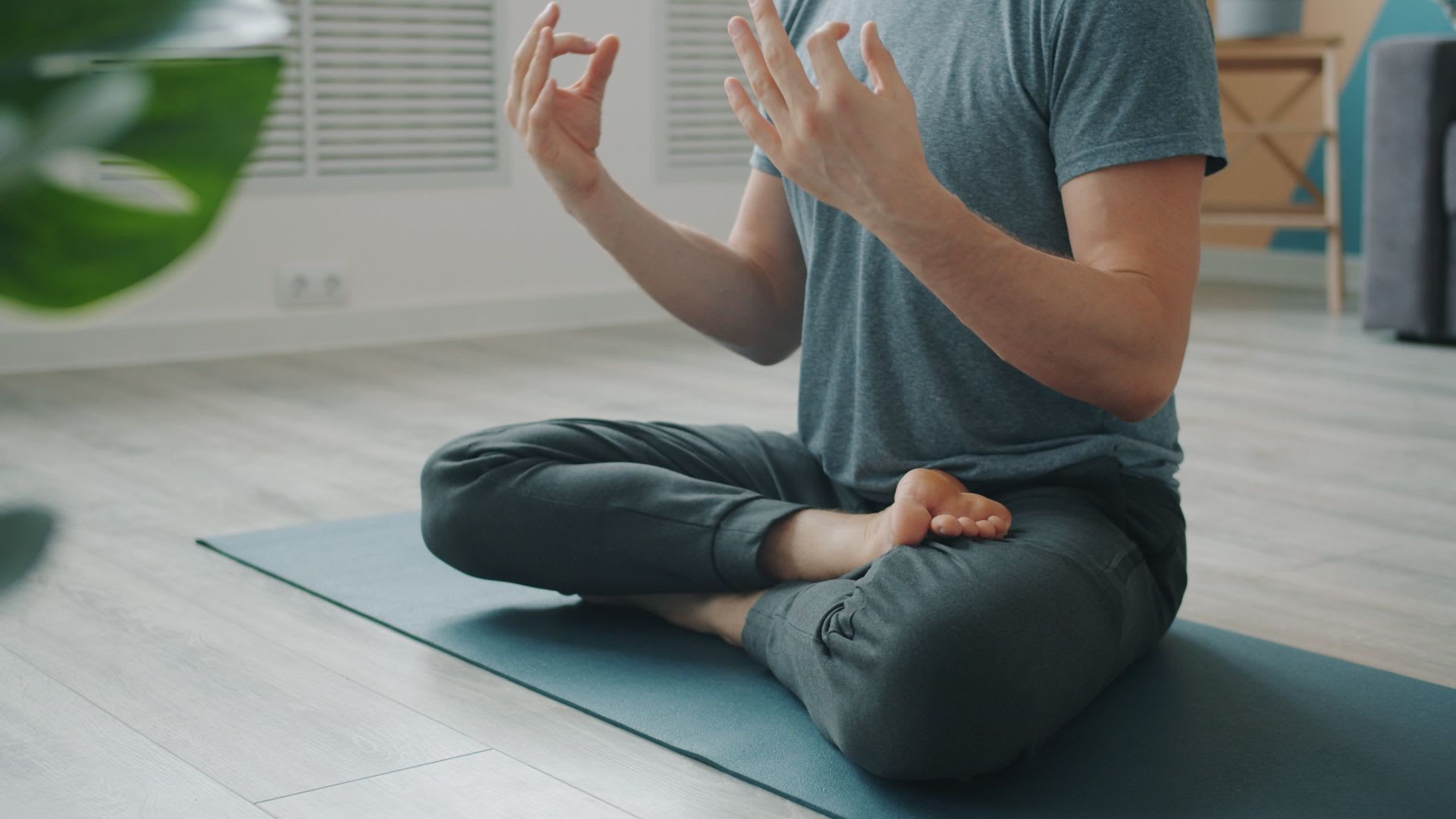
Stillness is harder than it looks. Holding a pose for 30 seconds without fidgeting, or lying completely still in the final relaxation pose for several minutes, can feel surprisingly difficult if you’re used to constant movement or a packed schedule. This isn’t a physical limitation — it’s simply an unfamiliar mental state for a lot of people.
Breath control takes real concentration at first. Coordinating breath with movement, or practicing structured breathing exercises (pranayama) on their own, requires a kind of focused attention that doesn’t come naturally until you’ve practiced it a few times.
Quieting a busy mind is, for many people, the single hardest part of the entire class — harder than any physical posture. Hatha yoga’s slower pace actually gives your mind more room to wander than a fast-paced class would, which some beginners find more challenging, not less, at least initially.
None of this is a flaw in you or a sign you’re “bad at yoga.” It’s simply an honest description of where the real effort tends to live in a style that’s physically gentle by design.
Common Hatha Postures, Ranked by Actual Difficulty
Part of what makes this question tricky to answer in one sentence is that Hatha, as a broad category, includes postures spanning an enormous range of difficulty — from extremely gentle to genuinely advanced. A well-structured beginner class draws only from the easier end of that range.
| Posture | Typical Difficulty for a Beginner |
|---|---|
| Standing Forward Bend (Pada Hasthasana) | Easy — modifiable with bent knees |
| Triangle Pose (Trikonasana) | Easy to moderate — balance takes a little practice |
| Cobra Pose (Bhujangasana) | Easy — gentle backbend, widely accessible |
| Sitting Forward Bend (Paschimottanasana) | Moderate — hamstring flexibility varies widely between people |
| Half Spinal Twist (Ardha Matsyendrasana) | Moderate — easier with a prop or supported variation |
| Locust Pose (Shalabhasana) | Moderate — requires some lower back and glute strength |
| Bow Pose (Dhanurasana) | Moderate to hard — a deeper backbend requiring more flexibility |
| Shoulder Stand (Sarvangasana) | Hard — an inversion requiring neck awareness and some practice |
| Plough Pose (Halasana) | Hard — a deep forward-folding inversion |
| Crow Pose (Kakasana) | Hard — an arm-balance requiring real core and wrist strength |
| Peacock Pose (Mayurasana) | Hard — an advanced arm balance, not a beginner posture |
| Headstand (Sirsasana) | Hard — requires significant preparation and, ideally, direct supervision |
If your first class includes anything from the “hard” column on day one without a long, careful build-up, that’s a sign the class may be better suited to intermediate students — a genuine beginner session should draw almost entirely from the easy and moderate range.
What to Expect in Your First Hatha Yoga Class
This is the part that actually answers the question in practice, not just in theory. A typical beginner-friendly Hatha session tends to unfold like this:
- Arrival and settling in (5-10 minutes). You’ll usually sit or lie down quietly while the teacher gives a short introduction and checks whether anyone is new or has an injury to mention.
- Gentle warm-up (5-10 minutes). Simple seated or standing movements to ease into the body before anything more structured begins.
- Standing postures (15-20 minutes). Foundational poses like Triangle Pose or Standing Forward Bend, held for several breaths each, with verbal cues on alignment.
- Seated and floor postures (15-20 minutes). Forward bends, twists, and gentle backbends, generally at a slower pace than the standing sequence.
- Pranayama, or breathing practice (5-10 minutes). A simple breathing technique, often done seated, to close out the active portion of class.
- Final relaxation, Shavasana (5-10 minutes). Lying flat and still, often the part beginners find most mentally challenging despite it being the most physically passive.
A full session usually runs somewhere between 60 and 90 minutes. Nothing above requires prior flexibility, strength, or experience — the entire sequence is built to be approachable for someone who has genuinely never practiced before.
Comparing Difficulty: Hatha vs. Other Yoga Styles
| Style | Pace | Physical Difficulty (Beginner’s Perspective) |
|---|---|---|
| Hatha Yoga | Slow, postures held for multiple breaths | Lower — widely considered the most accessible starting point |
| Vinyasa Yoga | Moderate to fast, continuous flow | Moderate to high — keeping pace with a flow can be tiring for a beginner |
| Ashtanga Yoga | Fast, fixed sequence (the Primary Series) | High — a physically demanding, athletic practice, though some schools, including Nepal Yoga Institute, note that no prior experience is required to begin |
| Power Yoga | Fast, strength and cardio-focused | High — generally recommended after building some foundational experience first |
| Iyengar Yoga | Slow, highly precise, prop-assisted | Lower to moderate — accessible but demands close attention to technical alignment |
Hatha consistently lands at the gentler end of this comparison, which is exactly why it’s the default recommendation for anyone asking whether they’re “ready” to start yoga at all.
Is a Hatha Yoga Teacher Training Harder Than a Single Class?
Significantly, yes — and this distinction matters if you’re considering going beyond occasional classes. Nepal Yoga Institute’s own Hatha Yoga Teacher Training in Nepal page is direct about this: the training is described as intense on a physical, mental, and spiritual level, requiring genuine physical stamina and mental discipline from participants. That’s a real difference from a single weekly class, and it’s worth taking seriously before committing.
What makes a teacher training harder than a single class isn’t a jump in posture difficulty — it’s the sheer volume and structure. A multi-week course means daily practice sessions, often both morning and evening, combined with theory classes covering philosophy and anatomy, self-study periods, and significantly earlier wake-up times than most people are used to. It’s less “is the yoga hard” and more “is a condensed, intensive daily schedule demanding” — and the honest answer there is yes, by design.
Encouragingly, according to the institute’s own course information, no specific prior yoga experience is required to join a teacher training course, and past participants have ranged in age from 18 to 65. So the training doesn’t require you to already be advanced — it requires you to be ready for a genuinely full, structured few weeks, not a relaxed, drop-in experience. Graduates of a Yoga Alliance-registered training like this one also become eligible to register as a certified teacher through Yoga Alliance, the internationally recognized nonprofit registry most studios and gyms look for when hiring — which is part of why the course is structured to be thorough rather than light, even though the Hatha style itself stays gentle throughout.
A Realistic Week-by-Week Picture of the Training
It helps to see this mapped out rather than described in the abstract. In the first few days of a Hatha Yoga Teacher Training, most of the difficulty is adjustment-related: an earlier wake-up time than you’re used to, learning the names and alignment cues for postures you may have only done casually before, and getting used to a packed daily schedule that includes both practice and theory.
By the second week, the physical routine typically feels more familiar, and the bigger challenge shifts toward the mental and academic side — absorbing philosophy and anatomy material, and, for many students, standing in front of peers to practice teaching for the first time, which tends to feel more intimidating than any posture in the course. By the final stretch, most students report the early intensity has leveled out into a sustainable, if still full, daily rhythm, with the earlier physical adjustment largely behind them.
This pattern is worth knowing precisely because it reframes what “hard” means over the course of a training: the difficulty doesn’t stay constant, and it isn’t primarily physical at any stage — it shifts from adjustment, to academic and social challenge, to a more settled routine, which is a very different shape than a single difficult posture or class.
Who Finds Hatha Yoga Easier, and Who Might Find It More Challenging
Tends to feel more approachable for:
- People new to any form of structured exercise, since the pace is forgiving
- Older beginners, thanks to the lower-impact, held-posture format
- People specifically seeking stress relief or a mental reset, since the breathing and stillness components are central rather than secondary
- Anyone recovering from a more intense or injury-prone sport, looking for something gentler
Tends to feel more genuinely challenging for:
- People with a very restless mind who struggle with any form of sustained stillness, at least initially
- People expecting a vigorous cardio workout, who may find the pace frustratingly slow rather than relaxing
- Anyone with an untreated injury attempting a posture without first telling the teacher or seeking a modification
- Complete beginners attempting a class that isn’t actually labeled or structured for beginners, regardless of being called “Hatha”
Does Body Type or Fitness Level Change How Hard Hatha Yoga Feels?
This is a fair and common worry, and it deserves a direct answer: your starting body type, weight, or general fitness level changes the specific sensation of certain postures, but it doesn’t change whether Hatha yoga as a style is accessible to you.
If you’re generally sedentary or new to structured movement, the main adjustment is usually stamina for holding a pose for the full breath count, not an inability to do the pose at all — most postures have an easier entry point that still delivers the same basic benefit.
If you carry more weight, certain forward folds or seated postures may feel more restricted through the torso, and that’s a completely normal, manageable variation rather than a barrier — modifications like a wider stance or a prop under the hips address this directly, and a good teacher will offer them without making it a point of attention.
If you’re naturally very stiff rather than flexible, deep stretches will understandably feel more intense at first, but this is precisely the population Hatha’s gentle, gradual approach is built for — flexibility-focused styles with faster pacing tend to be considerably less forgiving for a genuinely inflexible beginner than Hatha is.
If you’re already quite fit from another activity, like running or weightlifting, you may actually find Hatha’s stillness and controlled breathing more unfamiliar and, in its own way, more challenging than the physical postures — a reminder that general fitness and yoga-specific skill are related but distinct things.
The through-line across all of these: Hatha yoga’s structure assumes variation in starting point as the norm, not the exception, which is part of why it remains the most recommended entry style across such a wide range of body types and fitness backgrounds.
Difficulty Across a Single Class vs. a Full Course: A Side-by-Side View
Since this guide has covered both a single class and a full teacher training, it’s useful to see the difference laid out directly rather than scattered across sections.
| A Single Hatha Class | A Hatha Yoga Teacher Training | |
|---|---|---|
| Physical demand | Low to moderate | Moderate to high, due to volume and frequency |
| Mental demand | Moderate — mostly focus and stillness | High — sustained concentration across weeks, plus academic material |
| Daily time commitment | 60–90 minutes | Multiple hours daily, often with both morning and evening sessions |
| Prior experience needed | None | None required, according to the institute’s own course information |
| Main source of difficulty | Holding stillness and unfamiliar postures | Schedule intensity, volume of new material, and sustained daily commitment |
| Recovery time needed | Minimal — most people feel fine within a day or two | Built into the course structure itself, with rest days included |
Seeing it this way makes clear that difficulty has genuinely different answers depending on which of these two experiences you’re actually asking about — and most people picturing yoga as something intense are closer to imagining the second column than the first.
Tips to Make Your First Class Feel Easier
- Tell the teacher you’re new before class starts. This single step shapes the entire experience more than anything else on this list.
- Eat lightly beforehand, ideally nothing heavy in the hour or two before class, since several postures involve bending through the torso.
- Don’t chase the “full” version of any pose. A modified version done with good alignment is genuinely more valuable than a strained attempt at the advanced version.
- Expect your mind to wander, and don’t fight it. Gently returning your attention to the breath each time it drifts is the actual practice, not a sign you’re doing it wrong.
- Give it more than one session before deciding how hard it is. Most beginners report the physical and mental aspects both feeling noticeably more manageable by the third or fourth class.
- Hydrate normally during the day, but avoid overdoing it right before class starts.
For broader, evidence-based context on yoga’s general safety and what current research actually shows about its effects, the U.S. National Center for Complementary and Integrative Health maintains a plain-language overview of yoga research and safety, including guidance on when to check with a healthcare provider before starting.
How Nepal Yoga Institute Structures Hatha Yoga for Every Level
If your interest in Hatha goes beyond a single class, it helps to know there’s a clear path depending on how far you want to take it. Nepal Yoga Institute and Retreat, based in Budhanilkantha on the quieter northern edge of Kathmandu, offers several entry points.
For a lower-commitment way to experience guided practice without the intensity of a certification course, their Five Days Yoga Retreat Program and the more flexible Long Term/Short Term Yoga Retreat Package both combine daily practice with rest, in a considerably gentler format than a teacher training. For those ready for a full, structured education in the style, the Hatha Yoga Teacher Training in Nepal page covers what the course actually involves, while the broader 200 Hours Yoga Teacher Training blends Hatha with Ashtanga for students who aren’t yet sure which style to specialize in. Students wanting to continue their education afterward can also look at the school’s advanced-level yoga teacher training as a next step.
If you want a sense of how past students, including complete beginners, actually found the experience, the institute’s testimonials page is worth a read before booking anything, and its FAQ page answers a wide range of practical questions about daily schedules and what a course actually includes.
What If You Try It and Still Find It Hard?
It’s worth addressing directly, because it does happen: some beginners try a Hatha class and still find it genuinely uncomfortable, frustrating, or more difficult than expected, even with all the modifications and gentle pacing described above. A few things worth checking before concluding the style itself isn’t for you.
Was the class actually labeled for beginners? As covered earlier, not every class called “Hatha” is paced or structured the same way — a more advanced Hatha session, with longer holds and fewer modifications offered by default, will feel considerably harder than a genuine introductory class.
Did you mention you were new, and any relevant injury or limitation, before class started? A teacher working without that information can’t adjust their cues specifically for you, which makes a real difference to how manageable the session feels.
Was it your very first session, or have you given it a few tries? A single difficult first class is extremely common and doesn’t reliably predict how the second or third session will feel, once the postures and pacing are more familiar.
Is the discomfort physical pain, or unfamiliar effort? These are genuinely different signals. Unfamiliar muscular effort, mild stiffness, or a racing mind during stillness are normal parts of learning something new. Sharp, shooting, or joint-specific pain is not, and is a clear signal to stop, modify, or speak with the teacher directly rather than push through it.
If, after a fair trial across a few sessions with a genuinely beginner-appropriate class, Hatha still doesn’t feel like the right fit, that’s useful information too — not every style suits every person, and a gentler or more structured alternative, like Iyengar, or a shorter guided retreat format rather than a drop-in class, may be a better starting point than persisting with something that consistently feels wrong rather than just unfamiliar.
Common Myths About Hatha Yoga Being “Hard”
- “If I can’t touch my toes, Hatha yoga is too hard for me.” Flexibility is a result of practice, not a requirement to begin — modified versions of nearly every posture exist specifically for this reason.
- “It should feel like a workout, or it’s not doing anything.” Hatha’s slower pace builds strength, balance, and flexibility over time; the absence of a cardio-style sweat doesn’t mean nothing is happening.
- “Struggling to sit still means I’m failing at it.” Difficulty with stillness is an extremely common beginner experience, not a sign of failure — it’s often the actual skill being developed.
- “All yoga classes labeled Hatha are equally gentle.” Some Hatha classes are taught at a more advanced level with longer holds and more demanding postures — always check whether a class is specifically labeled for beginners.
- “A Hatha Yoga Teacher Training is just an extended version of a gentle class.” As covered above, the training itself is a genuinely intensive, structured commitment, even though the underlying style is gentle.
Frequently Asked Questions about Is Hatha Yoga Hard
1. Is Hatha yoga hard for complete beginners? No, not in a physically demanding sense — it’s widely considered one of the most accessible styles for someone starting from zero, thanks to its slower pace and emphasis on held, foundational postures.
2. Will I be sore after my first Hatha yoga class? Mild soreness in the day or two afterward is common and normal, especially in muscles you don’t typically stretch, but it’s usually much milder than soreness from higher-intensity exercise.
3. What’s the hardest part of Hatha yoga for most beginners? For many people, it’s mental rather than physical — specifically, holding stillness and maintaining focused breathing, which can feel more challenging than the postures themselves.
4. Is Hatha yoga harder than Vinyasa? Generally, no — Hatha is slower-paced with longer-held postures, while Vinyasa links movement to breath in a faster, more continuous flow that many beginners find more physically demanding to keep up with.
5. Is Hatha yoga harder than Ashtanga? Typically, no — Ashtanga follows a faster, fixed sequence that’s more physically intensive, while Hatha’s slower pace makes it the gentler of the two for most beginners.
6. Do I need to be flexible to start Hatha yoga? No. Flexibility develops through consistent practice; it isn’t something you need before your first class.
7. Will I sweat during a Hatha yoga class? Usually not much. Hatha’s slower pace rarely builds into the kind of sweat you’d get from a cardio-focused or fast-flowing class.
8. How long does a typical Hatha yoga class last? Most sessions run 60 to 90 minutes, including warm-up, postures, breathing practice, and a closing relaxation.
9. Is it normal to feel mentally tired after a Hatha yoga class rather than physically tired? Yes — many beginners report this exact pattern, since the concentration required for breath control and stillness can be more taxing initially than the physical postures.
10. Can older adults find Hatha yoga manageable? Yes — its lower-impact, slower-paced format is one of the more commonly recommended styles for older beginners specifically for this reason, though checking with a doctor first is sensible if you have an existing health condition.
11. Is a Hatha Yoga Teacher Training hard? Yes, genuinely. According to Nepal Yoga Institute’s own course description, the training is intense on a physical, mental, and spiritual level, requiring real stamina and discipline, even though the underlying style is gentle.
12. Do I need prior experience to join a Hatha Yoga Teacher Training? No specific prior experience is required, according to the institute’s course information — though you should expect the training days themselves to be long, structured, and demanding.
13. What age range typically joins a Hatha Yoga Teacher Training in Nepal? Past students have ranged from roughly 18 to 65 years old, based on the institute’s own published course details.
14. Why does holding a pose feel harder than it looks? Holding a posture engages stabilizing muscles continuously rather than briefly, which creates a different, more endurance-based kind of effort than quick, dynamic movement.
15. Is it okay to modify a pose instead of doing the full version? Yes, absolutely — modification is a built-in, expected part of a properly taught beginner class, not a lesser version of the “real” pose.
16. How many classes does it take before Hatha yoga starts feeling easier? Most beginners report a noticeable shift by their third or fourth class, as unfamiliar postures and breathing patterns start to feel more natural.
17. Can I do Hatha yoga if I have an old injury? Often yes, with appropriate modification — telling your teacher about the injury beforehand allows them to adjust specific postures rather than you attempting them at full range.
18. Is the final relaxation pose (Shavasana) really part of the difficulty? For many beginners, yes — lying completely still for several minutes can feel surprisingly difficult if you’re not used to it, even though it’s the most physically passive part of class.
19. Does Hatha yoga get harder as you continue practicing? Yes, naturally — as your body adapts, postures that once felt challenging become more accessible, and many practitioners progress toward longer holds, deeper variations, or complementary styles like Vinyasa or Ashtanga over time.
20. Is Hatha yoga a good starting point if I’ve never exercised regularly before? Yes — its gentle pace and emphasis on modification make it one of the more forgiving entry points into regular physical activity generally, not just into yoga specifically.
Final Thoughts: So, Is Hatha Yoga Hard?
Not in the way the question usually means. Hatha yoga is deliberately built to be one of the gentler, more approachable styles available, with a pace and structure designed around holding postures safely rather than rushing through them. The genuine challenge, when there is one, tends to live in the mental side of the practice — sitting with stillness, controlling the breath, staying present — rather than in the physical shapes themselves. That’s a very different, and far more manageable, kind of “hard” than most beginners picture before their first class.
Ready to Try Your First Hatha Yoga Class?
If you’re curious whether a single class, a short retreat, or a full Hatha Yoga Teacher Training would suit where you’re starting from, the team at Nepal Yoga Institute and Retreat is happy to walk you through it directly. Message their yoga teacher on WhatsApp at +977 9860480478 with any questions about pacing, current dates, or what to expect before you book.