Introduction on Yoga Mat in Nepal
A yoga mat is the simplest piece of equipment in yoga, and it is also one of the easiest to buy badly. Walk into a shop or scroll an online marketplace and you will find mats of every colour, thickness and material, with promises of grip, comfort and eco-friendliness. As a beginner, you have no way of knowing which promises matter. And because a mat sits between you and the floor for every posture you practise, the wrong one can make an easy class feel hard: you slip in a standing pose, your knees ache in a kneeling pose, or the mat curls and slides across a smooth floor.
This guide is for anyone looking for a yoga mat in Nepal, whether you live here, are visiting for a retreat, or are preparing to join a teacher training. It explains what a mat actually does, which sizes and thicknesses are normal, how the main materials differ, what to check for in a shop, how to care for a mat in Nepal’s seasons, and when you do not need to buy one at all. It also describes, using only what the school itself publishes, what Nepal Yoga Institute in Kathmandu provides and recommends.
Material facts come from standard reference sources, and where something depends on a particular brand, shop or price, the guide says so rather than guessing. In particular, it does not quote local retail prices, because they vary by shop and season and should be checked on the day.
Yoga Mat in Nepal: A Beginner’s Quick Answer
| Question | Short answer |
|---|---|
| Do I need my own mat? | Not always. Many studios and schools provide one, so check before you buy |
| Standard size | About 180 to 183 cm long and about 61 cm wide (roughly 6 feet by 2 feet) |
| Common thickness | About 3 mm is a standard thickness; travel mats are around 2 mm; thicker therapy or cushioned mats go up to about 6 mm. Listings on Nepali online marketplaces commonly show mats from about 4 mm to 7 mm |
| Best all-round choice for a beginner | A mat of moderate thickness with good grip and a size that fits your height |
| Materials to know | PVC, natural rubber, TPE, EVA foam, cork, jute and cotton |
| Allergy caution | Natural rubber is made from latex, so people with a latex allergy should avoid it and seek advice |
| Where to look | Local sports and fitness shops and online marketplaces such as Daraz; check availability and prices yourself |
| What does Nepal Yoga Institute provide? | Yoga mats, blankets, cushions and other supports for each student, according to its FAQ |
| What does it recommend? | That you bring your own mat, towel and personal items for longer stays |
| Published teacher training cost | $1,400 total, with a $200 non-refundable deposit |
What a Yoga Mat Actually Does
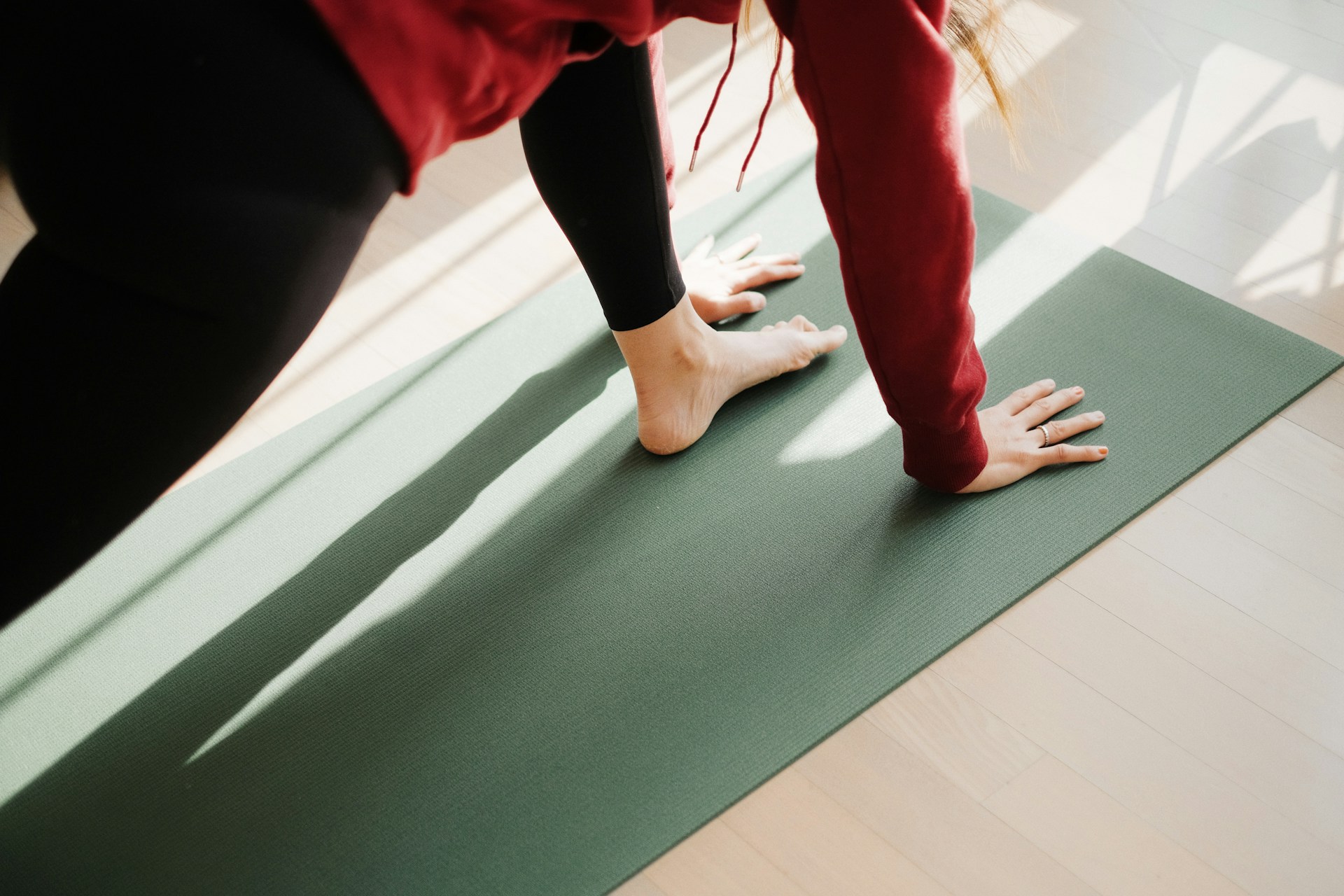
It is worth being clear about what you are buying. A yoga mat has three jobs.
Grip. The mat gives your hands and feet something to hold on to, so they do not slide in standing, kneeling and downward-facing poses. Reference sources note that early Western practitioners used towels or cotton mats on wooden floors, where the feet tended to skid, which is exactly the problem that sticky mats were created to solve.
Cushioning. The mat softens the floor under your knees, spine, hips and wrists. This matters most for poses that put weight on bony areas.
A defined space. A mat marks out a personal practice area, which helps concentration and keeps the body away from cold or dirty floors.
It is also worth knowing how new the modern mat is. Yoga was traditionally practised on kusha grass, bare earth, or animal skins, according to classical texts. Reference sources trace the modern sticky mat to 1982, when a teacher in Germany used carpet underlay cut to size, and the first purpose-made yoga mat was sold by a company in the 1990s. The mat has become one of the most recognisable symbols of yoga’s commercial side, but it is a convenience, not a requirement of the practice. You can read more in the general yoga mat reference article.
Size: Length and Width
The usual yoga mat measures about 6 feet (180 cm) long and about 2 feet (61 cm) wide. Nepali online listings commonly show mats at 183 by 61 cm, which is the same standard size expressed in centimetres (72 by 24 inches).
For most people, this is enough. If you are tall, however, a standard mat can leave your head or feet off the edge in lying poses, which is uncomfortable and slippery. If your height is much above the average, look for a longer mat and check the length before you buy. If you like space to move, a wider mat gives you room, though it is heavier and harder to carry.
| Your situation | Size suggestion |
|---|---|
| Average height, studio classes | Standard length and width |
| Taller than the mat in lying poses | Longer mat |
| Small room at home | Standard mat; check it fits your floor space |
| Travelling or trekking | A thinner, lighter mat or a foldable one |
Thickness: The Choice Beginners Get Most Wrong
Thickness is the single most visible feature of a mat, and the most misunderstood. Reference sources give a useful range: travel mats around 2 mm, a standard mat around 3 mm, and high-performance or therapy mats up to about 6 mm, with thickness trading off portability against comfort. Listings on Nepali online marketplaces often show mats in the 4 to 7 mm range, which is thicker than the traditional standard.
Many beginners assume thicker is better because it feels softer. It is not that simple.
| Thickness | Comfort | Stability | Portability | Best for |
|---|---|---|---|---|
| Thin (about 2 to 3 mm) | Firmer; more floor feeling | More stable in standing poses | Lighter, easier to carry | Travel, standing and balancing practice |
| Medium (about 4 to 5 mm) | A balance of cushion and feel | Good for most poses | Moderate | All-round beginner use |
| Thick (about 6 to 7 mm) | Very cushioned for knees and spine | Can feel unstable in balance poses | Heavier and bulkier | Gentle, floor-based or restorative practice; sensitive joints |
A thick mat can be a kindness to sore knees, but a very soft surface can make balance poses wobble because your feet sink slightly. A thin mat gives a firmer base but offers less protection on hard floors. For most beginners, a medium-thickness mat is a sensible starting point, and a folded blanket or a second thin layer can be added under the knees when needed. If you will practise mainly gentle, floor-based poses, a thicker mat may suit you better. If you will practise standing poses and balances, lean thinner.
Materials: What Your Mat Is Made Of
Material determines grip, weight, durability, comfort and environmental impact. Here is how the main options compare, drawing on reference sources and on the kinds of mats commonly listed in Nepal.
| Material | Grip and feel | Weight | Durability and care | Notes |
|---|---|---|---|---|
| PVC | Smooth, spongy; was the first commercial sticky mat | Moderate | Can crumble with use and gets dirty | Usually cheaper; environmental impact is high and it is not always recycled |
| Natural rubber | Best grip, firm | Heavy | Excellent durability; easy to wipe | High cost; contains latex, so avoid with a latex allergy |
| TPE | Good grip, light | Very light | Tends to get dirty | Described as recyclable and commonly sold as “eco-friendly” |
| EVA foam | Soft, cushioned | Light | Varies | Common in budget mats; check grip and thickness |
| Cork on rubber | Good grip, non-slip when wet; warm | Moderate to heavy | Mainly self-cleaning | High cost |
| Jute on rubber | Roughest surface, strong grip | Heavier | Washable | Textured; some find it harsh on skin |
| Cotton | Firm, poor grip | Light | Fibres wear out; washable | Better as a layer or for gentle practice |
Three practical points follow.
First, grip matters more than the label. A mat that slides is hard to use whatever it is made from. Press your palm and push it forward in a shop and see whether the mat grips the floor and your hand.
Second, “eco-friendly” is a claim, not a guarantee. Reference sources describe some such mats as “supposedly” eco-friendly. Ask what the mat is actually made of and whether the seller can say.
Third, cheaper mats are not bad mats, but they may wear faster. If you are not yet sure you will keep practising, a modest mat is a reasonable first purchase. If you practise daily, durability and grip become worth paying more for.
Latex Allergy: A Safety Point Worth Knowing
Natural rubber mats are made from rubber, and natural rubber latex can cause allergic reactions in some people. The Mayo Clinic’s latex allergy overview explains that latex allergy is a reaction to certain proteins in natural rubber latex, which comes from the rubber tree. Reactions can include itchy skin, hives or rash, and in rare cases a serious, life-threatening reaction called anaphylaxis. It notes that the risk is higher for people with certain conditions or histories, and that products made from synthetic materials are unlikely to cause the same reaction.
The practical advice is simple. If you know you are allergic to latex, avoid natural rubber mats and look at other materials. If you are unsure, check with a healthcare professional before buying a natural rubber mat. If you notice itching, redness or a rash after using a mat, stop using it and seek advice.
Weight, Portability and Travel
Weight rarely matters until you have to carry the mat. If you will walk to class, commute or travel to a retreat, the difference between a light and a heavy mat becomes obvious.
- Light mats (such as TPE or thin foam) are easy to carry and roll tightly.
- Heavy mats (such as natural rubber or jute) stay put on the floor but are cumbersome on a bus or a flight. Reference sources note that some very cushioned options, such as cotton futon mats, can weigh up to about 4.7 kg.
- Travel mats are thin, around 2 mm, and fold or roll small.
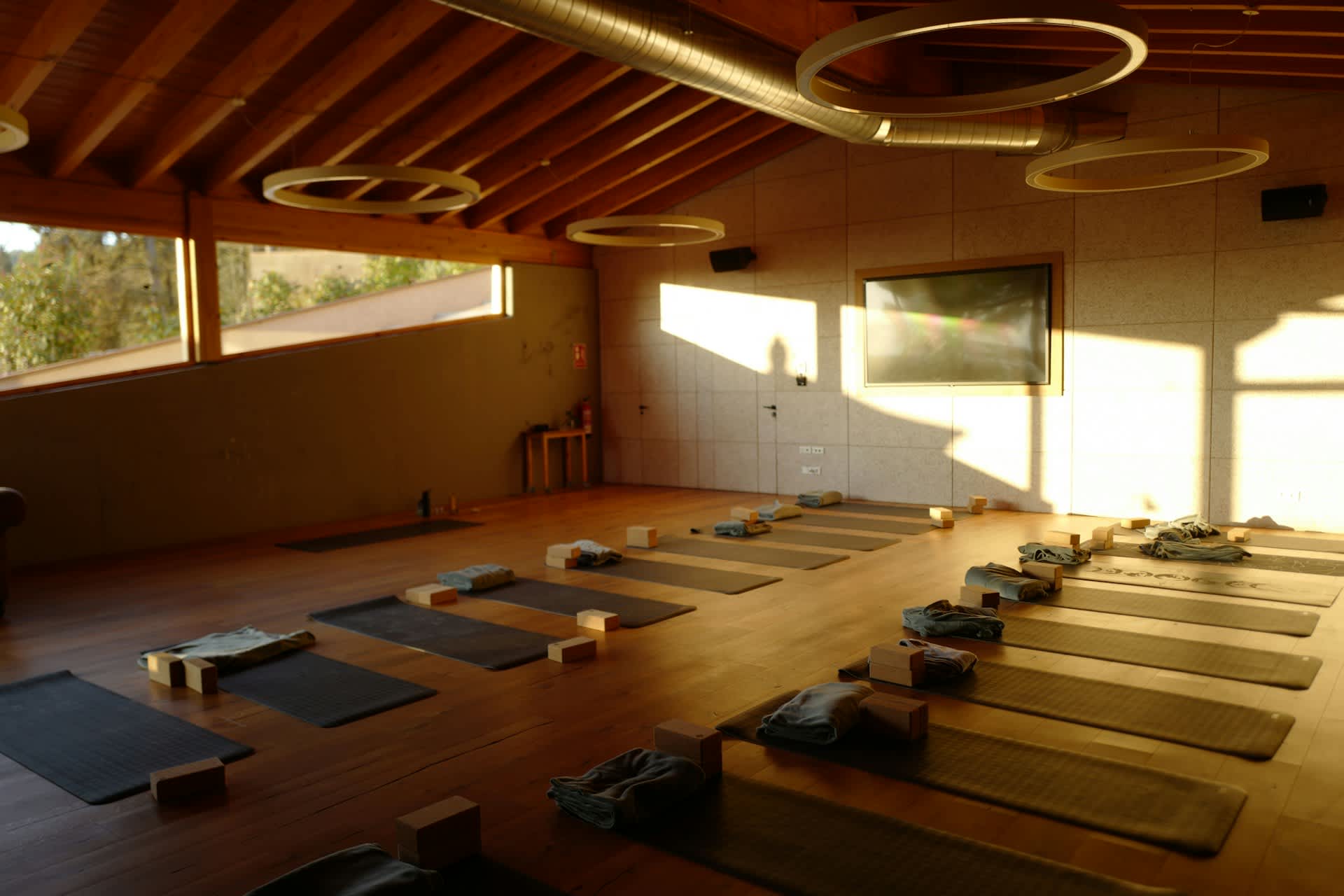
If you are travelling to Nepal for a retreat or training, think about whether you need to bring a mat at all. Many schools provide one, and Nepal Yoga Institute is among them. Carrying a bulky mat across the world for a stay of a few days may not be worth it. For a longer stay, you may prefer your own, as discussed below.
Some Nepali marketplace listings also describe foam mats as suitable for trekking, hiking and camping as well as yoga. These can be handy as a general-purpose mat, but check that the thickness and grip suit yoga rather than assuming they do.
Where to Look for a Yoga Mat in Nepal
Availability changes, so this guide does not name specific shops or quote prices. What can be said is that there are two broad routes.
Local shops. Sports and fitness shops in Kathmandu and other towns often stock yoga mats. The advantage is that you can see, touch and test the mat before you pay. Check the thickness, press your palm on it to test grip, smell it for a strong chemical odour, and roll and unroll it to see if it lies flat.
Online marketplaces. Major Nepali online marketplaces such as Daraz list a wide range of yoga mats, including options such as 6 mm and 7 mm mats, 4 mm anti-skid EVA mats, and TPE mats, in the standard size of about 183 by 61 cm. The advantage is range and convenience. The risk is that you cannot test the mat. Read the description carefully, check the stated material and thickness, note whether the colour is described as “may vary,” and look at the seller’s return policy.
| Check | Why |
|---|---|
| Material stated clearly | Tells you about grip, weight and allergy risk |
| Thickness in millimetres | Avoids buying too thick or too thin |
| Size in centimetres | Make sure it fits your height |
| Return or exchange policy | Lets you correct a wrong choice |
| Reviews that mention grip and smell | Real use matters more than the description |
Prices vary by material, brand and seller, and they change over time, so check them yourself on the day. A higher price does not guarantee a better mat, and a lower price does not guarantee a bad one.
A Simple Buying Checklist for Beginners
- Decide where you will practise. Studio, home, retreat, trekking?
- Pick a thickness. Medium for most; thinner for balance; thicker for sensitive joints.
- Check the size. Standard unless you are tall.
- Choose a material. Consider grip, weight, allergy and your budget.
- Test the grip. Press and push with your palm.
- Smell it. A very strong chemical smell is a reason to ask questions or choose another mat.
- Check it lies flat. A mat that curls at the edges can trip you.
- Read the return policy. Especially for online purchases.
- Plan for care. Know how you will clean it.
- Do not overbuy. A basic mat is enough while you learn what you like.
Caring for Your Mat in Nepal’s Seasons
A mat lasts longer with simple care. Reference sources give a useful starting point: hessian, cotton and hemp mats can be washed, latex mats are easy to wipe clean though light colours show dirt, cork is largely self-cleaning, and PVC and TPE mats tend to get dirty, with smooth surfaces showing it quickest.
A few general habits help in any season.
- Wipe after use. A damp cloth removes sweat and dust.
- Dry fully before rolling. A mat rolled up damp can develop a musty smell.
- Keep it out of direct harsh sun for long periods, which can dry out or damage some materials.
- Follow the maker’s cleaning instructions if any are provided, and avoid harsh cleaners unless they say they are safe.
- Use a towel on top in hot weather if your hands and feet get slippery.
Nepal’s seasons add a few considerations. In the monsoon months, roughly June to August, air is humid and mats may take longer to dry. In winter, floors can be cold, and a slightly thicker or warmer surface, such as cork, feels pleasant. In dry, dusty months, wipe your mat more often.
How Nepal Yoga Institute Handles Mats
Nepal Yoga Institute (published on its site as Nepal Yoga Institute and Retreat) is a yoga school and retreat centre at Budhanilkantha-11, Kathmandu. It does not describe selling yoga mats, so this section is about what it provides and recommends, not about a product. According to its FAQ page:
- The institute provides yoga mats and props, and each student receives a yoga mat, blanket, cushion and other supports.
- Students may wish to bring their own mat or mat cover.
- The institute recommends that students have their own yoga mat, towel and other personal items for the training period.
- Students should bring comfortable yoga clothing.
- For seasons, it suggests warm clothes in winter, and summer clothes, an umbrella, a raincoat and sunscreen in the hot and rainy months, and for all seasons a hat, mosquito repellent, a flashlight and trekking shoes for forest walks.
- Free Wi-Fi is available, and devices can be used in leisure time.
Should You Bring Your Own Mat?
The answer depends on how long you will stay and how particular you are.
| Situation | Suggestion |
|---|---|
| A short retreat of a few days | The institute provides mats, so a mat is optional; bring a towel or mat cover if you like |
| A longer stay such as teacher training | The institute recommends having your own mat, towel and personal items |
| You are sensitive to materials or have a latex allergy | Bring your own, so you know what it is made of, and tell the school about allergies in advance |
| You are flying with limited luggage | Consider a light travel mat, or rely on the provided one |
| You have a strong preference for grip or thickness | Bring your own |
For anyone planning a short stay, the our Five Days Yoga Retreat Program combines asana, pranayama, mantra singing, meditation, Ayurvedic massage and rest, and publishes a day-by-day schedule. The institute does not publish a fixed retreat price: its retreat pages say prices are calculated on request, and its FAQ states that retreat packages require a deposit of 20% of the package price, with full payment due on arrival. Because the institute supplies mats and supports, you can arrive with very little equipment, which is part of the appeal for beginners.
For anyone planning a longer course, our 200-hour yoga teacher training page publishes the following.
| Item | Published detail |
|---|---|
| Total cost | $1,400 |
| Advance deposit | $200, non-refundable |
| Balance | Payable on orientation day in Nepal |
| Length | 22 days |
| Start date | The 15th of every month |
| End date | The 7th or 8th of the following month |
| Class size | Up to 14 students |
| Weekly rest | Usually one day off a week, typically Sunday |
The training day runs from about 06:30 to 21:30, with asana practice in the morning and evening, so a mat that you like and that stays comfortable is genuinely useful over three weeks. Some other pages on the institute’s site list a slightly different course length, so confirm dates and length with the institute when you apply.
Packing Beyond the Mat: A Short Checklist for Retreat and Training
A mat is only one item on a packing list. The institute’s FAQ and its article on things to prepare for your yoga teacher training suggest a sensible set of essentials for a longer stay.
| Category | What the institute’s pages mention |
|---|---|
| Practice items | Comfortable yoga clothing; your own mat or mat cover and towel are recommended for longer stays, though mats and props are provided |
| Seasonal clothing | Warm clothes in winter; summer clothes, an umbrella, a raincoat and sunscreen in hot and rainy months |
| All-season items | Mosquito repellent, a hat, a flashlight and trekking shoes for forest walks |
| Personal items | Toiletries (the training article lists items such as soap, a bathing sponge, a towel, tissue, toothbrush and toothpaste), regular medicines, and branded products you rely on |
| Documents | Passport, visa and air tickets if you are travelling from abroad |
| Preparation | Regular practice before you arrive, good rest, and plenty of water |
The FAQ adds that local shops are available for toiletry products if you wish to travel light, but advises bringing branded products you trust, because they may not be available locally. It also states that you should bring regular medicine from home. The same advice applies to a favourite mat: if you are particular about it, bring it.
What to Wear on Your Mat
Clothing affects how a mat feels, because fabric can slide on some surfaces. Comfortable, stretchy, breathable clothing works best for most practice. Bare feet grip a mat better than socks, which is why most classes are practised barefoot. In relaxation at the end of class, many people like a light layer, because the body cools as it rests. In cold months, a shawl or warm top is helpful, and in humid months, light, quick-drying fabrics are more comfortable.
How Long Will a Mat Last?
There is no fixed lifespan, because it depends on material, how often you practise and how you care for it. Some signs that it is time for a new mat include:
- The surface has become smooth and slippery, even when clean.
- Pieces are crumbling or flaking, which reference sources note can happen with PVC.
- The mat no longer lies flat or has permanent creases that catch your feet.
- It has absorbed odours that do not wash out.
- It feels noticeably thinner under your knees and hands.
If you practise a few times a week, a basic mat may last a good while with care. If you practise daily, a higher-quality mat with durable grip may be a better investment. Either way, replacing a worn mat is a safety matter as much as a comfort one.
Practising Without a Mat
A mat is a convenience, not a necessity. Traditional practice used grass, bare earth or animal skins, according to classical texts cited in reference sources. Today, people also practise on carpet, on a folded blanket or on a non-slip floor. If you do not yet own a mat, you can start with a folded blanket on a carpeted floor for gentle poses, though standing poses are safer on a surface that grips. If you are joining a class, ask whether a mat is provided. As the institute’s beginner Hatha article notes, most studios and training centres provide one if you do not have your own.
Props: The Other Half of Mat Comfort
A mat is rarely the only thing you need. Props make many postures safer and more comfortable, particularly for beginners.
| Prop | What it does |
|---|---|
| Folded blanket | Pads knees, supports hips in seated poses, warms the body in relaxation |
| Cushion or bolster | Lifts the hips for seated meditation and supports restorative poses |
| Block | Brings the floor closer in standing and kneeling poses |
| Strap | Extends your reach in forward folds and stretches |
| Towel | Adds grip in hot weather or on a slippery mat |
The institute’s FAQ states that mats, blankets, cushions and props are provided, which means that you can try these supports in class before deciding what to buy for home practice. If you are buying your first mat, you may find that a folded blanket and a cushion are the most useful additions.
Choosing a Mat for the Style You Practise
Different styles ask different things of a mat.
| Style or purpose | What suits it |
|---|---|
| Gentle Hatha for beginners | A medium-thickness mat with good grip; props for comfort |
| Dynamic or flowing practice | A mat with strong grip that does not slide |
| Restorative and relaxation | A thicker mat and extra blankets or a bolster |
| Standing and balancing practice | A thinner, firmer mat |
| Meditation | A mat plus a cushion or folded blanket |
If you are unsure which style you will enjoy, the our guide to a Hatha yoga class for beginners explains what to expect in a first class, including what to wear and bring. It notes that most studios and training centres provide a mat if you do not have your own, so confirm with the school in advance.
For a longer, more intensive course, see the institute’s Hatha yoga teacher training page. Beginners who wonder whether they will cope may also find our institute’s article on whether Hatha yoga is hard reassuring. And if you want to know whether the institute offers single classes, its guide to yoga classes in Kathmandu explains that its classes run inside programmes, such as retreats and teacher training, and that it publishes no drop-in timetable or single-class price, so ask the team directly if you want a custom arrangement.
Common Mistakes When Buying a Yoga Mat
- Assuming thicker is always better. Very thick mats can feel unstable in balancing poses.
- Ignoring grip. A mat that slides is a mat you will stop using.
- Buying the cheapest mat without checking material. Some cheap mats wear quickly or have a strong smell.
- Skipping the size check. A mat that is too short is awkward in lying poses.
- Overlooking latex allergy. Natural rubber contains latex.
- Trusting “eco-friendly” labels blindly. Ask what the mat is made of.
- Buying before trying a class. Many schools provide mats, so you may learn what you like before spending.
- Not planning for travel weight. A heavy mat is a burden on a trip.
- Neglecting care. A damp mat rolled up smells.
- Forgetting props. A blanket or cushion can make an ordinary mat far more comfortable.
A Few Tips for Using Your Mat Well
- Place the mat on a flat, non-slip floor. A mat on a smooth floor can slide, and on carpet it can bunch.
- Keep the front edge parallel to a wall or line so you can see your alignment.
- Wash your hands and feet before practice to keep the mat clean and grippy.
- Use a towel for sweaty practice, especially in warm months.
- Roll the mat with the top surface facing out if it tends to curl, so it lies flatter when unrolled. This is a common trick, not a rule.
- Replace the mat when it wears thin or loses grip, because a worn-out mat can lead to slips.
Frequently Asked Questions about Yoga Mat in Nepal for Beginners
1. What is the best yoga mat in Nepal for beginners?
A medium-thickness mat with good grip, in a size that fits your height, is a sensible choice. There is no single best brand, so test grip and check the material and thickness.
2. What size is a standard yoga mat?
About 180 to 183 cm long and about 61 cm wide, which is roughly 6 feet by 2 feet. Nepali online listings commonly show 183 by 61 cm.
3. How thick should my mat be?
Reference sources describe about 3 mm as standard, 2 mm for travel and up to about 6 mm for therapy or cushioned mats. Many Nepali listings show 4 to 7 mm mats. Medium thickness suits most beginners.
4. Is a thicker mat better for beginners?
Not necessarily. Thicker mats cushion joints but can feel unstable in balancing poses. Choose based on the poses you will practise.
5. Which material is best?
It depends. Natural rubber offers strong grip and durability but is heavy and contains latex. TPE is light and often marketed as eco-friendly. PVC is common and affordable but wears faster. Cork offers good grip even when wet.
6. I have a latex allergy. What should I avoid?
Avoid natural rubber mats, which are made from latex, and speak with a healthcare professional if you are unsure. Mayo Clinic notes that products made from synthetic materials are unlikely to cause the same reaction.
7. Where can I buy a yoga mat in Nepal?
Sports and fitness shops stock mats, and online marketplaces such as Daraz list many options. Check material, thickness, size and return policy, and check prices yourself.
8. Does Nepal Yoga Institute sell yoga mats?
Its website does not describe selling mats. It states that it provides yoga mats and props, and recommends bringing your own mat, towel and personal items for the training period.
9. Do I need to bring a mat to a retreat at Nepal Yoga Institute?
Not necessarily. The institute states that it provides mats, blankets, cushions and other supports, though you may bring your own mat or mat cover.
10. How do I clean my yoga mat?
Wipe it with a damp cloth after use and let it dry fully before rolling it. Washable materials such as cotton, hemp and hessian can be washed, and latex mats can be wiped clean. Follow the maker’s instructions where given.
11. How much does a yoga mat cost in Nepal?
Prices vary by material, brand and seller and change over time, so this guide does not quote a figure. Compare a few options in shops or online on the day you buy.
12. How much does a retreat or teacher training cost at Nepal Yoga Institute?
The institute does not publish fixed retreat prices; its retreat pages say prices are calculated on request according to duration and group size. Its 200-hour teacher training is published at $1,400 total with a $200 non-refundable deposit.
13. When do the teacher training courses start?
The institute’s 200-hour page states that courses start on the 15th of every month and run for 22 days, with up to 14 students per course.
14. Can I take a single yoga class at Nepal Yoga Institute?
Its guide to yoga classes in Kathmandu states that classes run inside programmes and that no drop-in timetable or single-class price is published. Ask the team about a custom arrangement.
15. How do I book?
Use the institute’s Book Now page. The FAQ states that applications are processed within three working days and confirmed by email.
Ready to Practise, with or without Your Own Mat?
If you are planning a retreat or training in Kathmandu, you can arrive with very little. Nepal Yoga Institute provides mats and supports, and also welcomes you to bring your own. If you would like to know what to pack for your dates, what your programme includes, or whether a short stay suits you, ask the team.
- Read the Five Days Yoga Retreat Program or the 200-hour yoga teacher training.
- Not sure where to start? Read the guide to yoga retreats in Nepal for beginners.
- Ready to apply? Fill in the Book Now form.
- Questions about what to bring? Talk to the yoga teacher on WhatsApp: +977 9860480478
Nepal Yoga Institute and Retreat, Budhanilkantha-11, Kathmandu 44600, Nepal Phone: +977 9823022196 / +977 9860480478 Email: info@nepalyogainstitute.com