Introduction to Women’s Yoga Retreat in Nepal
Somewhere in your week there is a moment you recognise. You are standing in the kitchen at 10 p.m., answering one more message, and you realise nobody has asked what you need in a very long time. Not what the family needs, not what the team needs. You.
A yoga women’s retreat is built around that question. It is not a luxury and it is not an escape from your life. It is a few days when the schedule is decided for you, the meals appear, and the only job is to breathe, move gently and rest.
This guide is written for women who are thinking about booking a retreat in Nepal, perhaps alone, perhaps with a friend, and who want straight answers before they commit. We are Nepal Yoga Institute and Retreat, a residential yoga school at Budhanilkantha-11 on the northern edge of the Kathmandu Valley. Everything we state about days, costs, food and daily schedules comes from what we publish on our own website. Where something depends on your dates or group, we say so instead of guessing.
What Women Are Really Looking for in a Retreat
When women search for a retreat, the keywords are practical: yoga, Nepal, women, rest. The needs underneath are usually quieter.
Permission to stop. Many women carry a long list of invisible work. A retreat gives a legitimate reason to put it down, because the days are structured and nobody expects you to be useful.
Safety and ease. If you are travelling alone, you want to know where you will sleep, who will meet you at the airport, who the teachers are and what the house rules are before you buy a ticket.
Gentleness. Not every woman wants a sweaty, athletic week. Many want slow movement, breathing practice, good food and long stretches of quiet.
Honesty about the body. Periods, pregnancy, recovery after childbirth and midlife changes all affect how you practise. A good retreat lets you adjust without explaining yourself in front of a room.
Value and clarity. You want to know how many days, roughly what it costs and what is included, without decoding vague marketing.
The rest of this guide answers those needs one by one.
Is This a Women-Only Retreat? An Honest Answer
Let us be clear, because it matters. Our retreat is not advertised as a women-only program. It is open to all guests, and many women join, often on their own. We would rather say this plainly than let you arrive expecting something different.
| Question | Honest answer |
|---|---|
| Is the retreat women-only? | No. It is open to all guests |
| Can women come alone? | Yes. If you come alone, the team says it will arrange a roommate |
| Are there women teachers? | Yes. Our teachers include Yogini Indu, a Yoga Alliance USA certified teacher |
| Is there a code of conduct? | Yes. It covers respect, safety and a ban on harassment and discrimination |
| Can a group of friends book together? | Pricing is calculated by group size, so ask us about your group |
If a women-only setting is essential for you, ask us about your dates and group size before booking, and we will tell you what can and cannot be arranged. If a calm, respectful, small-group setting with a published code of conduct is what you need, this retreat may suit you well.
Why Nepal, and Why Budhanilkantha
Nepal is a practical choice for a rest-focused retreat: a quiet setting, a calm pace and a rich contemplative culture, all within reach of an international airport.
Our institute sits at Budhanilkantha-11, in the northern part of the Kathmandu Valley, at the foothills of the Manichud Hills and just below Shivapuri National Park. The institute lists its distance as about 22 km from Tribhuvan International Airport and 24 km from Thamel, the main tourist district. We describe clean air, quiet mornings and a view from the premises over the three historic cities of the valley: Kathmandu, Bhaktapur and Lalitpur.
That distance is part of the point. Early breathing practice feels different when the loudest sound is birdsong rather than traffic. A short walk toward the forested hills above the institute is a natural counterweight to a day of sitting still.
The institute is open seven days a week, from 6:00 to 21:00, and the team states that contact is possible 24 hours a day. That matters if your flight lands at an awkward hour.
A Five-Day Rhythm Built Around Rest
Most retreats advertise rest and then fill the day with classes. Our published five-day yoga retreat program does the opposite: two guided practice windows, with long, deliberate gaps between them.
Here is the daily rhythm for the full days, exactly as published.
| Time | Activity |
|---|---|
| 6:00 to 7:00 | Ushapan: lukewarm water with honey and lemon |
| 7:00 to 7:15 | Jala neti nasal cleanse (optional) and tea |
| 7:15 to 8:00 | Mantra singing and pranayama |
| 8:00 to 9:00 | Asana practice |
| 9:00 to 10:00 | Healthy breakfast |
| 10:00 to 11:30 | Relaxation time |
| 11:30 to 12:30 | Ayurveda oil massage |
| 12:30 to 13:30 | Ayurveda sauna |
| 13:30 to 14:30 | Lunch |
| 14:30 to 16:00 | Relaxation time |
| 16:00 to 18:00 | Yoga and meditation |
| 18:00 to 19:00 | Dinner |
Look at what that gives a tired body. Nothing is rushed before 9:00. There are two blocks of unscheduled time, one of an hour and a half in the morning and another of an hour and a half after lunch. Bodywork sits in the middle of the day, when you are warm and loose from the morning practice.
For many women, the free time is the hardest part at first. You may feel the pull to check messages, tidy something or be useful. Let those hours stay empty. Read, sleep, journal, sit on the terrace. That is the practice.
How a Day Actually Feels: Morning, Midday and Evening
A timetable tells you what happens. It does not tell you how it feels, so here is the shape of a full day in plain language.
The morning is slow and warm. You wake early, but nothing hurries you. Warm water with honey and lemon comes first, then tea, then a short stretch of mantra singing and breathing. By the time you reach the asana hour, the body has been eased awake rather than jolted. Breakfast follows, and then comes the first long gap of the day.
Midday is for the body. The Ayurveda oil massage and the sauna sit in the centre of the day, when the muscles are warm. Lunch follows, then another long rest. If you are used to eating at your desk, sitting down to a proper meal with nowhere to be can feel almost strange.
The evening is for the mind. The two-hour yoga and meditation block comes when the light is softening and the day’s noise has settled. Many women find this is when the mind finally quietens. Dinner is early, at 6:00 p.m., and the evening ends gently, so you can sleep properly.
Notice the pattern: movement, then food, then rest, then movement again. It is the opposite of a busy workday, and it is deliberately so.
Why Rest Is Part of the Practice
It is easy to treat rest as the reward you earn after the real work. On a retreat, it is built into the real work. Yoga traditions have long paired movement and breathing with deliberate stillness, and our schedule follows that logic: practice, food, rest, practice again.
For women who spend their days responding to other people, learning to rest on purpose can be harder than learning a posture. You may notice guilt in the first hours, or an urge to fill the gaps. That reaction is common, and it usually softens by the second day. The yogic relaxation sessions and the unscheduled afternoon hours are there to help you practise stopping.
We make no medical promises. A few days of regular meals, early nights and quiet will not solve every problem. But many women find that simply being allowed to rest, without explaining or apologising, is the most valuable part of the stay.
Phones, Messages and Boundaries
The institute states that free Wi-Fi is available and that you can use your phone and devices in your free time. That is helpful if you need to stay in touch with family or manage emergencies, and it is realistic for anyone with caring responsibilities.
The harder question is how you use it. If you check messages between every session, the retreat becomes a change of scenery instead of a change of pace. A simple approach works well: decide in advance on one or two short check-in windows each day, tell the people who need to know, and keep the phone out of the practice room. Our code of conduct also asks students to keep silence in the studio before and after class.
If you are the person everyone relies on, say so before you go and name a back-up. It is much easier to rest when you know the house will not fall apart.
Your First Day: Arriving Softly
Day one is deliberately gentler. Check-in starts at 12:00 with a herbal tea welcome, followed by a Nepalese lunch. The afternoon includes relaxation at the house, yogic relaxation, an Ayurvedic massage and an optional steam bath. Yoga and meditation follow in the early evening, then dinner.
There is no demand to perform. If you arrive after a long flight, say so, and ask how to adapt your first evening. The final day winds down with the morning routine, ending with a relaxation period, so you leave unhurried rather than rushed.
What You Will Practise
You do not need Sanskrit or experience. Here is what the words on the schedule mean.
Asana is the physical practice. Our site describes the institute’s approach as traditional, with a mix of Hatha, Ashtanga, mantra and Raja yoga. Hatha is the slower, more accessible style and is the natural fit for a rest-focused stay. If you want to know what to expect before you arrive, our guide to yoga retreats in Nepal for beginners walks through it.
Pranayama means breathing practices. It follows mantra singing in the early session. If you are new, ask the teacher to keep it simple at the start.
Mantra singing is chanting a sound or short phrase. It can feel awkward for the first few minutes. You can listen first and join when you are ready.
Jala neti is a traditional nasal rinse, listed as optional on our schedule. You are free to watch, ask questions or skip it.
Yoga and meditation is the two-hour late-afternoon block, the longest session of the day.
Yogic relaxation is guided rest, usually lying down. It is more demanding than it sounds, because stopping is hard.
Practising With a Woman’s Body
This is the part most retreat pages skip, so let us be careful and practical. We are yoga teachers, not doctors, and nothing here replaces medical advice.
During your period. Many yoga teachers recommend gentler practice on heavier days and often suggest avoiding strong inversions. There is no single rule that suits every woman, so listen to your body. Tell the teacher privately if you would like to adjust, and rest freely when you need to. Resting is part of the schedule, not a failure to keep up.
Pregnancy. If you are pregnant or trying to conceive, speak to your doctor before booking. Our published retreat is not described as a prenatal program, so please do not assume it has been designed for pregnancy.
After childbirth. Recovery varies from woman to woman. If you have recently given birth or had surgery, get your doctor’s agreement first and tell us on the booking form.
Midlife and menopause. Many women look for slower, more restorative pacing in midlife. Yoga can feel supportive, but it is not a treatment for symptoms, so keep your doctor involved if you have concerns.
Injuries and long-term conditions. Our booking form asks about illness, medication and previous yoga experience for a reason. Answer honestly. The code of conduct asks every student to tell the teacher about anything that may affect their practice.
The general rule is simple: if something hurts, stop and say so. Nobody on a retreat is graded.
When Stress and Burnout Are the Reason You Came
Many women come to a retreat because they are depleted, not because they want advanced yoga. If that is you, one of our programs is worth knowing about.
Our five-day stress management package follows the same daily rhythm as the retreat. On the first day it adds an assessment of your stress level and resilience capacity, along with management techniques. On the following days it runs dedicated stress management sessions and afternoon blocks of pranayama and yoga nidra. The approach draws on the academic work of our founder, Dr. Bal Krishna Khanal, who holds a Ph.D. in Yoga and Naturopathy from Nepal Sanskrit University.
Our site also describes psychological counseling as support for people facing mental health challenges. A retreat can be a helpful pause, but it is not a substitute for professional care. If you are struggling with persistent anxiety, low mood or exhaustion that does not lift, please keep a doctor or counsellor involved alongside any retreat.
Ayurvedic Massage, Sauna and Sattvic Food
Ayurvedic oil massage is scheduled from 11:30 to 12:30 on full days, followed by an Ayurveda sauna from 12:30 to 13:30. On day one there is also an Ayurvedic massage and an optional steam bath. Tell the therapist about skin sensitivities, allergies, injuries, pregnancy or anything else relevant before the session. If you have a preference about who gives your treatment, ask before you arrive rather than on the day.
Food is sattvic: organic vegetarian or vegan, with most ingredients sourced locally from organic farms. The institute does not serve meat, fish or eggs. If you have dietary needs or allergies, email the team in advance. Plan to eat what is served and drink water. A short stay is not the moment for a strict detox.
Facilities. The institute states that it provides yoga mats, blankets, cushions and other supports, and that free Wi-Fi is available. For longer stays, it still recommends bringing your own mat, towel and personal items.
Travelling Alone as a Woman: Safety and Comfort
Many of the women who ask about retreats are travelling on their own for the first time. Here is practical guidance, none of it dramatic.
Arrange your arrival. Our booking form includes an airport pick-up option and asks for your flight details. The institute is about 22 km from the airport, and our FAQ estimates a taxi at roughly US$20. Arriving at night is easier when someone is expecting you.
Know the house rules. Our code of conduct states that discrimination, harassment and bullying are not tolerated, and it asks students to respect others and follow safety guidance. Read it before you book.
Expect a roommate or ask about options. If you come alone, the team says it will arrange a roommate. Mention any comfort needs when you book.
Check the current travel advisory. The U.S. Department of State rated Nepal at Level 2, “exercise increased caution”, in its March 2026 update, citing the possibility of demonstrations, mostly in cities. Advisories change, so read the current Nepal travel advisory before you fly. The same advisory warns that heavy monsoon rain can cause floods and landslides between June and September.
Get proper insurance. The advisory and our FAQ both recommend travel insurance. Choose a policy that covers medical evacuation.
Use ordinary good judgement. Keep copies of your documents, tell someone at home where you are staying, dress modestly for temples, and walk forest paths with company rather than alone near dusk.
Visa. Visa rules depend on your nationality and purpose of travel, and fees change. Check the official Nepal immigration portal before you travel rather than relying on older guides.
Beyond the Mat: Quiet Things Around the Institute
The institute is a place to rest, not a sightseeing base, but a few things nearby add depth to a stay. These come from how we describe the area on our site.
The view and the hills. The institute describes a view from its premises over the three historic cities of the Kathmandu Valley. It also notes that short hikes through the Shivapuri conservation area toward Chisapani begin close by, which suits a free afternoon. Walk with company, carry water and tell someone where you are going.
Sankhu. A short distance away is Sankhu, which the institute describes as a place of pilgrimage. Devotees gather on the banks of the Shali river each year around Magh Shukla Purnima to practise yoga, meditation and fasting. You do not need any religious belief to find it interesting. It simply explains why the area has long been associated with contemplative practice.
Karma yoga. The institute works in partnership with J.P. Foundation (Maitri Sewa Ashram), a social organisation involved in education, health, senior-citizen care and organic farming. Our site is clear that taking part in service work is voluntary and that no service is mandatory. For some women, an hour of quiet, practical help is the part of the stay they remember most. For others, rest is enough. Either choice is welcome.
Who Teaches Your Classes
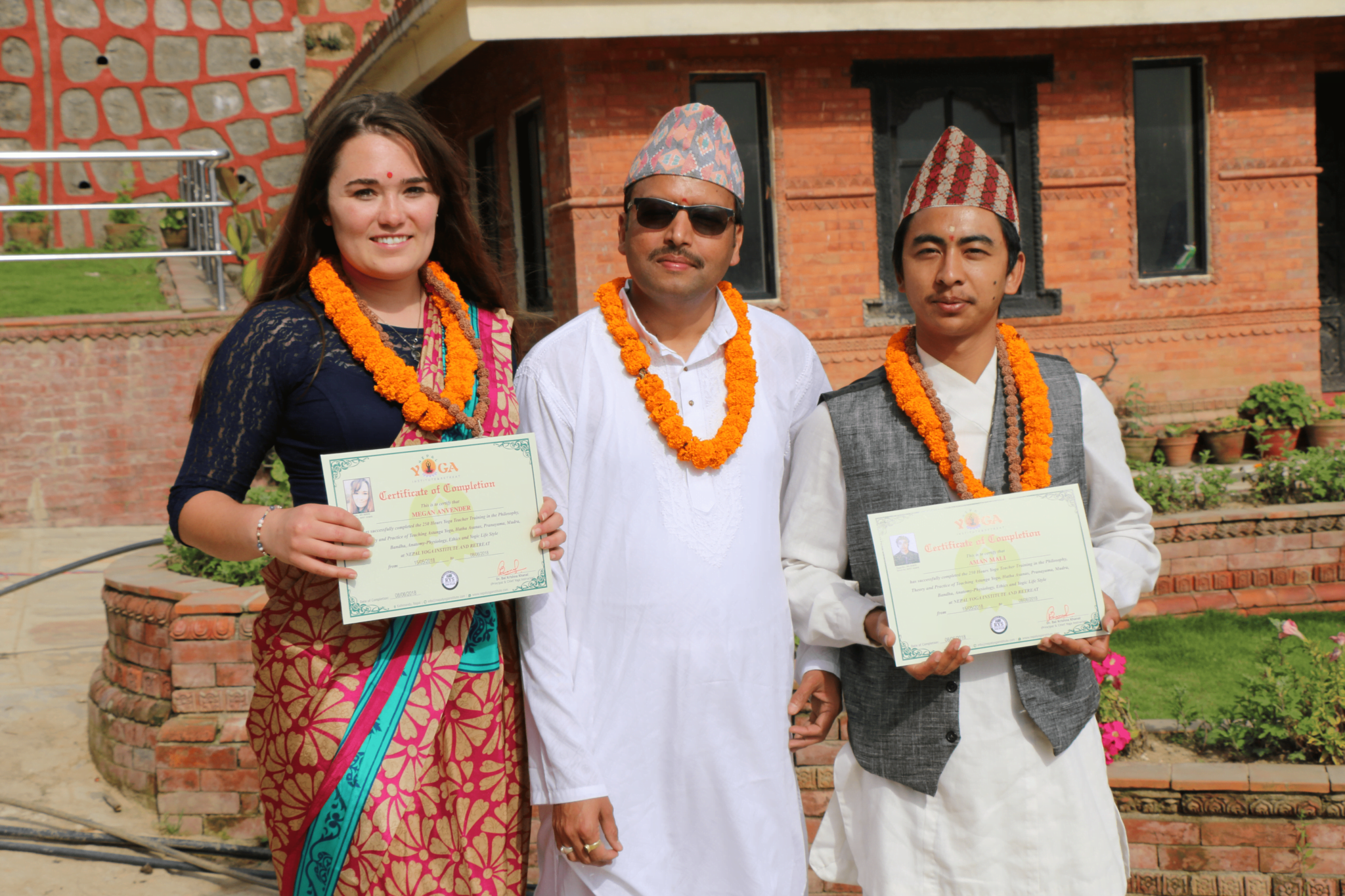
You are trusting people with your body and your quiet time, so it is fair to ask who they are. Our teachers page introduces the team in detail. In brief:
- Dr. Bal Krishna Khanal, founder and senior yoga teacher, with a Ph.D. in Yoga and Naturopathy from Nepal Sanskrit University.
- Yogini Indu, a Yoga Alliance USA certified teacher with more than ten years of teaching experience, who teaches Hatha, Ashtanga, Tantra yoga and yoga philosophy.
- Dr. Roshan Baskota, a registered Ayurveda doctor who teaches anatomy and physiology.
- Madhav Bhattarai, a yoga and meditation teacher with over five years of experience.
The institute states that it is registered with Yoga Alliance USA. You can check any school’s registration yourself on the Yoga Alliance directory.
Coming With a Friend, Sister or Mother
A retreat is easier to book when you are not doing it alone. Some women travel with a friend, a sister or a mother, and it can be a good way to rest side by side.
Pricing for our retreat packages is calculated according to group size, so a pair or a small group is arranged around the people attending. Tell us who is coming, your dates and any needs, such as a shared room or different practice levels, and we will explain what can be arranged. Do not assume; ask. It saves disappointment later.
Questions to Ask Yourself Before You Book
A retreat works best when you arrive with honest expectations. Take a few minutes with these questions.
- What do I actually need? Sleep, quiet, movement, company or time away from caring for others? The answer shapes how you use the free hours.
- Can I really switch off? If you will be answering work messages every evening, consider a day or two of out-of-office before you travel.
- Am I comfortable with a shared room? If you come alone, the team says it will arrange a roommate, so tell us early if you have concerns.
- Do I have health notes I should share? Injuries, medication, pregnancy or recent surgery all belong on the booking form.
- Is five days realistic for my life? If not, ask about the flexible package, or read about a shorter stay.
- Am I open to simple food and early nights? Sattvic meals and an early start are part of the structure.
If you can answer these honestly, you are ready to talk to us.
Days, Costs and Booking: What Our Site Publishes
You asked for facts that match the website, so here is what we publish. Prices for retreats are calculated on request, so we do not print a single figure here.
| Item | What our site publishes |
|---|---|
| Five-day yoga retreat | 5 days; price calculated on request according to group size |
| Short-term and long-term retreat package | Flexible length that can be increased or decreased; price calculated on request according to duration and group size |
| Five-day stress management package | 5 days; price calculated on request according to group size |
| Registration deposit for retreats | 20% of the package; full payment due on arrival, per our FAQ |
| Application processing | Within three working days, confirmed by email |
| Extra nights before or after | Available at a rate agreed in advance |
| Airport transfer | Pick-up option on the booking form; taxi roughly US$20 per our FAQ |
| Distance | About 22 km from the airport and 24 km from Thamel |
For a longer or more flexible stay, see our short-term and long-term yoga retreat package. When you request a quote, include your arrival and departure dates, how many people are coming, whether you need airport pick-up, and any dietary or health notes.
Our FAQ states that there are no additional taxes or fees beyond those stated on our website. Always confirm what your quote covers, including accommodation, meals, sessions and treatments, before you pay.
Preparing in the Two Weeks Before You Fly
A little preparation makes the first day of your retreat much easier.
Look after your sleep. Arriving rested helps. If you can, go to bed a little earlier in the week before you fly, so the early start does not feel like a shock.
Move gently. You do not need to train. A short daily walk and some easy stretching are enough to prepare the body for a week of practice.
Sort the practical things early. Check your passport and visa requirements, buy travel insurance that covers medical evacuation, and book your airport pick-up when you register. Our booking form asks for your flight details, so have them ready.
Tell people what to expect. Let family and colleagues know you will have limited availability. Setting that boundary before you leave makes it easier to keep.
Talk to your doctor if needed. If you have a health condition, take regular medication or are pregnant, get medical advice before you travel and share what is relevant with us.
Lower your expectations kindly. You are not going to fix your whole life in five days. You are going to rest, learn a few tools and remember what a slower pace feels like. That is plenty.
When to Come
The institute states that it runs courses every month of the year and that there is no single best month, so choose according to the weather you prefer. Here is a general guide.
| Season | Approximate months | What to expect |
|---|---|---|
| Spring | March to May | Warmer days and flowering hills |
| Monsoon | June to September | Rain and green hills; the travel advisory warns of floods and landslides |
| Autumn | October to November | Clear skies and the busiest travel season |
| Winter | December to February | Cold mornings and evenings; bring warm layers |
If you plan a short, rest-focused stay and dislike heavy rain, autumn and spring are the usual favourites. If you prefer quiet and do not mind rain, monsoon can be peaceful since practice takes place indoors. Check the weather before you go and keep your dates flexible if you can.
What to Pack
The institute suggests comfortable clothes for practice, warm clothes in winter, summer clothes plus an umbrella, raincoat and sunblock in the rainy and hot seasons, and mosquito repellent, a hat, a flashlight and trekking shoes for forest walks. Beyond that:
- A shawl, which doubles as a blanket for relaxation
- Modest clothing for temple visits
- Your regular medication, enough for the whole stay
- The personal and period products you prefer, so you are not shopping on arrival
- A notebook and a reusable water bottle
Bring your own mat, towel and personal items if you are staying longer. Ask us what is provided so you do not overpack.
Bringing the Calm Home
The common mistake after a retreat is trying to copy the whole schedule at home. You will not manage two hours of evening practice between work and dinner, and that is fine. Keep a few small things instead.
- A slow start. Even ten minutes of gentle movement and quiet breathing before you pick up your phone changes the tone of a day.
- A warm drink before screens. The ushapan idea travels well: lukewarm water with honey and lemon, drunk slowly.
- One protected rest. Put one afternoon or evening a week in your diary with no tasks and no one else’s needs attached.
- Honest limits. A retreat often shows you what you have been carrying. Choose one thing to say no to this month.
Small and repeatable beats ambitious and abandoned. If the retreat helps, you may want to return for a longer stay.
How to Judge Any Women’s Retreat
Before you book anywhere, run through this list:
- Is it honest about who it is for? A retreat should say clearly whether it is women-only or open to all.
- Is there a published daily schedule? Vague promises of daily yoga tell you little.
- Are the teachers named, with credentials you can check?
- Does it ask about your health? A good one does.
- Is there real rest in the day? If every hour is full, it is a boot camp.
- Are days and inclusions stated clearly?
- Is there a code of conduct? It signals how the house treats its guests.
- Can you read independent reviews? Look beyond the retreat’s own website. Our institute is listed on Tripadvisor, and you should read reviews of any retreat you consider.
If You Want Something Shorter, or Deeper
If five days feels like too much leave, read our guide to a short yoga retreat in Budhanilkantha and ask us what a shorter stay can look like. If a retreat leaves you wanting more, our 200-hour yoga teacher training runs for 22 days and costs $1,400, with a non-refundable $200 deposit and the balance due on orientation day in Nepal. It is the full commitment, so treat it as a second step, not a first.
Frequently Asked Questions About Women’s Yoga Retreat in Nepal
1. What is a yoga women’s retreat?
It is a residential stay built around yoga, breathing, meditation, rest and simple food, usually with an emphasis on gentleness and support. Some are women-only. Ours is open to all guests, and many women join, often alone.
2. Is Nepal Yoga Institute’s retreat women-only?
No. It is open to all guests. If a women-only setting matters to you, contact us with your dates and group size and we will tell you honestly what can be arranged.
3. How many days is the retreat?
Our published retreat lasts five days. We also offer a short-term and long-term package whose length can be increased or decreased, and a five-day stress management package.
4. How much does a yoga retreat in Nepal cost at your institute?
Prices are calculated on request. The five-day retreat and stress management package are priced according to group size, and the flexible package according to duration and group size. Send your dates and group size for a quote.
5. Is a deposit required?
Our FAQ states that a non-refundable deposit of 20% of the package starts your registration for retreats, with full payment due on arrival. Confirm the details in your quote.
6. Can I come alone as a woman?
Yes. Many guests come alone. The team says it will arrange a roommate, and our code of conduct sets expectations for respectful behaviour.
7. Do you have women teachers?
Yes. Yogini Indu is a Yoga Alliance USA certified teacher with more than ten years of teaching experience. Dr. Bal Krishna Khanal, Dr. Roshan Baskota and Madhav Bhattarai complete the teaching team.
8. Do I need yoga experience?
No. The retreat is gentle by design, with Hatha-style practice, long rest windows, massage and sauna. Tell us your experience level on the booking form so we can guide you.
9. What does a typical day look like?
It starts around 6:00 with warm water, then mantra and pranayama, asana, breakfast and rest. Midday has an Ayurveda massage and sauna, then lunch and rest. The late afternoon is two hours of yoga and meditation, followed by dinner.
10. What food is served?
Sattvic organic vegetarian or vegan meals, mostly sourced from local organic farms. Meat, fish and eggs are not served. Tell us about dietary needs or allergies in advance.
11. Can I do the retreat during my period?
Yes, many women do. Tell the teacher if you would like gentler practice, and rest whenever you need to. If you have heavy or painful periods, speak to your doctor first.
12. Can I join if I am pregnant?
Please speak to your doctor first and tell us on the booking form. Our published retreat is not described as a prenatal program, so do not assume it is designed for pregnancy.
13. Is it suitable after childbirth or surgery?
Only with your doctor’s agreement. Recovery differs for every woman, so share your history on the booking form and ask us before you book.
14. Is it a good retreat for burnout and stress?
Many women find a quiet, structured break helpful. We also offer a five-day stress management package with a first-day assessment. A retreat is not medical treatment, so keep a doctor or counsellor involved if symptoms persist.
15. How do I get from the airport?
The institute is about 22 km from Tribhuvan International Airport. You can request airport pick-up on the booking form, and our FAQ estimates a taxi at roughly US$20.
16. Is Nepal safe for women travelling alone?
Nepal is a popular destination for solo travellers, but conditions change. The U.S. Department of State rated Nepal Level 2 in March 2026. Check the current advisory, arrange your pick-up, buy insurance with medical evacuation cover and use ordinary good judgement.
17. What should I pack?
Comfortable practice clothes, warm layers or rain gear depending on season, a shawl, modest clothes for temples, regular medication, the personal products you prefer, and trekking shoes if you plan a forest walk.
18. Are mats and Wi-Fi provided?
The institute states that it provides yoga mats, blankets, cushions and other supports, and that free Wi-Fi is available. Bring your own mat and towel if you are staying longer.
19. When is the best time to come?
The institute runs courses every month and says there is no single best month. Autumn and spring are common favourites for clearer weather, while monsoon is wetter and quieter.
20. How do I book?
Fill in the booking form on our website or message us on WhatsApp with your dates, group size and any health or dietary notes. The institute says it processes applications within three working days and confirms by email.
Ready to Rest? Talk to Us First
You do not need to be flexible, spiritual or fit. You need a few days, an honest conversation about what you want and a place that lets you rest properly. Tell us your dates, whether you are coming alone or with someone, and anything we should know about your health or food. We will tell you plainly what we can arrange.
- Send your details through the Nepal Yoga Institute booking page.
- Prefer to talk first? Message us on WhatsApp at +977-9823022196, or reach the team through our contact page.
Nepal Yoga Institute, P.O. Box 1272, Budhanilkantha-11, Kathmandu 44600, Nepal.