Choosing a yoga teacher training is a strange kind of shopping. You are about to spend weeks of your life, and a meaningful amount of money, in a place you’ve only seen in photos, learning from people you’ve only read about. Every school’s website says it is authentic, experienced and life-changing. Very few say what a Tuesday actually looks like, who teaches the anatomy class, or what happens if you have a bad knee.
This guide is built to fix that. It explains what separates the best yoga training schools in Nepal from the merely well-marketed ones, gives you a checklist you can use on any school, and then walks through one school in detail: Nepal Yoga Institute and Retreat, a residential school in Budhanilkantha, Kathmandu. Everything said about the institute comes from the institute’s own published pages, including prices, schedules, group size and rules, so you can verify it yourself.
What “Best” Really Means When You’re Choosing a Yoga School
There is no official ranking of yoga schools in Nepal, and any list that claims to crown “the number one” is really a list of someone’s preferences. The better question is: best for what?
- Best for a first certification, with a clear syllabus and a supportive group?
- Best for a particular style, such as Hatha or the eight-limbed Ashtanga path?
- Best for someone who wants to try the school before committing to a full course?
- Best for someone who cares about food, ethics and the community around the school as much as the asanas?
A school that is perfect for a 25-year-old who wants a flexible vinyasa class might be wrong for a 50-year-old who wants classical philosophy and quiet. So this guide gives you the tools to decide, then shows how one school measures up.
What Makes the Best Yoga Training Schools in Nepal: A Practical Checklist
Use these nine questions on any school you’re considering. A good school answers them clearly and without being asked twice.
1. Is it registered with a recognized body?
Yoga Alliance is the international registry most schools reference. Don’t take a website’s word for it: you can search any school on the Yoga Alliance directory yourself. Nepal Yoga Institute states that it is a registered school of Yoga Alliance USA.
2. Is the curriculum published, hour by hour?
Vague promises like “comprehensive training” tell you nothing. Look for a breakdown: how many hours of practice, philosophy, anatomy, teaching methodology and practicum.
3. Who actually teaches, and what are their credentials?
Look for named teachers with traceable training, not a rotating cast with no names.
4. How big is the group?
Class size determines how much personal correction you get. A stated maximum is a good sign.
5. What’s included in the price, and what isn’t?
Meals, accommodation, textbooks, taxes and certificate should be listed. So should the extras: airport transfer, laundry, insurance.
6. What does a real day look like?
A published daily schedule shows the true intensity of the course.
7. What are the house rules?
Rules on diet, phones, alcohol and conduct tell you what kind of community you’re joining. Better to know before you book.
8. Where is it, and does the setting support the practice?
Early-morning pranayama in a quiet place is a different experience from the same practice beside a main road.
9. What happens after?
Look for a path to continue: further courses, retreats, or ways to keep learning.
Nepal Yoga Institute Against the Checklist
Here is how the institute answers those nine questions, using only what its site says.
| Checklist question | What the institute publishes |
|---|---|
| Registration | Registered school of Yoga Alliance USA |
| Published curriculum | Yes: hour-by-hour breakdown for the 200-hour course |
| Teacher credentials | Named teachers with listed qualifications |
| Group size | Up to 14 students per 200-hour course |
| Price clarity | $1,400 complete cost; inclusions and exclusions listed |
| Daily schedule | Full daily timetable, 6:30 a.m. to 9:30 p.m. |
| House rules | Published: vegetarian community meals, no alcohol, smoking or drugs, no phones during class |
| Setting | Budhanilkantha, below Shivapuri National Park |
| What comes after | Hatha and Ashtanga tracks, a 300-hour course, retreats, stress-management programs |
The rest of this guide expands each of those rows.

The Core Program: 200-Hour Yoga Teacher Training
The flagship course is the 200-hour yoga teacher training in Nepal. The institute describes it as grounded in traditional (Sanatan) yoga, derived from classical Hatha yoga and Ashtanga (Patanjali’s eightfold path). Here is the curriculum as published on the 200-hour yoga teacher training page:
| Subject | Hours | What it covers |
|---|---|---|
| Practice | 100 | Asana, pranayama, kriya, chanting, mantra, mudra, meditation and other traditional techniques, plus how to teach them |
| Philosophy | 20 | Yoga Sutras, Hatha Yoga Pradipika, origins and history |
| Anatomy & physiology | 20 | Physical and energy anatomy and their application to practice |
| Practicum | 20 | Every trainee leads classes, observes others, gives and receives feedback |
| Teaching methodology | 15 | Communication, teaching styles, group dynamics, class preparation |
| Q&A discussions | 15 | Overall training, reports on experiences, questions |
| Yogic diet, lifestyle & ethics | 10 | Ahimsa, dharma and karma, the ethics of a yoga teacher, sattvic meals |
| Mantra chant / prayer | 5 | Every morning begins with chanting |
| Triyoga: Karma, Bhakti, Jnana | 5 | The paths of action, devotion and knowledge |
The school adds that the course runs from beginner to advanced level, and that teachers guide each student according to their needs. Topics also include satkarma (cleansing techniques), body alignment, yoga safety guidelines, mudra and bandha, business and communication skills, and how to set up, observe, assist and correct classes. Reading the list, what stands out is how much of it is about teaching, not just practicing.
Dates, Length, Price and Group Size
| Detail | What the site states |
|---|---|
| Fee | $1,400 (described as the complete cost) |
| Deposit | $200, non-refundable, paid in advance |
| Balance | Payable on orientation day in Nepal |
| Length | 22 days |
| Start date | The 15th of every month |
| End date | The 7th or 8th of the following month, depending on 30- or 31-day months |
| Group size | Up to 14 students per course |
| Day off | One day a week, usually Sunday |
The institute says courses run every month of the year and that there is no single best month; it depends on your schedule and the weather you prefer.
What the $1,400 Includes (and What It Doesn’t)
Transparent pricing is one of the clearest signs of a trustworthy school. The institute’s course page lists:
Included:
- Unlimited herbal tea
- Three organic (mostly vegetarian/vegan) meals a day
- Shatkarma (cleansing) practice
- Yoga textbook and practice copy
- Shared accommodation
- One Ayurvedic massage
- 13% VAT and 10% service charge
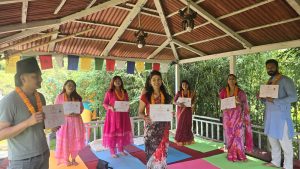
- Yoga Alliance certificate
Not included:
- Outside trip costs to and from the institute
- Airport transfer
- Travel and medical insurance (suggested)
- Laundry (available for an additional cost)
Rooms are described as shared, with two single beds, and a single room can be requested for an extra charge. In winter the institute says it provides all bedding, towels, extra blankets and electric heaters for the rooms.
A Real Day on the Course
This is the published daily schedule. It can vary by season and student requests, according to the school.
| Time | Activity |
|---|---|
| 6:30–7:00 | Satkarma, chanting and pranayama |
| 7:00–7:15 | Tea break |
| 7:15–9:30 | Mantra chanting, yogasana and pranayama |
| 9:30–10:30 | Breakfast |
| 10:30–13:00 | Theory class and yogic relaxation |
| 13:00–14:00 | Lunch |
| 14:00–15:00 | Self-study |
| 15:00–16:45 | Meditation and workshop |
| 16:45–17:00 | Tea break |
| 17:00–18:30 | Asana practice |
| 18:30–19:30 | Dinner |
| 19:30–21:30 | Self-study and sadhana |
It is a full day, roughly fifteen hours from first practice to the end of evening study, but with real rest built in: a long midday break, tea breaks, and a weekly day off for hiking, heritage sites, temples or volunteer service.
Hatha or Ashtanga? Choosing Your Style
Good schools are clear about which tradition they teach. The institute offers dedicated tracks for both.
| Hatha | Ashtanga | |
|---|---|---|
| How the institute describes it | A branch of yoga where physical techniques are practiced to obtain relaxation | The eight limbs of Patanjali’s Yoga Sutras: asana, pranayama, pratyahara, dharana, dhyana and samadhi, alongside ethical principles |
| Training covers | Asanas, pranayama, shatkarma, mudra and bandha | Breathing techniques, asanas, meditation and a sensible attitude toward life |
| Feel in practice | Moderate and accessible; you leave calm and relaxed rather than drenched in sweat | A broader philosophical path aimed at purifying body and mind |
| Who it suits | Anyone wanting a physical foundation and a gentler approach | Anyone wanting the full eight-limbed framework |
Both are explained in detail on the Hatha yoga teacher training page and the Ashtanga yoga teacher training page. One point worth knowing: the school’s FAQ states that its teaching mostly covers Ashtanga, Hatha, Mantra and Raja yoga, so in practice the 200-hour course blends these traditions. The reference text it names is Asana, Pranayama, Mudra, Bandha by Swami Satyananda Saraswati (Bihar School of Yoga), and students receive a copy along with the school’s own manual.
Both tracks note that the training is demanding on a physical, mental and spiritual level, and that you need reasonable stamina and mental discipline. They also say that prior experience isn’t required, and that the course is open to people who simply want to deepen their own practice, not only those who plan to teach.
The Teachers Behind the Course
When you compare the best yoga teacher training in Nepal, the teaching team matters more than the scenery. Here are the people the institute lists on its teachers page and founder page.
Dr. Bal Krishna Khanal, founder and chief yoga teacher.
He holds a Ph.D. in Yoga and Naturopathy from Nepal Sanskrit University, with research on stress management by yoga and naturopathy. He completed a three-year Diploma in Yoga and Naturopathy at Gandhi National Academy, New Delhi (1999), and a postgraduate qualification in Psychological Counseling from Tribhuvan University (2006). He is a certified naturopathic physician under Nepal’s National Skill Testing Board (CTEVT). He holds ERYT 500 status with Yoga Alliance Australia and RYT status with Yoga Alliance USA, and is known for his Sanskrit verses and mantra chanting.
Yogini Indu.
A Yoga Alliance USA certified teacher with more than ten years of teaching experience. She teaches Hatha, Ashtanga, Tantra yoga and yoga philosophy, and is also a certified Art of Living teacher.
Dr. Roshan Baskota.
A registered Ayurveda doctor (Bachelor of Ayurvedic Medicine and Surgery, Tribhuvan University) who teaches anatomy and physiology in the training programs.
Madhav Bhattarai.
A yoga and meditation teacher with over five years of experience, trained at the Patanjali Institute in Haridwar, with Vipassana experience and nine months of practice at the Isha Foundation.
That spread of backgrounds is useful: philosophy and mantra, asana and Tantra, Ayurvedic anatomy, and meditation, each taught by someone whose training matches the subject.
Reviews on the institute’s site point to the same strength from the student side. Several mention the founder’s guidance reaching beyond yoga into life and career questions, and describe a homely atmosphere. The homepage displays a five-star Google rating based on 20 reviews, and the institute is also listed on Tripadvisor, where you can read independent feedback.

The Setting: Budhanilkantha and the Maitri Sewa Ashram
The institute is at Budhanilkantha-11, Kathmandu. It lists its distance as about 22 km from Tribhuvan International Airport and 24 km from Thamel. Residential training takes place at Maitri Sewa Ashram, run by J.P. Foundation, which the institute describes as being about 20 km from the main city, below Shivapuri National Park at the foothills of the Manichud Hills. From the premises you can see the three cities of the Kathmandu Valley: Kathmandu, Bhaktapur and Lalitpur.
J.P. Foundation is a social organization working in education, health, senior-citizen care, organic farming and cow husbandry. Its ashram provides free accommodation, food and health services to economically disadvantaged senior citizens. The institute and the foundation collaborate on the principle that yoga is more effective when combined with social service.
For students, this creates optional opportunities, summarized on the karma yoga page. The institute is explicit that taking part is voluntary and that no service is mandatory. If you choose to join, you can spend time with senior residents, help with organic farming, or assist with the roughly 20 to 25 cows reared at the ashram. The school notes that food, vegetables and fruits grown there are served first to people in the ashram.
Not every student wants this, and that is fine. But if a school’s values matter to you as much as its syllabus, a training connected to a working social-service ashram is a distinctive thing to find.
Daily Life: Food, Rules, Phones and Packing
A course page tells you the syllabus. This section tells you what living there is like, which is where many people are caught off guard.
Food. The institute serves organic vegetarian or vegan meals on a fixed menu at fixed times, and students eat together as a community. It does not serve meat, fish or eggs, and all dairy is cow-based. If you have a medical diet or special requirement, tell the team in advance.
House rules. The school states that it follows Patanjali’s eight limbs strictly, which includes no violence, no swearing, no meat consumption, no smoking, and no alcohol or drugs. Respect, integrity and honesty are expected from staff, guests and students alike.
Phones. Mobile phones and other electronic devices are not permitted during class time. Free Wi-Fi is available in your leisure time.
Electricity. The institute is candid that electricity problems can occasionally occur. It is a small honesty that tells you something about the school.
Equipment. Yoga mats, blankets, cushions and supports are provided, though the school suggests bringing your own mat or towel if you have preferences.
What to pack. The institute recommends:
- Warm clothes for winter, plus a warm cardigan, blanket or shawl for meditation
- Cotton or traditional-style clothing for yoga (it specifically asks you not to bring crop tops, low-cut tops, shorts or transparent clothes)
- Traditional dress for temple and heritage-site visits
- A refillable water bottle or thermos, a headlamp or flashlight, and water-resistant walking shoes
- Sandals for around the institute, warm socks and a hat for winter
- A personal medical kit, toiletries, and mosquito or bug repellent for summer and the rainy season
It also describes the seasons plainly: summer (March to June) is hotter, the rainy season (July to September) is warmer with rainfall, and December to February is a little cold, particularly in the mornings and evenings.
Roommates. If you arrive alone, the team says it will arrange a roommate for you.
Beyond the 200 Hours: Where to Go Next
A good school gives you somewhere to grow. Besides the 200-hour course, the institute lists:
- 300-hour teacher training, which its course page says is available for booking at any time.
- A five-day yoga retreat, a gentler introduction with daily asana, mantra and pranayama, Ayurveda oil massage and sauna, and yoga and meditation sessions. Prices are calculated on request according to group size. For anyone nervous about committing to a month-long course, it works as a trial of the school’s teaching and atmosphere.
- Short-term and long-term retreat packages, where the duration can be increased or decreased as needed and prices are calculated on request.
- Stress management programs, including a five-day package and a corporate program, shaped by the founder’s research in this field.
- Psychological counseling, which the institute lists among its services.
- Yoga treks, combining hiking with yoga sessions. Destinations named include Annapurna Base Camp, Sagarmatha Base Camp, Langtang Valley, Upper Mustang, Gosaikunda and Chisapani.
Top Picks for 2026: Which Program Fits Which Student
Since the honest answer to “which is best?” is “it depends,” here is a quick way to match your situation to a program.
| If you are… | Consider | Why |
|---|---|---|
| A first-time trainee who wants certification | 200-hour yoga teacher training | Published curriculum, $1,400 complete cost, up to 14 students, monthly start dates |
| Drawn to physical, accessible practice | Hatha yoga teacher training | Focus on asanas, pranayama, shatkarma, mudra and bandha |
| Drawn to philosophy and the eight limbs | Ashtanga yoga teacher training | Patanjali’s full path, from asana to samadhi |
| Unsure and wanting a taste first | Five-day yoga retreat | Short, structured, with the same daily rhythm and no certification pressure |
| Burned out or overwhelmed | Five-day stress management package | Includes a stress-level and resilience assessment and dedicated sessions |
| Ready to go deeper after 200 hours | 300-hour training | Available for booking at any time |
| Motivated by service | Karma yoga alongside any program | Voluntary work with seniors, farming or cows at the partner ashram |
For Hatha and Ashtanga tracks, scheduling and fee details aren’t listed on those pages, so ask the team directly before booking.
How to Book and Pay
Booking runs through the institute’s online form, which asks for your personal details, chosen program and start date, arrival and departure dates, whether you want airport pickup, and any health conditions, medication, previous yoga experience and emergency contact. The institute says it processes applications within three working days and confirms by email.
A few specifics from the site:
- Deposit: $200 for teacher training, non-refundable. For retreat packages, the FAQ states a 20% non-refundable deposit. Full payment is due on arrival.
- Payment methods: bank transfer, Western Union, credit card or cash.
- Extra fees: the institute says there are no additional taxes or fees beyond those stated on its website.
- Extra nights: available before or after your course at a rate agreed in advance.
- Invitation letter: the team can send one by email.
- Age: teacher training requires students to be at least 18; the school notes students range from 18 to 65.
- Insurance: the institute recommends travel insurance and asks for copies of identity documents on arrival.
Getting to Nepal
Most visitors need a visa to enter Nepal, and fees and rules change, so check the official Nepal Department of Immigration website before you travel instead of relying on older articles. Airport transfer isn’t included in the course fee, but you can request pickup on the booking form.
Red Flags to Watch for in Any Yoga School
Having looked at what a transparent school publishes, here is what should make you cautious elsewhere:
- No named teachers, or credentials you can’t trace
- No published curriculum or daily schedule
- A price with unclear inclusions, or extras revealed only after you arrive
- No stated group size
- A promise of 200 hours of training in an unrealistically short time
- Registration claims you can’t verify on the registry itself
- No stated house rules, which often means no clear expectations on either side
The Short Version
The best yoga training schools in Nepal share a few traits: they’re registered, they publish their syllabus and schedule, they name their teachers, they limit group size, and they’re upfront about price and rules. Nepal Yoga Institute publishes all of that for its 200-hour course, backs it with a founder holding a doctorate in yoga, and adds an unusual community dimension through its partnership with a social-service ashram.
Whether it’s the right school for you depends on whether quiet, classical, vegetarian, phone-free practice is what you’re after. If it is, it is worth a serious look.
Frequently Asked Questions about Best Yoga Training Schools in Nepal
1. What are the best yoga training schools in Nepal?
There is no official ranking, so “best” depends on your goals. The most reliable approach is to judge schools on the same criteria: registration, a published curriculum, named and qualified teachers, small groups, transparent pricing, and a clear schedule and rules.
2. Is Nepal Yoga Institute registered with Yoga Alliance?
The institute states that it is a registered school of Yoga Alliance USA. You can confirm any school’s status on the Yoga Alliance directory.
3. How much does the 200-hour yoga teacher training cost?
The complete cost is $1,400. A $200 non-refundable deposit is paid in advance, and the balance is due on orientation day in Nepal.
4. How long is the 200-hour course?
It runs for 22 days. Courses start on the 15th of every month and end on the 7th or 8th of the following month.
5. How many students are in each course?
Up to 14 students per 200-hour course, which the institute says protects the quality of the class.
6. What does the course fee include?
Unlimited herbal tea, three organic mostly vegetarian or vegan meals a day, shatkarma practice, a yoga textbook and practice copy, shared accommodation, one Ayurvedic massage, 13% VAT and 10% service charge, and a Yoga Alliance certificate.
7. What isn’t included in the fee?
Outside trip costs, airport transfer, travel and medical insurance (recommended), and laundry, which is available for an additional cost.
8. Do I need yoga experience to join?
No specific experience is required. The institute welcomes all backgrounds, and the course moves from beginner to advanced level.
9. Is there an age requirement?
Students must be at least 18. The institute says its students range from 18 to 65.
10. Which styles does the training cover?
Mostly Ashtanga (Patanjali’s eight limbs), Hatha, Mantra and Raja yoga within a traditional (Sanatan) approach. Dedicated Hatha and Ashtanga training pages are available.
11. Who teaches the course?
Dr. Bal Krishna Khanal (founder and chief teacher), Yogini Indu, Dr. Roshan Baskota (Ayurveda doctor teaching anatomy and physiology) and Madhav Bhattarai (yoga and meditation teacher).
12. What are the founder’s qualifications?
Dr. Khanal holds a Ph.D. in Yoga and Naturopathy from Nepal Sanskrit University, a diploma in yoga and naturopathy from Gandhi National Academy in New Delhi, and a postgraduate qualification in psychological counseling from Tribhuvan University. He holds ERYT 500 with Yoga Alliance Australia and RYT with Yoga Alliance USA.
13. What does a typical day look like?
It starts at 6:30 with satkarma, chanting and pranayama, then moves through asana, theory, self-study, meditation, an evening asana session and dinner, ending with self-study and sadhana around 21:30.
14. What food is served?
Organic vegetarian or vegan meals at fixed times, eaten together as a community. No meat, fish or eggs are served, and dairy products are cow-based.
15. Can I use my phone during the course?
Mobile phones and electronic devices are not permitted during class time. Free Wi-Fi is available during leisure time.
16. Are there any lifestyle rules?
Yes. The school follows Patanjali’s eight limbs strictly: no violence, swearing, meat, smoking, alcohol or drugs, with respect, integrity and honesty expected from everyone.
17. Is there time off during the course?
One day a week, usually Sunday, for hiking, heritage sites, temples or volunteer service.
18. Is karma yoga compulsory?
No. Service work with senior residents, organic farming or cows at the partner ashram is entirely voluntary.
19. Can I try the school before committing to teacher training?
Yes. The five-day yoga retreat and the stress-management package follow a similar daily rhythm and let you experience the setting and teaching. Prices are calculated on request according to group size.
20. How do I book, and how fast will I hear back?
Complete the online booking form with your program, dates and health information. The institute says it processes applications within three working days and confirms by email. You can also message the team directly on WhatsApp.
Ready to Choose Your Yoga Teacher Training?
If you’re weighing your options among the best yoga training schools in Nepal, the fastest way to find out whether a school is right for you is to talk to a real teacher. Share your dates, your experience level and what you want from the training, and the team will point you to the right program, whether that’s a five-day trial retreat, a 200-hour certification or a longer path.
Chat with our yoga teacher on WhatsApp: +977 9860480478