Introduction to Yoga for Anxiety Management
Almost everyone knows the feeling: a tight chest before an exam, a racing mind at two in the morning, a stomach that knots up before a difficult conversation. For many people that feeling does not pass. It becomes a background hum that shapes work, sleep and relationships. This guide is about yoga for anxiety management: what the practice can realistically offer, which breathing techniques and poses are gentle enough to start with, and how to build a routine that fits an ordinary day.
We write from Budhanilkantha, at the northern edge of the Kathmandu Valley, where Nepal Yoga Institute teaches yoga, pranayama and meditation. We will be direct about two things from the start. First, yoga is a helpful companion for anxiety, but it is not a treatment for an anxiety disorder on its own. Second, the best results come from practicing gently and regularly, not from forcing a dramatic experience in a single class. Where research is limited, we say so. Where an idea comes from yoga tradition rather than laboratory evidence, we label it as tradition.
Yoga for Anxiety Management at a Glance
| Topic | Short answer |
|---|---|
| What it is | A set of gentle postures, slow breathing practices, relaxation and meditation used to settle the body and mind |
| Best starting point | Slow breathing with a longer exhale, then two or three restful poses, then lying down in Savasana |
| Time needed | 5 to 20 minutes a day is enough to begin |
| Experience needed | None; every technique below has a beginner version |
| What to avoid at first | Forceful breathing, long breath holds, deep backbends and strong, fast flows |
| What it cannot do | Replace therapy, medication or medical care when anxiety is severe or lasting |
| When to get help | When anxiety interferes with work, study, sleep or relationships, or when you feel unsafe |
What Anxiety Actually Is
Anxiety is a normal human response to a threat or a challenge. A little of it sharpens attention before a presentation or keeps you careful on a mountain trail. The U.S. National Institute of Mental Health (NIMH) draws a line between this ordinary anxiety and an anxiety disorder: in a disorder, the fear or worry is out of proportion to the situation, hard to control, and gets in the way of daily life.
Anxiety disorders are common. NIMH estimates that roughly one in three adults in the United States experiences one at some point in life. That figure comes from American data, but it is a useful reminder that anxiety is a very ordinary human problem and nothing to be ashamed of.
Using generalised anxiety disorder as an example, NIMH describes symptoms such as:
- excessive worry about everyday matters such as work, health, money or family
- difficulty controlling the worry
- feeling restless, on edge or irritable
- trouble concentrating
- sleep problems and tiredness
- physical symptoms such as muscle tension, headaches, stomach aches, trembling or sweating
For a diagnosis of generalised anxiety disorder, the worry is typically present on most days for at least six months, alongside several of these symptoms. Only a qualified health professional can diagnose an anxiety disorder, so this list is for understanding, not for self-diagnosis.
The physical symptoms matter for yoga. Anxiety is not only a thought pattern; it lives in the body as shallow breathing, a clenched jaw, raised shoulders and a restless nervous system. Yoga works through the body first, which is why many people find it an easier doorway than “just stop worrying.”
What Yoga Can and Cannot Do
Honest framing builds trust, so here is the evidence picture as the U.S. National Center for Complementary and Integrative Health (NCCIH) describes it in its guidance on yoga: effectiveness and safety. Research suggests yoga may help some people manage stress and anxiety symptoms, but many studies are small or vary in quality, and results are not uniform. That is a promising but modest finding, and we prefer to state it plainly.
Relaxation techniques have a similar profile. NCCIH describes breathing exercises, progressive muscle relaxation and guided imagery as practices meant to trigger the body’s relaxation response, with slower breathing, lower blood pressure and a slower heart rate. Reviews it cites found that relaxation therapy reduced anxiety symptoms in people with anxiety disorders, although it was less effective than cognitive behavioural therapy (CBT) for some conditions such as PTSD and OCD, and many of the underlying studies were small or of low quality.
NCCIH also notes that relaxation techniques are generally considered safe for healthy people, but a few people report more anxiety, intrusive thoughts or a fear of losing control, and rarely they may worsen symptoms for people with epilepsy, certain psychiatric conditions or a history of abuse or trauma.
Put together, a fair summary looks like this:
| Yoga can | Yoga cannot |
|---|---|
| Give you a practical way to slow your breathing and relax tense muscles | Cure an anxiety disorder |
| Build the habit of noticing your body and your thoughts without reacting at once | Replace CBT, other therapy or prescribed medication |
| Offer a calm, regular routine when life feels chaotic | Resolve the real-life causes of stress such as overwork, conflict or loss |
| Work alongside professional care as a self-care tool | Be a safe substitute for emergency or crisis support |
NIMH itself lists exercise, mindfulness and meditation, sufficient sleep and reduced caffeine as self-care habits that can reduce symptoms when combined with standard treatment, and it is clear that these habits are not a replacement for treatment. Yoga fits within that picture as a form of gentle movement, breathing and mindfulness rolled into one.
How Yoga May Calm the Body
Traditional yoga explains calm through the movement of prana, the vital energy associated with the breath. Modern physiology offers a complementary explanation: slow, even breathing is associated with the body’s relaxation response, and gentle stretching and held postures give tense muscles a chance to let go. Attention to the breath and the body also gives a restless mind a simple object to rest on.
We want to be careful here. The relationship between particular poses or breathing patterns and particular outcomes is still being studied, and a 2018 systematic review of pranayama research found “interesting albeit limited evidence” linking slow breathing to psychological outcomes in healthy people. So we do not promise that any single technique will lower anxiety by a set amount. What we can say is that these practices are low-cost, low-risk when done gently, and worth trying with patience.
Safety First: Ground Rules for Anxious Beginners
Before the techniques, a few ground rules that we ask every new student at Nepal Yoga Institute to keep in mind:
- Go slowly and stay comfortable. If a pose or breath makes you dizzy, panicky or sharply uncomfortable, stop and return to normal breathing. Anxiety is not helped by pushing through discomfort.
- Start without breath holds. Classical texts such as the Hatha Yoga Pradipika warn that forcing the breath by hurrying or using too much force can harm the practitioner. Uneven ratios and long retention are traditionally taught to experienced students with a teacher, not to beginners.
- Keep the eyes open if closing them feels frightening. A soft gaze at the floor is perfectly valid.
- Tell your teacher about any health conditions, including pregnancy, high or low blood pressure, eye conditions such as glaucoma, epilepsy, recent surgery, and any history of trauma.
- Keep your professional care. Do not stop or change medication or therapy because you have started yoga. Discuss any new complementary practice with your doctor or therapist.
- You are allowed to stop. If a practice stirs up distressing memories or feelings, you can stop at any time. Seek support from a qualified professional.
Breathing Practices for Anxiety
Breathing is the quickest, most portable tool in yoga, and it is the best place to begin. Pranayama, the yogic regulation of the breath, is the fourth limb of Patanjali’s eight-limbed path. The modern, gentle versions below are very different from the strenuous practices of older traditions, and we keep to the gentle end.
1. Slow Diaphragmatic Breathing (Belly Breathing)
This is the simplest technique and the one NCCIH highlights among relaxation methods.
- Sit comfortably or lie on your back with knees bent. Place one hand on your belly and one on your chest.
- Breathe in slowly through the nose. Let the belly rise under your lower hand while the chest stays fairly quiet.
- Breathe out slowly through the nose or softly through the lips. Feel the belly settle.
- Continue for 3 to 5 minutes. Do not strain; the breath should feel soft and unforced.
If you feel light-headed, return to ordinary breathing and shorten the practice next time.
2. The Longer Exhale
Many teachers, including those who guide stress classes, ask students to let the exhale be a little longer than the inhale, for example in for a count of four and out for a count of six. There is no magic ratio; the aim is a smooth, unhurried out-breath. If counting makes you more anxious, drop it and simply let each exhale be slow.
3. Nadi Shodhana (Alternate Nostril Breathing)
Nadi shodhana, also called anuloma viloma, is one of the best-known pranayama practices in hatha yoga. The classical instruction is to use the right thumb to close the right nostril, and the ring and little fingers to close the left.
- Sit tall, relax your shoulders and rest your left hand on your knee.
- Close the right nostril with the thumb and inhale slowly through the left.
- Close the left nostril, release the right, and exhale slowly through the right.
- Inhale through the right, close it, release the left and exhale through the left. That is one round.
- Begin with 5 rounds and build slowly toward 5 to 10 minutes.
Keep the inhale and the exhale equal and easy. Traditional sources advise that uneven ratios and breath retention are for experienced students working with a teacher. If you have a blocked nose, simply breathe normally.
4. Bhramari (Humming Bee Breath)
Bhramari is described in the pranayama literature as a soothing practice. Its name refers to the humming bee.
- Sit comfortably and breathe in through the nose.
- As you exhale, make a gentle, steady humming sound with the lips closed.
- Feel the vibration around the face and head. Keep the sound soft; it should never feel forced.
- Repeat for 5 to 8 breaths, then rest and breathe normally.
5. Light Ujjayi Breathing
Ujjayi, the “victorious breath,” is a modern technique used widely in vinyasa and Ashtanga yoga. A gentle version involves a very slight narrowing at the back of the throat so the breath makes a soft, oceanlike sound. For anxiety, keep it quiet and smooth. If the throat feels tight or the breath feels effortful, drop it and breathe normally.
What to Leave for Later
Forceful practices such as kapalabhati (skull-shining breath) and bhastrika (bellows breath) involve rapid, strong breathing. They are traditional techniques, but they are not where an anxious beginner should start, because rapid breathing can feel like the very panic you are trying to settle. If you wish to explore them, do so later and under the guidance of an experienced teacher, which is also what B. K. S. Iyengar advised for pranayama in general.
Gentle Poses for Anxiety
Poses for anxiety do not need to be impressive. The aim is to soften tension, lengthen the breath and feel supported. Choose a quiet space, a mat and a couple of folded blankets or cushions. Hold each pose for 5 to 10 slow breaths unless noted otherwise.
| Pose | Sanskrit name | What it offers | Beginner note |
|---|---|---|---|
| Child’s pose | Balasana | A supported, folded rest | Knees can be wide; use a cushion under forehead or hips |
| Cat-cow | Marjaryasana-Bitilasana | Spinal movement paired with breath | Move slowly, matching breath to motion |
| Standing forward fold | Uttanasana | Releases neck, shoulders and back | Bend the knees generously |
| Legs up the wall | Viparita Karani | A restful, supported inversion | Use a folded blanket under the hips |
| Bridge pose | Setu Bandhasana | Gentle opening of chest and hips | Keep the lift small; avoid pushing the neck |
| Easy seat | Sukhasana | A stable seat for breathing | Sit on a cushion so the hips are above the knees |
| Cobra and locust | Bhujangasana, Shalabhasana | Gentle back strengthening | Keep the lift low and easy |
| Corpse pose | Savasana | Complete rest | Bend the knees if the lower back is uncomfortable |
Balasana (Child’s Pose)
The name comes from the Sanskrit bala, “child.” Kneel, bring the big toes together, open the knees as wide as is comfortable, and lower the forehead to the floor or a cushion. Let the arms rest alongside the body with palms up, or stretch them forward. Common modifications include opening the knees wider, which is also suggested during pregnancy, and stacking the forearms or using a rolled blanket if the neck or shoulders feel strained. If kneeling is uncomfortable for your knees, skip it and choose another pose.
Marjaryasana-Bitilasana (Cat-Cow)
From hands and knees, inhale and let the belly soften as the chest lifts slightly, then exhale and round the spine toward the ceiling. The point is not range of movement but the link between breath and motion. Ten slow rounds are plenty. For many anxious people, this rhythmic, repeated movement is a kind way to begin, because it gives the mind something steady to follow.
Uttanasana (Standing Forward Fold)
Stand with feet hip-width apart, bend the knees generously and hang forward, letting the head and arms be heavy. You can hold opposite elbows and sway slightly. Release the jaw and let the neck be loose. Come up slowly, rolling the spine, to avoid dizziness. If you have low blood pressure, take extra care when rising.
Viparita Karani (Legs Up the Wall)
Viparita means “inverted” or “reversed,” and karani a particular type of practice. In modern yoga it is usually done as a fully supported, restful pose against a wall, with the lower back and buttocks resting on a folded blanket and the legs resting on the wall. Iyengar Yoga describes it as a restful practice in which the body is inverted without effort. Stay for 3 to 5 minutes, breathing slowly. Come out by bending the knees and rolling to one side. If you have an eye condition such as glaucoma, serious neck problems or are pregnant, check with a qualified teacher or healthcare provider before including inversions, even supported ones.
Setu Bandhasana (Bridge Pose)
Lie on your back with the knees bent and feet hip-width apart. Press the feet into the floor and lift the hips a modest distance, keeping the back of the neck long and relaxed. Hold for a few breaths and lower slowly. Support the pose with a block or folded blanket under the sacrum if you prefer a restful version. Because backbends can feel stimulating to some people, keep the lift small.
Sukhasana (Easy Seat)
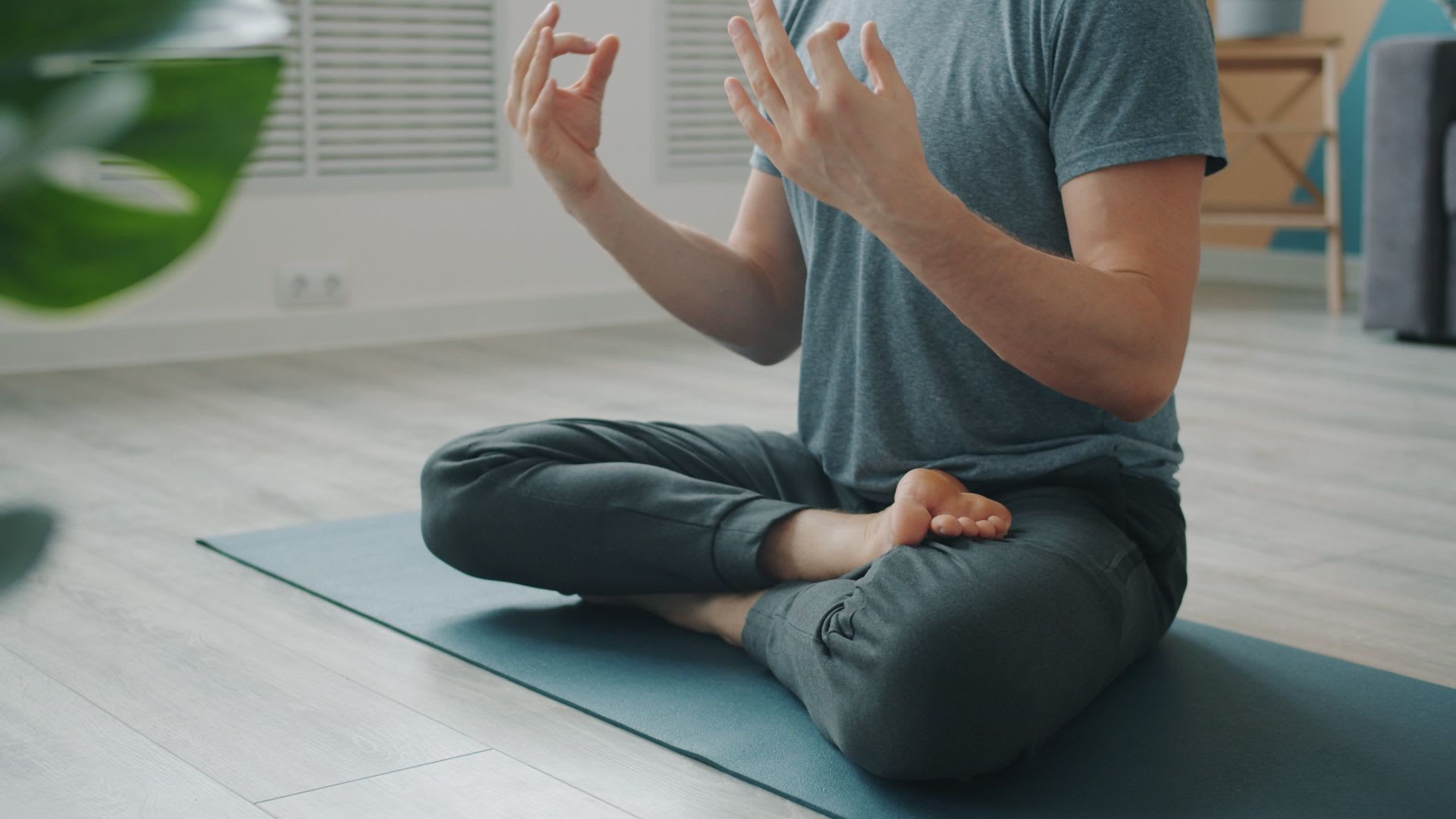
Sit cross-legged on a folded blanket or cushion so that the hips are higher than the knees and the spine can lengthen without effort. Rest the hands on the thighs. This is the seat for most of the breathing practices above. If the floor is uncomfortable, sit on a chair with the feet flat.
Bhujangasana and Shalabhasana (Cobra and Locust)
These gentle back-strengthening poses appear in our own notes on stress management by yoga asana, where we describe them as part of a stress-relieving sequence in the tradition we teach. Lie on your belly and lift the chest a short distance for cobra, or lift the legs slightly for locust, keeping the breath steady. Keep the lift low and comfortable, and skip these if they strain your back.
Savasana (Corpse Pose)
The name comes from the Sanskrit shava, meaning “corpse.” Lie on your back with the legs comfortably apart and the arms relaxed by the sides, palms up. Close the eyes if that feels safe, and follow the movement of the breath in the chest and belly. Savasana is typically practiced for 5 to 10 minutes at the end of a session and can be held longer. If lying flat is uncomfortable for your lower back, bend the knees with the feet hip-width apart. If you feel restless, deepen the breath a little instead of fighting the restlessness.
Yoga Nidra, Meditation and Mindfulness
Many people who struggle with anxiety find sitting meditation difficult at first. Sitting still with an anxious mind can feel like turning up the volume. That is normal, and it is why we introduce body-based practices first.
Yoga nidra means “yogic sleep.” It is a guided practice, done lying down, in which a teacher or recording leads you through relaxing parts of the body in turn, while you remain awake and listening. It is deeply restful and needs no experience. At Nepal Yoga Institute, yoga nidra forms part of the afternoon schedule in our stress management package, alongside pranayama.
Mindfulness means paying attention to the present moment on purpose, with a kind and non-judging attitude. You can practice it during any activity: feeling your feet on the floor as you walk, noticing the taste of tea, or listening to the sounds around you for one minute. Our page on mindfulness explains how we teach it, and our article on the three scientific reasons to meditate gives more background on why people take up meditation.
A word of balance, again from NCCIH’s guidance on meditation and mindfulness: the evidence suggests these practices can help some people with anxiety and stress, but a minority of participants, roughly 8 percent in the studies NCCIH cites, report unpleasant experiences such as increased anxiety or depression. If meditation makes you feel worse, shorten it, keep the eyes open, return to body-based practices or talk to a professional. You are not failing; a different approach may suit you better.
A Simple Mindfulness Exercise for Anxious Moments
Try this 60-second grounding exercise anywhere:
- Feel the contact of your feet with the floor or your body with the chair.
- Name silently three things you can see, two you can hear and one you can feel on your skin.
- Take three slow breaths with a longer exhale.
- Ask yourself: what is the next small thing I need to do?
Three Short Sequences You Can Start Today
The 5-Minute Reset
Use this between meetings, before bed or whenever tension builds.
| Step | Practice | Time |
|---|---|---|
| 1 | Sit comfortably, soften the shoulders and jaw | 30 seconds |
| 2 | Belly breathing with a slightly longer exhale | 2 minutes |
| 3 | Five slow neck and shoulder rolls each way | 1 minute |
| 4 | Bhramari, five breaths | 1 minute |
| 5 | Sit quietly and notice how you feel | 30 seconds |
The 10-Minute Evening Wind-Down
| Step | Practice | Time |
|---|---|---|
| 1 | Cat-cow, slow rounds | 2 minutes |
| 2 | Child’s pose | 2 minutes |
| 3 | Standing forward fold, then roll up | 1 minute |
| 4 | Legs up the wall | 3 minutes |
| 5 | Slow breathing in Savasana | 2 minutes |
The 20-Minute Weekend Practice
| Step | Practice | Time |
|---|---|---|
| 1 | Easy seat, belly breathing | 3 minutes |
| 2 | Nadi shodhana, equal breaths | 3 minutes |
| 3 | Cat-cow, child’s pose, gentle forward fold | 5 minutes |
| 4 | Bridge pose, two or three rounds | 2 minutes |
| 5 | Legs up the wall | 3 minutes |
| 6 | Savasana or a short yoga nidra recording | 4 minutes |
Keep the pace slow in all three. If a step does not feel right, leave it out. A practice that you can keep up is worth more than an ambitious one that you abandon after a week.
Building a Routine You Will Actually Keep
Consistency matters more than length. Here are some practical ways to make it stick:
- Anchor it to an existing habit. Do your breathing right after brushing your teeth or before your first cup of tea.
- Start tiny. Five minutes a day for two weeks beats an hour once a month.
- Choose a consistent place. A corner with a mat and a cushion becomes a cue for your body to slow down.
- Track how you feel, not how you perform. A short note after practice, such as “calmer,” “restless” or “tired,” helps you see patterns over time.
- Pair yoga with other habits that help. NIMH lists regular exercise, adequate sleep and cutting back on caffeine among helpful self-care habits.
- Be kind about missed days. Skipping a day does not undo the benefit; begin again.
A sample weekly rhythm might be the 5-minute reset on weekday mornings, the 10-minute wind-down on three evenings, and the 20-minute practice on one weekend day. Adjust it freely to fit your life.
Common Mistakes to Avoid
- Trying to relax by force. Effort and relaxation pull in opposite directions. Aim for “allowing” rather than “achieving.”
- Jumping into strong breathing. Forceful pranayama can raise rather than lower arousal for beginners.
- Treating yoga as a performance. Flexibility is not the goal; no one is grading your pose.
- Expecting an instant change. Some people feel calmer after a single session; many need weeks of regular practice. Both experiences are normal.
- Ignoring the lifestyle side. Poor sleep, heavy caffeine and constant overwork can undo a lot of good breathing.
- Using yoga to avoid help. If anxiety is severe or persistent, practice alongside professional care, not instead of it.
When to Seek Professional Help
Yoga is a useful self-care tool, but there are times when you need more. NIMH advises seeking professional help when anxiety starts to interfere with school, work or relationships, and a primary care doctor can provide a referral to a mental health professional. NIMH describes CBT as the most studied psychotherapy for generalised anxiety disorder, with acceptance and commitment therapy as another option, and notes that medication can also help some people. Those are decisions to make with a qualified clinician.
Consider reaching out to a doctor or mental health professional if:
- worry is constant, hard to control or lasts for weeks or months
- you avoid places, people or activities because of fear
- you have frequent panic attacks, or physical symptoms that worry you
- sleep, appetite or concentration are seriously affected
- you are using alcohol or other substances to cope
- you feel hopeless, or you have thoughts of harming yourself
If you are thinking about harming yourself or you feel unsafe, contact your local emergency services or a trusted person right now, and ask a doctor or a mental health professional for help as soon as you can. In Nepal, this means seeking support from a hospital, a registered psychiatrist or a licensed counsellor in your area. Nepal Yoga Institute also lists psychological counseling among its services; please contact us to ask what is available and how it works.
Who Should Take Extra Care
Most healthy adults can try the gentle practices above, but a few groups should speak to a doctor or experienced teacher first:
- Pregnant women, especially for inversions, deep twists and breath holds
- People with high or low blood pressure, because of forward folds, inversions and rapid changes in position
- People with eye conditions such as glaucoma, for inversions and head-down positions
- People with epilepsy, certain psychiatric conditions or a history of trauma, where NCCIH notes relaxation techniques may rarely cause or worsen symptoms
- People with recent surgery, spinal problems or joint injuries
- Children and older adults, who need age-appropriate adaptations
Tell your teacher what is going on in your body and mind before class. A good teacher will adapt the practice, not push you.
How Nepal Yoga Institute Supports Anxiety and Stress Management
Nepal Yoga Institute provides yoga, pranayama, meditation and relaxation programs at our centre in Budhanilkantha-11, Kathmandu. We do not claim to treat anxiety disorders. What we provide is structured, supportive training in the practices described in this article, guided by teachers with years of experience in yoga and stress research. Our founder, Dr. Bal Krishna Khanal, holds a PhD in Yoga and Naturopathy from Nepal Sanskrit University, with stress management as an area of his research.
The Five Days Stress Management Package
Our Five Days Stress Management Package is built around relaxation and gentle practice. The published schedule runs like this:
| Day | What Nepal Yoga Institute provides |
|---|---|
| Day 1 | Check-in at 12:00 and lunch; relaxation; a stress level and resilience assessment; Ayurvedic massage; optional steam bath; yoga asana, pranayama and meditation for stress; dinner |
| Days 2 to 4 | Early morning ushapan and optional jalaneti with tea; mantra and pranayama; asana; breakfast; relaxation sessions; a stress management session; lunch; pranayama and yoga nidra in the afternoon; yogasana and meditation; dinner |
| Day 5 | The same daily rhythm, with a second stress management session in the afternoon |
Fixed prices are not published for this package. Our team calculates the cost on request according to group size and duration, so please contact us for a current quotation.
Long-Term and Short-Term Stress Management Programs
If five days is too short or too long, our Long Term and Short Term Stress Management Package provides programs of different lengths. Because anxiety management is a matter of habit, many people benefit from a longer rhythm of daily practice. As with the five-day package, the price is calculated on request.
Corporate Stress Management Training
Workplace stress is a common source of anxiety. Our corporate positive attitude and stress management training program includes a confidential psychological assessment (case history, stress level test and stress resilience test), a presentation, and a practice class with discussion. The four-day version totals eight hours, at two hours per day, for groups of up to 20 people, and it is led by Dr. Bal Krishna. No fixed prices are published; contact us with your group size and goals.
Learning to Teach and Practice Deeply
Some students come to us for stress relief and decide they want to go deeper. Our 200-hour yoga teacher training runs for 22 days from the 15th of each month, with up to 14 students per batch and one day off a week. It includes philosophy, anatomy and physiology, teaching methodology and 100 hours of practice, with the total fee published at $1,400 and a $200 non-refundable deposit to secure your place. We mention it so that you know the option exists; it is not necessary for learning yoga for anxiety management.
Food, Setting and Practicalities
Meals at the institute are organic sattvic vegetarian or vegan, free Wi-Fi is available, and mats and props are provided. Our FAQ page answers questions on payment, application processing and airport transfers; please check it or contact us before you travel. The centre is around 22 km from Tribhuvan International Airport and about 24 km from Thamel.
Frequently Asked Questions about Yoga for Anxiety Management
1. Can yoga cure anxiety?
No. Yoga is not a cure for anxiety or for an anxiety disorder. Research suggests it may help some people manage stress and anxiety symptoms, but the evidence is mixed and many studies are small. We recommend yoga as a complement to professional care, not a replacement for it.
2. What is the best yoga for anxiety management?
There is no single best style. Slow, gentle styles that combine easy breathing, restful poses and relaxation tend to suit beginners better than fast or intense flows. A simple routine of belly breathing, cat-cow, child’s pose, legs up the wall and Savasana is a good start.
3. Which breathing exercise is best for anxiety?
Slow diaphragmatic breathing with a smooth, slightly longer exhale is the easiest place to begin, and it is among the relaxation techniques NCCIH describes. Alternate nostril breathing and the humming bee breath are gentle next steps. Avoid forceful breathing and long breath holds until you have a teacher.
4. How long should I practice each day?
Five to twenty minutes a day is enough to start. Regular short practice is better than an occasional long session. Build slowly and let the practice feel like a rest, not another task.
5. How soon will I feel a difference?
It varies. Some people feel calmer after a single session of slow breathing and Savasana. For others it takes weeks of regular practice, and some people notice little change. If you are not feeling better after a few weeks, or you feel worse, speak with a health professional.
6. Can yoga make anxiety worse?
For some people, yes. NCCIH notes that relaxation techniques and meditation are generally safe, but a few people report more anxiety, intrusive thoughts or a fear of losing control. If a practice makes you feel worse, stop, try a gentler or more body-based practice, and talk to a professional.
7. Is yoga better than therapy or medication?
Neither is “better” in general; they do different jobs. NIMH describes CBT as the most studied treatment for generalised anxiety disorder, and medication helps some people. Yoga is a self-care practice that can sit alongside these. Do not stop treatment without speaking to your clinician.
8. Is it safe to do yoga during a panic attack?
During a panic attack, simple steps are best: sit or lie down, plant your feet, and breathe slowly. Avoid fast or forceful breathing. If panic attacks are frequent or frightening, see a doctor or mental health professional. If you feel unsafe, contact your local emergency services.
9. Do I need to be flexible?
No. Every pose in this guide can be done with bent knees, cushions and blankets. Flexibility is not the goal; comfort and steady breathing are.
10. Should I practice in the morning or at night?
Either works. Morning practice can set a calmer tone for the day, and evening practice can help you wind down before bed. Choose the time you will keep. Avoid practising strong, energising poses close to bedtime.
11. Can I do these practices at work?
Yes. Slow breathing, shoulder rolls, a seated forward fold and the 60-second grounding exercise can all be done at a desk. For workplace groups, Nepal Yoga Institute provides a corporate stress management program, described above.
12. What if I cannot sit still to meditate?
Start with movement and lying-down practices such as cat-cow, legs up the wall and yoga nidra. Add one or two minutes of sitting when you are ready. Mindfulness can also be done while walking or drinking tea.
13. Can I learn yoga for anxiety management online or at home?
Yes, many people practice at home using a gentle routine like the ones above. Learning in person at first helps you to check your technique and ask questions. If you are considering a stay with us, please confirm current programs, availability and costs with the institute directly.
14. Does Nepal Yoga Institute give fixed prices for stress management programs?
Fixed prices are not published for the stress management packages. We calculate cost on request according to group size and duration. The 200-hour teacher training has a published fee of $1,400, with a $200 non-refundable deposit. Please contact us for a current quotation.
15. Who should I talk to before starting?
If you have a medical or mental health condition, are pregnant, take regular medication or have a history of trauma, speak to your doctor or therapist first, and tell your yoga teacher. This is especially important before trying inversions, breath retention or long meditations.
Ready to Begin? Practice With Us in Kathmandu
If you would like guided practice in a calm setting, Nepal Yoga Institute provides programs designed around breathing, relaxation and gentle movement. Here is how to take the next step:
- Ask questions first: our FAQ page covers payments, applications and arrival.
- Reserve your place: use our booking page to send an application.
- Talk to us on WhatsApp: message us at +977 9860480478 and tell us what you would like help with.
- Email us: info@nepalyogainstitute.com
Whatever you choose, take care of yourself first, and if anxiety feels too much to carry alone, please speak to a doctor or mental health professional.