Introduction on Yoga Classes for Beginners
The mat is rolled out. Other people are arriving, some of them unpacking blocks and straps, a few already folded into shapes that look like punishment. You are standing near the back, wondering whether you should have practised, whether your socks are allowed and whether anyone will notice that you do not know what “Savasana” means.
If that picture is uncomfortably familiar, this guide is for you. Almost everyone in that room remembers their own first class. Most of them were nervous too.
Yoga classes for beginners exist precisely so that you do not need to know anything beforehand. This article walks you through what happens in a first class, how the main styles differ, what to wear and bring, the words you will hear, the worries almost every beginner has, the safety points worth knowing, and a gentle eight-week plan to carry you past the awkward first month. It also explains where Nepal Yoga Institute fits, using the days and costs it publishes.
What Counts as a Beginner Yoga Class?
A beginner class is one that assumes you are new. That usually means:
- Slower pacing. Poses are introduced one at a time, with time to understand them.
- Plain explanations. The teacher names each pose, describes how to enter it and offers an easier or harder option.
- More demonstrations. You are shown, not just told.
- Props. Blocks, straps and walls are treated as normal tools.
- No expectation of flexibility, strength or experience.
You will see classes labelled “beginners,” “foundations,” “gentle,” “basics,” “Hatha” and “all levels.” These are not identical, so ask. A “beginners” class is built for people with no experience. An “all levels” class is open to everyone, which can be wonderful with a good teacher and overwhelming with a rushed one.
The label matters less than the teacher. A skilled instructor can make an “all levels” class feel safe, and an inexperienced one can make a “beginners” class feel like a test. That is why the later section on choosing a class focuses on the person at the front of the room.
What Happens in a First Class, Step by Step
Most beginner classes follow a similar shape. Knowing it in advance removes a surprising amount of nerves.
| Stage | What happens | Roughly how long |
|---|---|---|
| Arrival | You settle your mat, sit or lie down, and the teacher may ask about injuries or experience | A few minutes |
| Centring | A short pause for quiet breathing, sometimes with a simple intention | A few minutes |
| Warm-up | Gentle movements for the spine, shoulders, hips and legs | 5 to 15 minutes |
| Standing poses | Poses such as Mountain, Chair, Warrior and Triangle | 15 to 30 minutes |
| Balance or core work | Simple balances or core exercises | A few minutes |
| Floor poses | Seated stretches, folds, gentle twists, perhaps a bridge | 10 to 20 minutes |
| Final relaxation | Lying still in Savasana | Often 5 to 10 minutes |
| Closing | A few quiet breaths, sometimes a word of thanks | A minute or two |
Beginner classes often run somewhere between 60 and 90 minutes, though schools differ. Ask before you book so you know what to plan around.
Walking through your first visit
Before class. Arrive ten to fifteen minutes early. That gives you time to find the room, set up your mat and speak to the teacher without rushing. Tell them it is your first class, and mention anything that matters: an old injury, recent surgery, pregnancy, high blood pressure, or simply “my knees are cranky.”
Choosing a spot. Many beginners hide in the back row. It is fine to do that for your first visit, but a spot toward the middle or side often lets you see the teacher and other students more easily. Pick whichever makes you feel at ease.
During class. Listen to the teacher, glance at others for reference if you need to, and do your version. If a pose is too much, rest. Almost every class includes a resting pose, often Child’s Pose, that you can take at any time without explanation.
The relaxation at the end. Savasana can feel strange at first. Lying still with nothing to do is harder than it sounds, and your mind may race. That is normal. Let your breath settle and allow the stillness to do its quiet work.
After class. Notice how you feel. Many people feel looser, calmer or sleepy. Some feel a little sore the next day. A mild ache in muscles you do not usually use is common. Sharp or joint pain is not.
The Main Styles of Yoga Class and Which Suit Beginners
Walk into a studio and you will see a timetable full of names. Here is a plain-language guide.
| Style | What it feels like | Beginner suitability |
|---|---|---|
| Hatha | Slow, steady, posture by posture, with breath and pauses | Excellent first choice |
| Iyengar | Precise alignment, long holds, generous use of props | Excellent for learning detail |
| Vinyasa | Flowing movements linked to breath, often faster | Good with a “beginner” label |
| Ashtanga | A set sequence practised in a steady rhythm; demanding | Better after some experience, or with a beginner-focused introduction |
| Yin | Long, passive floor poses held for several minutes | Good, especially for tight hips |
| Restorative | Fully supported rest with props | Good for stress and fatigue |
| Yoga Nidra | Guided deep relaxation lying down | Good for rest and sleep |
| Kundalini | Breathwork, chanting, repeated movements | Works for open-minded beginners |
| Hot yoga | Practised in a heated room | Use caution; check with a doctor and hydrate carefully |
| Prenatal / chair / gentle | Adapted for pregnancy, limited mobility or low energy | Excellent when the need fits |
For most first-timers, Hatha or a clearly labelled beginner class is the safest bet. If you want to know whether it will be too hard, the guide on whether Hatha yoga is hard speaks to that worry directly, and the guide to a Hatha yoga class for beginners shows what that kind of class looks like.
A sensible rule: choose the style you can imagine returning to on a tired day. A gentler class you attend weekly beats an intense one you attend once.
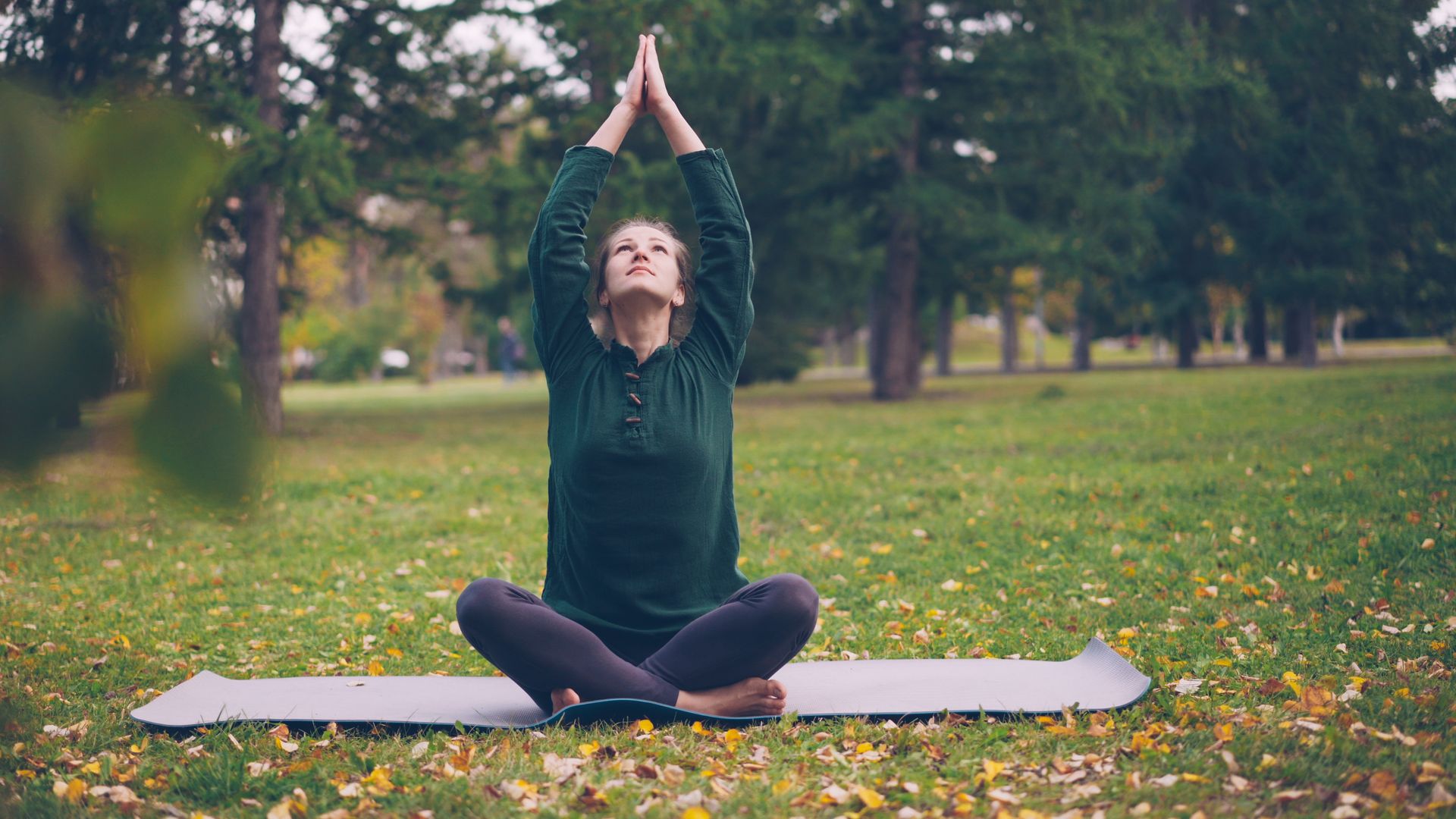
What to Wear, Bring and Eat
You do not need expensive equipment. You do need a few basics.
Clothing. Wear comfortable, stretchy clothes that let you bend, reach and fold without adjusting them. Avoid anything too loose, which can flop over your face in a forward fold, or too tight, which can restrict your breath. Layers help, because you may feel cool during relaxation.
Feet. Yoga is normally practised barefoot, which helps grip and balance. Socks are fine for relaxation if you get cold, but they can be slippery during active poses.
The mat. A non-slip mat gives grip and cushioning. Many studios lend or rent mats, so ask before you buy. If you plan to practise at home, a basic mat is plenty at the start.
Water. Bring a small bottle and sip before and after class rather than during the practice.
A towel. Optional, but useful if you sweat or are practising in a warm room.
Props. Blocks, a strap and a blanket are often provided. If not, ask the studio what you will need.
Food. Many teachers suggest avoiding a heavy meal in the couple of hours before class, because folds and twists feel better on a lighter stomach. A small snack earlier is fine. Listen to your own body.
Phone. Switch it to silent, or leave it outside the room. The quiet is part of the value.
Words You Will Hear in Class
Yoga borrows from Sanskrit, and a few terms come up in almost every class. Here are the common ones.
| Word | Plain meaning |
|---|---|
| Asana | A yoga posture |
| Pranayama | Breathing practice |
| Savasana | Final relaxation, lying still (often translated as Corpse Pose) |
| Drishti | A steady gaze point used to help balance and focus |
| Vinyasa | Movement linked with breath, or a flowing style |
| Namaste | A traditional greeting, commonly understood as “I bow to you” |
| Om | A sacred syllable sometimes chanted at the start or end of class |
| Mudra | A symbolic hand or body gesture |
| Chakra | A traditional concept of energy centres in the body |
Do not worry about pronunciation. Teachers usually give English names too, and nobody expects you to say “Virabhadrasana” correctly on day one.
Simple Class Etiquette
Yoga rooms run on a few unwritten courtesies. None of them are difficult, and knowing them removes a lot of low-level anxiety.
- Arrive on time. Late arrivals disturb the opening quiet, which is often the most useful part for a nervous beginner. If you are running late, enter quietly and set up your mat at the back or side.
- Silence your phone. Better still, leave it outside the room or in your bag.
- Give people space. Place your mat so that arms and legs have room to move without touching your neighbour.
- Tell the teacher what you need. A quick word before class about injuries or limits is welcome, not a nuisance.
- Stay for the final relaxation. If you must leave early, let the teacher know beforehand and go before Savasana begins, so you do not disturb others.
- Keep fragrance light. Strong perfume can bother people who are breathing deeply.
- Be gentle with yourself and others. Avoid comparing, commenting on other people’s bodies or offering unrequested advice.
- Ask before photographing. Phones and cameras are usually not appropriate during class.
Breathing in a Beginner Class: What the Teacher Means
Breath is where a lot of yoga’s calming effect is said to live, and it is also where beginners most often get confused. A few simple ideas are enough to start.
Breathe through the nose when you can. Nasal breathing tends to be slower and quieter. If you cannot breathe smoothly through your nose, you are probably working too hard.
Let the belly move. In a relaxed breath, the belly and lower ribs expand gently on the inhale and soften on the exhale. You do not need to force this.
Lengthen the exhale slightly. Many teachers invite students to let the exhale run a little longer than the inhale, because a slow exhale is often associated with a calmer feeling. Do not strain. A comfortable count of four in and five or six out is plenty, and you can simply follow the teacher’s pace.
Use the breath as a speedometer. If your breath becomes ragged, shallow or held, the pose is too intense. Ease back until your breathing steadies.
Avoid forceful techniques at first. Practices that involve rapid or forceful breathing, or long breath holds, are best learned from a qualified teacher in person, and are not recommended if you have high blood pressure, heart conditions, are pregnant or feel unwell. In a beginner class, the breathing will usually be gentle.
Over time, the breath becomes a way of noticing how you are rather than a technique you perform. If that idea is new to you, do not worry. It develops by repetition, not by effort.
The Worries Almost Every Beginner Has
“I’m not flexible enough.”
Flexibility is something yoga builds, not something it requires. If you cannot touch your toes, you bend your knees or use a block. The pose is the same shape for your body at the level you are at today.
“I’ll look silly.”
Everyone in a beginner class is thinking about their own balance, their own breathing and their own shaky legs. Teachers have seen it all and are usually delighted to see a new face.
“I can’t keep up.”
You do not have to. Rest in Child’s Pose whenever you like. A good teacher will tell you at the start that resting is part of the practice.
“I’m too old, too heavy, too stiff.”
There are gentle, chair-based and adapted classes for many bodies and ages. Tell the teacher what your body needs, and ask whether the class suits you before you commit.
“What if I get hurt?”
Serious injury in yoga is uncommon, but it is not impossible, particularly when people push into pain or compare themselves with others. Telling the teacher about injuries, going slowly and stopping when something hurts reduce the risk considerably.
“What if it’s religious or spiritual?”
Yoga has spiritual roots, and some classes include chanting or philosophy. Many are mostly physical and breath-based. Ask the teacher or school what to expect, and choose what feels right to you.
“What if I cry or feel strange?”
It sometimes happens. Slow breathing and quiet can bring emotions to the surface, and it is not a sign that something is wrong. Be gentle with yourself and talk to the teacher afterwards if it bothers you.
Safety First: Health Conditions and Common Sense
Yoga is generally considered safe for most healthy people when practised appropriately. The U.S. National Center for Complementary and Integrative Health summarises the evidence in its overview of yoga’s effectiveness and safety, noting that serious injury from yoga is rare. That reassurance has conditions.
Speak to your doctor first if you have:
- Pregnancy
- High blood pressure or a heart condition
- Eye conditions such as glaucoma
- Recent surgery or an ongoing injury
- Osteoporosis or significant joint problems
- Chronic pain
- A condition affecting balance or dizziness
For every beginner:
- Tell the teacher about your health before class begins, not during it.
- Move slowly into and out of poses.
- Stop if you feel sharp pain, dizziness or breathlessness.
- Keep a slight bend in the knees in standing poses and folds rather than locking them.
- Do not hold your breath. Smooth, comfortable breathing is your best guide.
- Be especially careful with forceful breathing practices and deep backbends until you have a teacher’s guidance.
If the class does not ask about health conditions at all, ask yourself whether you want to learn from someone who does not.
What the Research Actually Supports
The honest summary of the research is that yoga can help with some things, usually modestly. According to NCCIH, of 17 studies included in a 2014 review, 12 showed improvements in physical or psychological measures related to stress. For chronic low-back pain, the evidence points to a slight benefit compared with no exercise. Yoga is considered a reasonable option alongside, not instead of, standard medical care.
That matters for expectations. After a month of weekly classes, you might notice better sleep, a calmer mood, a slightly more flexible body and a better sense of how you hold yourself. You will probably not notice a transformation overnight, and no responsible teacher should promise one. If stress is your main reason for joining, tell the teacher at the start, because slow breathing, longer exhales and a generous final relaxation are the parts of class most likely to help.
What Your Body and Mind May Feel in the First Month
Beginners are often surprised by how ordinary the first few weeks feel, and by how many small changes arrive quietly.
Week one. You may feel pleasantly loose after class, or mildly sore the next day in your thighs, shoulders or the sides of your waist. That soreness comes from using muscles in unfamiliar ways. It should ease within a couple of days. Gentle walking and a glass of water usually help more than complete rest.
Weeks two and three. The movements start to feel less foreign. You may find you recognise the sequence of a class and anticipate what comes next. Some people notice they are standing taller or catching themselves slumping at a desk.
Week four and beyond. Many people report that they sleep a little more easily or feel less keyed up in the evenings, though experiences differ and nobody should promise that for you. You may also notice that your breathing is calmer in everyday situations, because you have been practising slow breathing on purpose.
What is less comfortable is that yoga can also show you things you would rather not see: a stiff hip you had ignored, a habit of rushing, a tendency to compare yourself with others. That is part of the point. A good class gives you somewhere safe to notice these things without turning them into a verdict.
If something feels persistently wrong, such as pain that lingers beyond a couple of days, dizziness or unusual fatigue, pause your practice and speak to a doctor. Yoga should leave you feeling more at home in your body, not less.
In-Person, Online or Private: Which Format Suits You?
| Format | How it works | Best for | Watch out for |
|---|---|---|---|
| In-person group class | You attend a class in a studio or centre | People who like community and hands-on adjustments | Travel time; large classes with less individual attention |
| Online live class | A scheduled session by video call | Busy schedules, people far from a studio | Poor camera angle, limited correction, connection problems |
| Online recorded class | Pre-made videos you play any time | Flexibility and trying styles | No feedback; easy to stop |
| Private one-to-one | Just you and the teacher | Injuries, specific goals, shy beginners | Higher cost |
| Retreat or residential programme | Several days of practice in a set programme | A fresh start and immersion | Needs time away; check inclusions and terms |
If you are weighing the online route, the guide to online yoga classes in Nepal covers formats, time zones and what to ask before you pay. A common and sensible pattern is to attend a live class in person or online first, then add recorded practices for the days you cannot attend.
How to Choose the Right Class and Teacher
A short checklist saves a lot of regret.
- A clear beginner or foundations label. Look for classes that say they are suited to beginners and describe their pace.
- A named teacher with visible training. Training background, years of teaching and style should be easy to find.
- Credentials you can check. Yoga Alliance keeps a public directory of registered schools and teachers at yogaalliance.org. Registration signals that a school or teacher meets certain training standards. It is a useful baseline, not a guarantee of teaching quality.
- A trial class or introductory offer. A good school is happy for you to try before you commit.
- Small enough groups. Smaller classes mean more individual attention.
- A published schedule and price. If you must send three messages to learn the cost, expect similar friction later.
- Health screening. The teacher should ask about injuries and conditions.
- Clear policies. Know the cancellation, refund and rescheduling rules before you pay.
- Language. Choose a class taught in a language you understand easily, especially for breathing and relaxation instructions.
- Your gut feeling. After a trial class, ask yourself whether you felt welcome and safe, or hurried and judged.
Red flags
- Pressure to buy a large package before you have tried a class.
- Promises that yoga will cure serious illnesses.
- Pushing you deeper into a pose after you have said it hurts.
- No questions about your health or experience.
- Vague answers about the teacher’s training.
Practising at Home Between Classes
A class gives you feedback. Home practice gives you familiarity. Together they speed things up. You do not need an hour. Ten minutes, done regularly, is enough to start.
Here is a simple ten-minute routine made of common beginner poses. Move slowly, breathe steadily and skip anything that hurts.
| Order | Pose | Time | Note |
|---|---|---|---|
| 1 | Easy seated breathing | 1 minute | Sit comfortably and follow the breath |
| 2 | Cat-Cow (on hands and knees) | 1 minute | Move gently with the breath |
| 3 | Child’s Pose | 1 minute | Rest your forehead on the mat or a cushion |
| 4 | Mountain Pose | 1 minute | Feel your weight spread evenly through both feet |
| 5 | Standing Forward Fold | 1 minute | Bend the knees as much as you like |
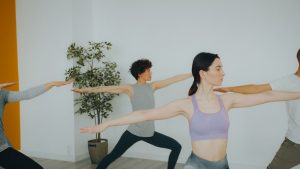
| 6 | Warrior II (each side) | 2 minutes | Keep the front knee over the ankle |
| 7 | Bridge Pose | 1 minute | Press your feet down and lift the hips gently |
| 8 | Savasana | 2 minutes | Lie still and let the breath settle |
A few tips keep home practice going:
- Pick a fixed time. After waking or before dinner works well for many people.
- Prepare the space the night before. A mat already unrolled removes a surprising amount of resistance.
- Start small. Five minutes counts. Many people continue for longer once they begin.
- Do not copy advanced poses from social media. Stay with the basics until a teacher has checked your form.
- Pair home practice with a class. A teacher’s eye catches the things you cannot feel.
Your First Eight Weeks: A Gentle Plan
The first month is where most people quit, usually because life gets busy rather than because yoga is too hard. A simple plan helps.
| Week | Goal | What to do |
|---|---|---|
| 1 | Show up | Attend one or two classes. Learn the routine and do not judge yourself |
| 2 | Choose an anchor | Pick fixed days and times and treat them like appointments |
| 3 | Add a short home practice | Do five to ten minutes of simple stretches and standing poses |
| 4 | Notice breath | Pay attention to the breathing portions of class |
| 5 | Review | Ask how you feel, whether the class suits you, and whether to change anything |
| 6 | Try something new | Attend a different style or a slightly longer class |
| 7 | Deepen | Add a longer home practice or a second weekly class |
| 8 | Decide | Choose how to continue: more classes, a short retreat or further study |
Expect to miss a session now and then. Treat a missed class as information, not failure. What matters is returning.
For the breathing and attention portions of class, the explanation of mindfulness is a plain-language way to understand what the teacher is asking you to notice.
Practical Points When Choosing a Class in Nepal
If you live in Nepal, or plan to visit, a few local details are worth weighing before you commit.
Language. Instructions for breathing and relaxation land best in a language you understand easily. Ask whether the teacher works in English, Nepali, Hindi or another language, and attend a trial session to check how clear it feels.
Travel time. Getting across Kathmandu Valley can take far longer than the distance suggests. A class that is close to home or work is one you are more likely to keep attending, so weigh the journey as seriously as the style.
Season and schedule. Timetables can shift with the seasons, festivals and daylight. Ask the school how it handles holidays and what happens if a class is cancelled.
Visitors and short stays. If you are in Nepal for a limited time, a programme with a fixed start date and clear inclusions may suit you better than a loose weekly class. Check what is and is not covered, including meals, accommodation and transport.
Payment. Ask which payment methods a school accepts, whether it quotes in US dollars or local currency, and what its refund and rescheduling terms are before you pay a deposit.
Pace and group size. Smaller groups give a nervous beginner more attention. Ask how many students usually attend.
None of these points is a reason to hesitate. They are simply the questions that turn a vague plan into a booked class you will actually attend.
Where Nepal Yoga Institute Fits
Nepal Yoga Institute and Retreat is a residential yoga school at Budhanilkantha-11, on the northern edge of the Kathmandu Valley, below Shivapuri National Park. According to the institute, it is about 22 kilometres from Tribhuvan International Airport and 24 kilometres from Thamel. It describes its method as classical and traditional, and describes itself as a Yoga Alliance USA registered school. The institute is open seven days a week from 6:00 to 21:00, and the team states that contact is possible 24 hours a day.
An honest point is worth stating clearly. The institute delivers its classes inside its programmes (retreats, stress-management packages and teacher training), and its website publishes no drop-in timetable or single-class price. Its page on yoga classes in Kathmandu, Nepal explains how classes work there. If you are looking for a casual weekly class, ask the team directly what is currently available rather than assuming.
For a beginner who wants to experience classes in a structured, supported setting, the five-day yoga retreat programme is the gentlest way in. On days two to four, the published schedule includes mantra singing and pranayama at 7:15, an hour of asana practice from 8:00 to 9:00, and a second yoga and meditation session from 16:00, with rest, Ayurveda massage and a sauna through the middle of the day.
Day one begins with check-in at noon. The school notes that the schedule can vary by season and student requests. The retreat lasts five days, its price is calculated on request according to group size, and the institute states a non-refundable deposit of 20% of the package, with full payment on arrival. For a wider read on what a first retreat is like, the institute’s guide to a yoga retreat in Nepal for beginners is a helpful companion.
If a few days of classes leave you wanting to study seriously, the 200-hour yoga teacher training runs for 22 days at a published complete cost of $1,400. A $200 non-refundable deposit is paid in advance, and the balance is due on orientation day in Nepal. Courses start on the 15th of every month and take up to 14 students. According to the institute’s FAQ, the fee covers all meals and tea, training materials and shared accommodation, while transport to and from the institute is not included. You do not need to want to teach to join; many students simply want to learn yoga properly.
Applications are processed within three working days and confirmed by email. If you are unsure which option suits you, the best first step is a short message explaining your experience, your dates and what you hope to feel afterwards.
FAQs about Yoga Classes for Beginners
1. What happens in a beginner yoga class?
A typical class includes a brief arrival and breathing pause, a warm-up, standing poses, some balance or core work, floor stretches and a final relaxation. The teacher names and demonstrates each pose and offers easier options.
2. Do I need to be flexible to start yoga?
No. Flexibility is built through practice. If a pose feels out of reach, bend your knees, use a block or take a simpler version. Every pose has a modification.
3. How long is a beginner yoga class?
Many run between 60 and 90 minutes, though schools differ. Ask before booking so you know what to plan for.
4. What should I wear to a yoga class?
Comfortable, stretchy clothes that let you move freely. Avoid anything too loose or too tight. Yoga is usually practised barefoot.
5. Do I need to buy a yoga mat before my first class?
Not always. Many studios lend or rent mats, so ask first. If you plan to practise at home, a basic non-slip mat is enough to begin.
6. Should I eat before yoga?
Many teachers suggest avoiding a heavy meal in the couple of hours before class. A light snack earlier is fine. Choose what feels comfortable for your body.
7. Which type of yoga is best for beginners?
Hatha is the most common recommendation because it is slow and steady, and many people also like Iyengar for its detail and props. Classes labelled “beginners” or “foundations” are ideal.
8. Is yoga safe for beginners?
Yoga is generally considered safe when practised sensibly, and NCCIH notes serious injuries are rare. Tell your teacher about health conditions, move slowly and stop if you feel sharp pain or dizziness.
9. How often should a beginner attend yoga classes?
One to three classes a week is a realistic start. Consistency matters more than volume, so choose a rhythm you can keep through busy weeks.
10. What if I can’t keep up with the class?
Rest in Child’s Pose or any comfortable position. Resting is part of yoga, and good teachers expect and welcome it.
11. Is online yoga good for beginners?
It can be, particularly live classes where the teacher can see and correct you. Recorded classes are convenient but give no feedback. A mix of both works well for many people.
12. How much do yoga classes for beginners cost?
Prices vary widely by place, format and teacher. Ask for the price, the unit (per class, per week or per package) and the cancellation terms before you pay.
13. Can I do yoga if I have back or knee problems?
Many people do, but speak to your doctor first and tell the teacher before class. Gentle, adapted or one-to-one classes may suit you better than a fast group class.
14. Is yoga safe during pregnancy?
Only with medical approval and ideally a teacher trained in prenatal yoga. Some poses and breathing practices are unsuitable during pregnancy.
15. What does Savasana do and why is it so long?
Savasana is a final relaxation lying still. It lets the body and nervous system absorb the practice. Many people find it the hardest and most valuable part of class.
16. Do I have to chant or do anything religious?
Not necessarily. Yoga has spiritual roots and some classes include chanting or philosophy, but many are mostly physical and breath-based. Ask the school what to expect.
17. How soon will I notice results from yoga?
Many people notice calmer moods or better sleep within a few weeks, though experiences vary. Research summarised by NCCIH shows modest benefits for stress and chronic low-back pain, so keep your expectations realistic.
18. Does Nepal Yoga Institute offer drop-in classes?
The institute delivers its classes inside its programmes, such as retreats and teacher training, and does not publish a drop-in timetable or single-class price. Contact the team to ask what is currently available.
19. How much do Nepal Yoga Institute’s programmes cost?
The 200-hour yoga teacher training lasts 22 days and costs $1,400, with a $200 non-refundable deposit and the balance due on orientation day. The five-day retreat has no fixed published price. It is calculated on request according to group size.
20. How do I contact Nepal Yoga Institute?
You can message the team on WhatsApp, email info@nepalyogainstitute.com or use the contact page. The institute is open seven days a week from 6:00 to 21:00, and states that contact is possible 24 hours a day.
Ready to Take Your First Step?
Every yoga practice starts with a first class, and every teacher was once nervous in the back row. If you would like to experience classes inside a supported programme, or simply ask what would suit a beginner, send a short message. Tell the team how long you can stay, how many people are coming and what you hope to learn.