If you are weighing online yoga teacher training against a course you attend in person, you are really asking two questions at once. Will the certificate count, and will you come out able to teach? The honest answer to the first is usually yes, if the school is set up correctly. The answer to the second depends far more on the format you choose than most course pages admit.
This guide compares the two formats on the things that matter: Yoga Alliance rules, hands-on feedback, cost, time, discipline, and what each one is like to actually live through. It also covers hybrid options, the questions to ask any school, and how Nepal Yoga Institute runs its in-person 200-hour course in Budhanilkantha, Kathmandu, so you can compare a real program against the online alternatives.
Online Yoga Teacher Training vs In-Person: The Short Answer
Online training suits you if you cannot travel, need to fit study around work or family, and already have a solid personal practice. In-person training suits you if you want immersion, hands-on correction and live practice teaching in front of real people. Neither is automatically better. Each is a different trade.
| Your situation | Better fit |
|---|---|
| You cannot take weeks away from home or work | Online or part-time local |
| You are new to yoga and want physical correction | In-person |
| You want to focus fully and step out of daily life | In-person residential |
| You already practice and teach informally | Online can work well |
| You want to build a community of fellow trainees | In-person, or a live-heavy hybrid |
| You want to study abroad in a yoga setting | In-person residential |
If you are earlier in the process and still deciding whether to train at all, the step-by-step guide on how to train as a yoga teacher covers the whole path from first practice to first class.
What Online Yoga Teacher Training Actually Means
The phrase covers very different products, and the differences matter more than the word “online”. Before you compare prices, work out which kind a school is selling.
Live online courses
Teachers and trainees meet together on video at scheduled times. You practice, attend lectures, ask questions and teach each other in real time. This is the closest online format to a classroom.
Self-paced courses
You work through recorded lessons and assignments on your own schedule. It is flexible and usually the cheapest to run, but you get the least feedback. Many self-paced programs add a few live sessions to meet the minimum live hours that Yoga Alliance requires.
Blended or hybrid courses
Part of the training is online, and part happens in person, often as a short residential block. This tries to combine flexibility with real hands-on practice.
When a school says “online”, ask three questions. How many hours are live? Who answers your questions? How and when will someone watch you teach? The answers tell you more than the brochure.
Does Yoga Alliance Accept Online Teacher Training?
This is the question that drives most searches, so here are the facts as they stand today.
Yoga Alliance is a US-based registry. Schools register with it as a Registered Yoga School (RYS), and graduates can then apply to register as a Registered Yoga Teacher (RYT). It permits registered schools to deliver training in person, fully online, or as a mix, as long as they meet its standards. For a 200-hour program, the standards require a minimum of 30 hours of synchronous instruction, which means teachers and trainees interacting in real time. That is 15 percent of the course.
A few other points apply to both formats:
- The training must be delivered by a Registered Yoga School for you to qualify for the RYT 200 credential.
- Multiple trainings cannot be combined to meet the 200-hour requirement, so stitching together short courses from different schools will not work.
- Registration is voluntary. It is a credentialing system, not a government licence to teach.
- Yoga Alliance has announced changes to how credentials and membership work from 2027, so check its credential information page for the rules in force when you apply.
The core curriculum for a 200-hour program is the same whether you study online or in a studio:
| Category | Hours |
|---|---|
| Techniques, Training and Practice | 75 |
| Anatomy and Physiology | 30 |
| Yoga Humanities (philosophy, history, ethics) | 30 |
| Professional Essentials (teaching methodology, professional development, practicum) | 50 |
| Flexible hours allocated by the school | 15 |
So the registry does not treat the two formats as different qualifications. What differs is the quality of the delivery. A well-run online course and a weak in-person course are not equal just because the second one has a classroom. If you want to understand how recognition works for training done in Nepal specifically, the guide to yoga certification in Nepal explains it further.
Online vs In-Person at a Glance
This table sets the two formats side by side on the points that most affect a decision.
| Factor | Online | In-person (residential) |
|---|---|---|
| Flexibility | High. Study from home, often around a job. | Low. You commit a fixed block of days. |
| Hands-on correction | Limited. Teachers see you through a screen. | Strong. Teachers can adjust you and watch you from every angle. |
| Practice teaching | Possible on video, with delays and screen limits. | Natural. You lead real classes and get immediate feedback. |
| Immersion | Depends on your discipline and home environment. | High. Daily life is built around the course. |
| Travel and accommodation | None. | Needed unless you train locally. |
| Community | Can be good in live groups, weaker in self-paced courses. | Strong. You live and learn alongside the same group. |
| Time zones | Live classes may fall at awkward hours. | Not an issue once you arrive. |
| Registration eligibility | Possible if delivered by a registered school. | Possible if delivered by a registered school. |
No row decides the question alone. The most useful way to read the table is to circle the two or three factors that matter most for you and let those weigh heaviest.
What a Typical Week Looks Like in Each Format
It is hard to judge a format from a feature list, so picture the week itself. Schedules vary a great deal from school to school, but the shape of the experience tends to differ in predictable ways.
An online week
In a live online course, your week is usually built from scheduled video sessions, such as lectures, practice classes and discussion groups, plus assignments and recorded material you complete in between. In a self-paced course, you choose when to study, which gives you freedom and also removes the structure that keeps many people going. Either way, your training shares space with the rest of your life. Work, family and errands continue around it, and you decide where study fits.
An in-person week
In a residential course, the schedule is set for you and fills most of the day. At Nepal Yoga Institute, for example, the published timetable runs from early-morning practice to evening self-study and sadhana, with one day off each week. You do not need to decide what to study next, because the program decides. The trade is that you give up that control for the length of the course.
Neither is better in the abstract. People who struggle to start things on their own often thrive with a fixed timetable. People who need to keep earning or caring for others may have no choice but to study around everything else.
The Real Advantages of Learning Online
Online training earns its place for good reasons, and a fair comparison should say so.
You keep your life running
Not everyone can leave a job, a family or a business for several weeks. Online study lets you train in the evenings or weekends, or in blocks that suit your life, without a flight or a leave request.
No travel or accommodation costs
Residential training means paying for travel, and sometimes for time away from paid work. Studying at home removes those costs, although the course fee itself still varies widely between schools.
You can review the material
Recorded lectures on anatomy or philosophy can be replayed until they make sense. That is hard to do in a live lecture where the class moves on.
Access to teachers far from home
Online learning lets you study with teachers you would otherwise never meet. If a particular tradition or teacher matters to you, the format can make that possible.
A gentler start for shy learners
Some people find it easier to practice and ask questions from the comfort of their own space. For nervous beginners with a developing practice, that can lower the barrier to starting.
The Limits of Online Teacher Training
The limits are just as real, and they cluster around the skills that make someone a good teacher rather than a knowledgeable student.
Hands-on feedback is thin
Alignment is three-dimensional. On a screen, a teacher sees one angle, often a small and slightly delayed one. Subtle problems, such as uneven weight, a collapsed shoulder or a strained neck, are easy to miss. In a room, a teacher can walk over, adjust and demonstrate.
Practice teaching is harder
Leading a class means reading a room, adjusting your volume and pace, and noticing who is struggling. Teaching to a grid of faces on a screen tests only part of that. Many new teachers find that the first time they teach in a real room is the first time they discover what they need to improve.
Distractions are your own to manage
At home, the phone rings, the laundry waits and work messages arrive. Immersive courses remove those pulls. Online courses ask you to build the boundaries yourself, and that takes real discipline over many weeks.
Hands-on assists and ethics are harder to teach
Learning when and how to offer a physical adjustment, and when not to, is a skill best learned with real bodies and real consent conversations. Screens limit it.
Quality varies enormously
Because online courses are cheap to scale, the range runs from thoughtful, live-heavy programs with real feedback to thin collections of recordings with a certificate at the end. The format does not guarantee quality in either direction.
How Teaching Skills Are Built in Each Format
The practicum is where a trainee becomes a teacher, so it deserves a closer comparison. A practicum is the part of the course where you plan a class, teach it to others and receive feedback.
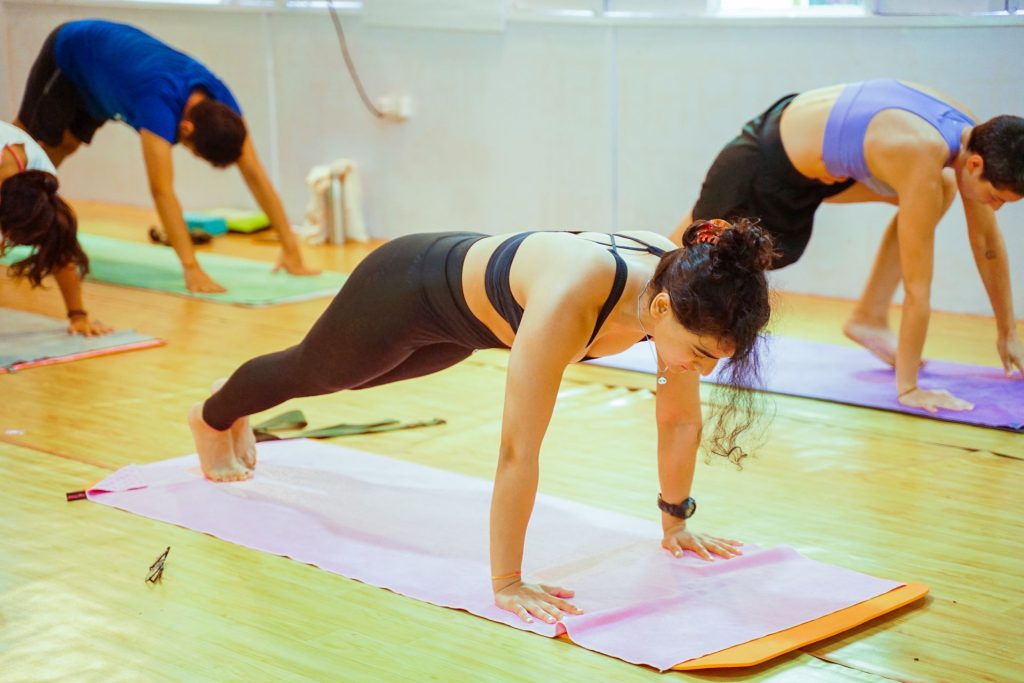
In person, you stand in front of a real group. You learn to project your voice, to position yourself so everyone can see you, to move around the room and to notice a student who has stopped following. Feedback is immediate and specific, and you can try again the next day. You also learn by watching dozens of classes led by your fellow trainees, each with a different style.
Online, you teach through a camera. You can still practice sequencing, cueing, timing and clear language, and those are real skills. A good live course will have you teach short segments to a small group, record your sessions or arrange feedback from a teacher. What it cannot easily recreate is the physical presence of a room, the way people move, and the quick, wordless adjustments of a live class.
If you train online, make up for the gap. Teach friends or family in person before and after the course, ask them for honest feedback, and consider adding a short in-person workshop or mentoring session once you finish.
What In-Person Immersion Adds
A residential course changes the experience in ways that go beyond the classroom. You wake up, eat, practice, study and rest in the same place, with the same people, for the same days. The rhythm builds habits, and the shared effort builds a community that often lasts after the course ends.
It also brings a different kind of learning. You watch your teachers practice. You see how they handle a struggling student, a difficult question or a tired room. You lead classes with real people, receive honest feedback on the spot and try again the next day. Those loops are hard to recreate on a screen.
If you are unsure whether you want a restful immersion or a structured teaching course, the comparison of yoga retreat vs yoga teacher training explains how the two differ, which matters because the two are often confused.
In-person training is not perfect. It costs more in time and travel, it can be tiring, and it asks you to adapt to a new place and schedule. But for many people, particularly beginners and those who want to teach full time, those costs are worth paying.
The Hybrid Option
A hybrid course tries to take the best of both. A typical structure puts lectures, philosophy and some practice online, then adds a shorter in-person block for hands-on teaching practice and assessment. It can be a good fit if you want flexibility but do not want to skip the practicum.
When you look at a hybrid course, check these points:
- How many hours are online, and how many are in person?
- Where is the in-person block held, and are there extra costs for travel and accommodation?
- Are live online sessions scheduled at times that work in your time zone?
- Who assesses your teaching, and when?
- Does the whole program, online and in person, come from one registered school? Remember that separate trainings cannot be combined to reach 200 hours.
That last point catches people out. Some providers sell a short online course as the first step toward a full certificate with another school later. If your goal is a 200-hour credential, confirm in writing that the hours will count before you pay.
How to Judge Any Online Yoga Teacher Training
If you decide to study online, use this checklist to separate serious courses from thin ones.
- Is the school registered? Look it up on the official Yoga Alliance directory rather than relying on a logo on the school’s website.
- How many hours are live? The minimum is 30 for a 200-hour program. More is better, because live contact is where feedback happens.
- Who are the teachers? Look for named teachers with real backgrounds and a clear role in the course.
- How is teaching assessed? Ask how and when a teacher will watch you teach and give feedback.
- What is the group size? Small live groups give more attention than large ones.
- What is the schedule? Check live class times against your time zone and your life.
- What is included? Ask about materials, assessments, certificate fees and how long you keep access to recordings.
- What is the refund policy? Know what happens if you cannot finish or fall behind.
- What do independent reviews say? Read reviews outside the school’s own website.
Red flags
- A promise that you will be certified in a few days without real study.
- No named teachers, or no way to reach one.
- Vague claims about “international accreditation” with no school name you can check.
- Pressure to pay quickly because a discount is about to end.
- No live teaching or feedback at all.
A good school is happy to answer every one of these questions in writing. If a school avoids them, that tells you something.
Setting Up for Online Study: Practical Details
If you go online, a few practical choices make a bigger difference than people expect.
- Space: choose a spot where you can lie down, stand and move with arms extended, without furniture in the way. Keep it the same each time so your body learns the cue.
- Camera angle: place the camera so the teacher can see your whole body in standing and floor postures. A teacher who cannot see your feet cannot correct them.
- Connection and sound: a stable internet connection and clear audio matter more than a fancy device. Test both before the first live session.
- Time zone: convert live class times to your local time and add them to your calendar with reminders.
- Props: have a mat, a strap, blocks or substitutes such as a firm cushion and a belt ready before class starts.
- Accountability: tell someone at home your study hours, or find a fellow trainee to study with, because self-paced courses lose people through lost momentum.
- Notes: take notes by hand during lectures and review them weekly. Recordings take far longer to rewatch than notes take to read.
Who Should Choose Which Format
These are not rules, only patterns worth thinking about.
Online tends to suit you if
- You cannot travel or take extended leave.
- You already have a steady personal practice and some teaching or training experience.
- You are disciplined and comfortable studying alone.
- You want to deepen your knowledge more than start a full-time teaching career.
In-person tends to suit you if
- You are newer to yoga and want physical correction and guidance.
- You want to teach full time or in studios and need confidence in a real room.
- You learn best with routine and structure around you.
- You want a break from daily life and a chance to concentrate.
Hybrid tends to suit you if
- You want some flexibility but also want a real practicum.
- You can manage a short trip but not a full residential course.
It also helps to ask what you want from the certificate. If it is a stepping stone to teaching your first classes at a studio, hands-on practice matters more. If it is a structured way to deepen your own understanding, a well-run online course may be enough.
A Quick Self-Assessment
If you are still undecided, answer these questions honestly. There are no right answers, only useful ones.
- How long have you practiced regularly? A few months suggests in-person guidance will help. Several years makes online study more realistic.
- Have you ever taught a class, even informally? If not, hands-on practice teaching will probably matter to you.
- Can you step away from daily life for several weeks? If not, online or part-time may be your only practical choice.
- Do you finish courses you start on your own? Be honest. Self-paced study rewards people who do.
- Do you learn best by reading, watching or doing? Doing is easier to arrange in person.
- What do you plan to do with the certificate? Teaching at studios, teaching privately and personal growth each point to a slightly different choice.
- What does your budget cover, including travel and time off? Compare the full cost, not just the fee.
If your answers split down the middle, a hybrid route, or an online course followed by an in-person workshop, may be the sensible compromise.

Safety and Injury Prevention in Both Formats
Teacher training asks a lot of the body. Long practice sessions, new postures and unfamiliar routines can bring out old injuries or create new ones, and the format changes how well a teacher can protect you.
In person, teachers can see how you move all day and step in early if something looks wrong. That is one reason many people with injuries or health conditions prefer to train in person. Whatever you choose, tell your teachers about any injury, medication or medical condition before the course begins. Nepal Yoga Institute, for example, asks about medication, health conditions and previous yoga experience on its booking form.
Online, you carry more of that responsibility. You choose how far to go in a posture with a teacher who cannot see your face clearly or sense your effort. Slow down, use props, rest when you need to and stop if something hurts. A good online teacher will tell you the same, and will make clear that modifying a posture is part of learning, not a failure.
Whichever route you take, remember that a yoga teacher is not a doctor. Part of what you learn in any good course is when to adapt a practice and when to send a student to a qualified professional.
Preparing for Either Format
Whichever route you choose, preparation changes how much you get out of it.
Start with your own practice. Teacher training assumes you already know your way around a class. If you are still new, spend a few months in regular classes first. The guide to yoga classes for beginners explains what to expect and how to choose a class that suits your level.
If you plan to train in person, think about logistics early: dates, travel, visa rules, insurance and what to pack. The guide to things to prepare for your yoga teacher training is a useful checklist for the weeks before you go.
Cost and Time: What Can Be Compared Fairly
Prices vary enormously by school, country and format, so averages can mislead. Rather than quote figures that may be out of date, here are the points you can compare and the figures that are published and verifiable.
What affects the total cost
- Course fee: varies widely between online and in-person schools, and within each format.
- Travel and accommodation: relevant mainly to in-person training away from home.
- Time off work: a real cost for residential courses, and sometimes for live online blocks.
- Technology and setup: usually small, but include a reliable device and connection for online study.
- Registration: Yoga Alliance lists a one-time application fee of $50 and annual dues of $65 for teachers who choose to register.
Published figures for the in-person course in this guide
| Item | Amount | Source |
|---|---|---|
| Nepal Yoga Institute 200-hour training (complete cost) | $1,400 | Institute’s course page |
| Nepal Yoga Institute deposit | $200, non-refundable | Institute’s course page |
| Nepal Yoga Institute course length | 22 days | Institute’s course page |
| Yoga Alliance RYT application | $50 one-time | Yoga Alliance fees |
| Yoga Alliance RYT annual dues | $65 per year | Yoga Alliance fees |
When you compare, put the full cost of each option side by side: the fee, the extras and the time you give up. A cheaper course that you never finish is more expensive than a pricier one you complete.
In-Person Training in Nepal: Nepal Yoga Institute
For readers who decide that in-person training is the right choice, here is how one program works. Nepal Yoga Institute and Retreat is a residential yoga school in Budhanilkantha, on the northern edge of the Kathmandu Valley, below Shivapuri National Park. The school lists its distance as about 22 km from Tribhuvan International Airport. Its main focus is the 200-hour yoga teacher training, alongside retreats, stress management programs and psychological counseling.
The school is led by its founder, Dr. Bal Krishna Khanal, who holds a Ph.D. in Yoga and Naturopathy from Nepal Sanskrit University. His team includes a Yoga Alliance USA certified teacher, an Ayurveda doctor who teaches anatomy and physiology, and a yoga and meditation teacher. The institute states that it is registered with Yoga Alliance USA and that its teachers hold Experienced Registered Teacher status. As with any school, you can verify registration yourself on the Yoga Alliance directory before paying a deposit.
The 200-hour course at a glance
| Detail | As published by the institute |
|---|---|
| Format | Residential, in person at the institute |
| Course length | 22 days |
| Complete cost | $1,400 |
| Deposit | $200, paid in advance and non-refundable |
| Balance | Payable on orientation day in Nepal |
| Start dates | The 15th of every month, ending on the 7th or 8th of the following month |
| Group size | Up to 14 students per course |
| Day off | One day a week, typically Sunday |
| Minimum age | 18 |
According to the institute’s FAQ, the fee covers all meals and tea, training materials and shared accommodation. Transport to and from the institute is not included. Meals are sattvic, meaning organic vegetarian or vegan, and meat, fish and eggs are not served.
What the in-person format adds in practice
The institute’s published daily schedule starts at 6:30 with satkarma (cleansing practices), chanting and pranayama, followed by mantra chanting, asana and pranayama, then breakfast. Mid-morning is theory and yogic relaxation, the afternoon includes self-study, meditation and a workshop, and evenings have asana practice, dinner, self-study and sadhana until about 9:30 pm. The school notes that the timetable can change with the season and student requests.
The published curriculum puts the largest block of time, about 100 hours, into practice. It also includes 20 hours of philosophy, 20 hours of anatomy and physiology, a 20-hour practicum, and 15 hours of teaching methodology. In the practicum, every trainee leads classes, observes others and gives and receives feedback, which is exactly the kind of live teaching practice that online formats find hardest to match. You can see the full curriculum and booking details on the 200-hour yoga teacher training page.
If you want to try online practice before committing to any training, the guide to online yoga classes in Nepal is a gentler place to start, and if you are weighing a trip, the article on why Nepal is a good country for yoga teacher training explains what the setting offers.
Common Mistakes When Choosing a Format
- Choosing on price alone. The cheapest course is rarely the best value, and the most expensive is not automatically better.
- Assuming “online” means “registered”. Verify any registration claim on the official directory.
- Ignoring the live hours. A course with the minimum live hours gives you much less feedback than one with many.
- Underestimating the discipline online study needs. Self-paced courses fail most often through lost momentum, not difficulty.
- Skipping the practicum question. Ask exactly how and when you will be watched teaching.
- Splitting hours across providers. Separate trainings cannot be combined to make a 200-hour credential.
- Starting too soon. Training with very little personal practice makes any format harder.
- Not budgeting the whole cost. Include extras, travel, time off and registration.
What Comes After Your 200 Hours
Whichever format you choose, the course is the start. Give yourself a little time to digest it, keep practicing every day and teach your first classes to people you trust. Ask for honest feedback and build a few sequences you know well before you expand.
When you are ready for more depth, an advanced course is the natural next step, and the guide to advanced yoga teacher training in Nepal explains what to expect beyond the foundation level. Many teachers who began online also choose to add an in-person block later, because hands-on teaching practice is what many new teachers feel they need most.
Frequently Asked Questions About Online Yoga Teacher Training
Is online yoga teacher training legitimate?
It can be. Yoga Alliance allows registered schools to deliver 200-hour training fully online, as long as they meet its standards, including a minimum of 30 hours of live, synchronous instruction. Legitimacy depends on the school, so check its registration and ask how teaching is assessed.
Will an online certificate be accepted by Yoga Alliance?
If the course is delivered by a Registered Yoga School, graduates can apply to register as an RYT. Registration is voluntary and you apply individually after completing the training. Courses from unregistered providers do not qualify, however good they are.
Can I become a yoga teacher entirely online?
You can complete a qualifying 200-hour training online if the school is registered and delivers it under Yoga Alliance’s current standards. Whether you will feel ready to teach is a separate question, and many new teachers choose to add in-person practice to build confidence.
Is online training cheaper than in-person training?
Often the course fee is lower and you avoid travel and accommodation, but prices vary widely by school. Compare the full cost, including extras and time away from work, rather than the headline fee alone.
How long does an online 200-hour course take?
It depends on the school. Some run as intensive live programs over a few weeks, and others spread study over several months. Nepal Yoga Institute’s in-person 200-hour training runs over 22 days, starting on the 15th of every month.
Do I need yoga experience before an online course?
Many schools expect a regular personal practice, and it helps a lot. Without a teacher in the room to correct you, a developing practice is harder to refine. Nepal Yoga Institute states that no specific experience is required for its in-person 200-hour course.
What is the difference between synchronous and asynchronous learning?
Synchronous learning happens in real time with a teacher, such as live classes on video. Asynchronous learning is self-paced, such as recorded lectures you watch when you choose. Yoga Alliance requires a minimum number of synchronous hours for registered 200-hour programs.
Can I combine an online course with in-person training later?
Only if the hours come from the same registered program. Yoga Alliance does not allow multiple trainings to be combined to meet the 200-hour requirement, so confirm in writing with the school how the hours would count.
How much does the in-person course at Nepal Yoga Institute cost?
The complete cost of the 200-hour training is $1,400. A $200 non-refundable deposit is paid in advance, and the balance is due on orientation day in Nepal. The course runs for 22 days and starts on the 15th of every month.
What should I ask before I pay for any teacher training?
Ask whether the school is registered and how to verify it, how many hours are live, who the teachers are, how your teaching is assessed, what is included in the price and what the refund policy is. Get the answers in writing.
Ready to Talk About Your Teacher Training?
If you are leaning toward training in person, or you simply want to ask about dates, what is included and whether the course suits your level, the team at Nepal Yoga Institute is happy to answer. Tell them your experience, your goals and when you would like to come, and they will guide you.
Chat with Nepal Yoga Institute on WhatsApp: +977 9860480478
You can also reserve your place through the online booking form.