Introduction to Primary Series Ashtanga
If you’ve spent any time around an Ashtanga room, you’ve probably heard the phrase “just do your practice, and all is coming.” It sounds simple. It isn’t. The Primary Series — the sequence every Ashtanga student starts with — is a 90-minute conversation between breath and body that takes years to actually understand, even though you can memorize the poses in a few months.
This guide is for the person standing at the edge of that conversation: maybe you’ve taken a few Mysore-style classes and want to know what you’re actually building toward, maybe you’re recovering from an injury and wondering if Ashtanga is even appropriate for you, or maybe you’re planning a dedicated training in Nepal and want to know exactly what the Primary Series involves before you commit weeks of your life and a plane ticket to it.
We’ll walk through the full pose-by-pose structure, the philosophy behind why it’s built the way it is, realistic timelines, safety considerations, and what training the Primary Series looks like on the ground in Kathmandu.
What Is the Ashtanga Primary Series?
The Primary Series is the first of six sequences in the Ashtanga Vinyasa system, and it is the sequence nearly every Ashtanga practitioner — beginner or advanced — returns to for years, sometimes for life. In Sanskrit, it’s called Yoga Chikitsa, which translates roughly to “yoga therapy” or “the medicine of yoga.” That name isn’t decorative. The sequence was designed to systematically work through the body — aligning the spine, opening the hips and hamstrings, strengthening the core and shoulders, and stimulating the digestive and nervous systems — before a student is introduced to the more demanding backbends and inversions of the Intermediate Series (Nadi Shodhana) and beyond.
Unlike a typical vinyasa flow class where the sequence changes daily, the Primary Series is fixed. Every posture appears in the same order, held for the same number of breaths, linked by the same transitional movements (vinyasas). That rigidity is deliberate: it removes decision-making from the practice so that a student’s attention can go entirely into breath, gaze (drishti), and internal awareness rather than working out what comes next.
Three technical pillars hold the whole system together:
- Vinyasa – a precise count of breath-linked movements that connect one posture to the next, so the practice becomes one continuous, moving meditation rather than a series of disconnected poses.
- Ujjayi breath – an audible, slightly constricted breath through the nose that keeps the body warm, the mind focused, and the movement steady.
- Bandhas and drishti – internal muscular locks (primarily mula bandha at the pelvic floor and uddiyana bandha at the lower belly) paired with a fixed gazing point in each pose, which together anchor concentration and protect the joints during deeper stretches.
Practiced with these three elements together, the Primary Series produces heat, a strong sweat, and — over months — a noticeably different relationship with your own body.
Where the Primary Series Comes From
The Primary Series wasn’t invented in a studio marketing meeting; it has a documented, single lineage. It was systematized in Mysore, South India, by Sri K. Pattabhi Jois, who began studying under the yoga teacher Tirumalai Krishnamacharya at the age of twelve, in 1927. Krishnamacharya had healed the Maharaja of Mysore through yoga, and in gratitude the Maharaja established a yoga hall for him on the palace grounds, where Jois trained under him for the following decades.
In 1948, Jois founded the Ashtanga Yoga Research Institute in the Lakshmipuram area of Mysore, the school known today as the Sri K. Pattabhi Jois Ashtanga Yoga Institute (KPJAYI). Foreign students began arriving in the 1960s after a Belgian practitioner who had studied the Primary and Intermediate sequences with Jois wrote about the method in a published book, and from there Ashtanga spread through generations of Western teachers who trained directly in Mysore before returning home to teach.
Pattabhi Jois taught at his Mysore school until his death in 2009, by which point thousands of international students had trained under him directly, many of whom went on to become the teachers who first brought Ashtanga to Europe, North America, and eventually Asia. Leadership of the KPJAYI institute in Mysore later passed to his grandson, Sharath Jois, who continues to teach and authorize senior instructors in the same lineage today.
That single-lineage history matters for something practical: it’s the reason the sequence, the counting, and the pose order you learn in Kathmandu, Kyiv, or California should all match. A teacher’s training lineage — who they studied under, and for how long — is one of the more useful things to ask about before signing up for any Ashtanga program, including in Nepal.
The Full Structure of the Primary Series
The Primary Series always follows the same architecture: an opening invocation, sun salutations, standing postures, seated postures, a short backbending sequence, and a fixed closing sequence. A full, unmodified practice typically runs 75 to 120 minutes depending on a student’s pace and how many vinyasas are taken between postures.
1. Opening and Sun Salutations
| Segment | What Happens |
|---|---|
| Opening chant (optional) | A short invocation, traditionally recited before practice begins |
| Surya Namaskara A | 5 rounds — the foundational sun salutation, establishing the breath-movement rhythm |
| Surya Namaskara B | 5 rounds — adds Chair Pose (Utkatasana) and Warrior I (Virabhadrasana) to build heat |
2. Standing Postures
These build the stability, alignment, and hip opening that everything later in the sequence depends on.
| Pose (Sanskrit) | English Name |
|---|---|
| Padangusthasana | Big Toe Pose |
| Padahastasana | Hand Under Foot Pose |
| Utthita Trikonasana | Extended Triangle Pose |
| Parivrtta Trikonasana | Revolved Triangle Pose |
| Utthita Parsvakonasana | Extended Side Angle Pose |
| Parivrtta Parsvakonasana | Revolved Side Angle Pose |
| Prasarita Padottanasana A–D | Wide-Legged Forward Bend (four variations) |
| Parsvottanasana | Intense Side Stretch Pose |
| Utthita Hasta Padangusthasana | Extended Hand-to-Big-Toe Pose |
| Ardha Baddha Padmottanasana | Half Bound Lotus Forward Bend |
| Utkatasana | Chair Pose |
| Virabhadrasana I & II | Warrior I and II |
3. Seated Postures
This is the longest and most demanding part of the practice — a progression of forward bends, twists, arm balances, and hip openers.
| Pose (Sanskrit) | English Name |
|---|---|
| Dandasana | Staff Pose |
| Paschimottanasana | Seated Forward Bend |
| Purvottanasana | Upward Plank Pose |
| Ardha Baddha Padma Paschimottanasana | Half Bound Lotus Forward Bend (seated) |
| Triang Mukhaikapada Paschimottanasana | Three-Limbed Forward Bend |
| Janu Sirsasana A, B, C | Head-to-Knee Pose (three variations) |
| Marichyasana A, B, C, D | Marichi’s Pose (four variations) |
| Navasana | Boat Pose (repeated 5 times) |
| Bhujapidasana | Shoulder-Pressing Pose |
| Kurmasana | Tortoise Pose |
| Supta Kurmasana | Sleeping Tortoise Pose |
| Garbha Pindasana | Embryo Pose |
| Kukkutasana | Rooster Pose |
| Baddha Konasana A & B | Bound Angle Pose |
| Upavistha Konasana A & B | Wide-Angle Seated Forward Bend |
| Supta Konasana | Reclining Angle Pose |
| Supta Padangusthasana A & B | Reclining Big Toe Pose |
| Ubhaya Padangusthasana | Both Big Toes Pose |
| Urdhva Mukha Paschimottanasana | Upward-Facing Forward Bend |
4. Backbending Sequence
| Pose (Sanskrit) | English Name |
|---|---|
| Setu Bandhasana | Bridge Pose |
| Urdhva Dhanurasana | Upward Bow / Wheel Pose (traditionally 3 rounds) |
5. Closing (Finishing) Sequence
Every Ashtanga practice — regardless of which series a student is on — ends with the same closing sequence of inversions and calming postures.
| Pose (Sanskrit) | English Name |
|---|---|
| Paschimottanasana | Seated Forward Bend (counterpose) |
| Salamba Sarvangasana | Supported Shoulderstand |
| Halasana | Plow Pose |
| Karnapidasana | Ear-Pressure Pose |
| Urdhva Padmasana | Upward Lotus |
| Pindasana | Embryo Pose (in shoulderstand) |
| Matsyasana | Fish Pose |
| Uttana Padasana | Extended Leg Pose |
| Sirsasana A & B | Headstand |
| Balasana | Child’s Pose |
| Yoga Mudra | Seal of Yoga |
| Padmasana | Lotus Pose |
| Utpluthih | Lifting Up (arm-balance breath count) |
| Savasana | Corpse Pose — final relaxation |
If that list looks intimidating, that’s normal. No one is expected to do the full sequence, in full expression, on day one — which is exactly why traditional training uses the Mysore method described below.
The Six Series of Ashtanga: Where Primary Fits
It helps to see the whole map before focusing on one region of it. Ashtanga Vinyasa is built from six sequential series, and the Primary Series is deliberately the entry point for all of them — no student moves to later series until the earlier one is stable and reasonably comfortable.
| Series | Sanskrit Name | Focus |
|---|---|---|
| Primary Series | Yoga Chikitsa (yoga therapy) | Alignment, detoxification, foundational strength and flexibility |
| Intermediate Series | Nadi Shodhana (nerve cleansing) | Deeper backbends and hip work, aimed at clearing energy channels |
| Advanced A–D | Sthira Bhaga (centering of strength) | Highly demanding arm balances, deep backbends, and advanced flexibility work reserved for long-term practitioners |
In practice, the overwhelming majority of Ashtanga students — including most teachers — spend years working within Primary and Intermediate alone, and a great many build a fulfilling lifelong practice without ever moving into the Advanced series. There’s no obligation to “progress” through all six; depth within the Primary Series is itself a complete and demanding practice.
Key Sanskrit Terms Worth Knowing Before You Start
Walking into a Mysore room for the first time involves a small vocabulary of its own. Knowing these terms in advance makes the first week considerably less disorienting:
| Term | Meaning |
|---|---|
| Vinyasa | A breath-linked movement connecting one posture to the next |
| Ujjayi | The audible “ocean breath” used throughout the practice |
| Drishti | A fixed gazing point held during each posture to support concentration |
| Bandha | An internal muscular lock (mula bandha and uddiyana bandha are the two used continuously) |
| Asana | A yoga posture |
| Sthira and sukha | Steadiness and ease — the balance every posture aims for, per the Yoga Sutras |
| Guruji | An honorific term traditionally used for Pattabhi Jois within the Ashtanga community |
| Shala | A yoga studio or practice hall, from the Sanskrit word for “house” |
Mysore Style vs. Led Classes
Ashtanga is taught in two formats, and understanding the difference matters when you’re choosing a training program.
| Mysore Style | Led Class | |
|---|---|---|
| Pace | Self-paced; each student moves through their own current sequence | Group-paced; teacher calls the count out loud for everyone |
| Best for | Beginners building the sequence gradually, and long-term practitioners | Practicing full vinyasa count precision, usually once or twice a week |
| Teacher’s role | Walks the room, gives hands-on adjustments, “gives” new postures when a student is ready | Leads breath count and transitions from the front |
| Learning curve | Slower to start, but postures are absorbed more safely and individually | Faster exposure to the whole sequence, but less individualized correction |
Most authentic teacher trainings — including Primary Series-focused courses in Nepal — use the Mysore method for the bulk of daily practice, with one or two led Primary Series classes per week so students learn the exact Sanskrit vinyasa count.
Why It’s Called “Yoga Chikitsa” — The Therapeutic Intent
The Primary Series is sequenced, not random, and each section has a specific physiological job:
- Sun salutations raise core body temperature and synchronize breath with movement before any deep stretching begins.
- Standing postures build the leg and hip strength and alignment that protect the knees and lower back during the seated work that follows.
- Seated forward bends and twists (Paschimottanasana through the Marichyasana series) work through the hamstrings, hips, and spine while compressing and releasing the abdominal organs — traditionally described as supporting digestion.
- Arm balances and hip openers (Bhujapidasana through Kukkutasana) build shoulder and core strength while continuing to open the hips.
- Backbends counter the many hours most people spend flexed forward at a desk, opening the chest and strengthening the muscles along the spine.
- Inversions and the closing sequence are traditionally associated with calming the nervous system and settling the mind after an otherwise vigorous practice.
Reported benefits that regular practitioners and teachers commonly describe include improved strength and flexibility, better cardiovascular conditioning from the continuous vinyasa flow, reduced stress through the combination of breath control and physical exertion, and improved body awareness. These are practice-based observations passed down through the Ashtanga teaching tradition rather than formal medical claims, and — as with any physically demanding discipline — results vary by individual and consistency of practice.
Who Should Start With the Primary Series (and Who Should Be Cautious)
Ashtanga’s Primary Series is accessible to genuine beginners — you do not need any prior flexibility or yoga experience to start — but it is also physically demanding, and it isn’t the right entry point for everyone without modification.
Good candidates:
- Anyone reasonably fit and willing to build a daily or near-daily practice habit
- Students who prefer structure and repetition over variety
- People recovering from generalized stress, poor posture, or low core strength who are cleared for vigorous exercise
Practice with caution, and always inform your teacher first:
- Pregnancy (many postures, particularly deep twists and belly-compressing forward bends, require significant modification)
- Existing lower-back, SI-joint, hamstring-tendon, knee, or wrist injuries — these are the joints under the most repetitive load in the Primary Series
- Uncontrolled high or low blood pressure (inversions in the closing sequence may need to be modified or skipped)
- Recent surgery or acute injury of any kind
A qualified Mysore-style teacher’s entire job is to modify postures for exactly these situations — skipping or adapting Supta Kurmasana for tight hips, offering shoulder-stand alternatives for neck or blood-pressure concerns, and pacing new postures according to what a student’s body can safely handle. This is one of the strongest arguments for learning the Primary Series in a supervised training setting rather than solely from videos: an experienced eye catches compensations you can’t feel yourself.
Common Mistakes and Injury Risk Points
Because the same joints repeat across dozens of postures, a handful of injury patterns show up disproportionately in Ashtanga practitioners, and knowing them in advance makes for a much safer learning curve:
- Forcing hamstring flexibility in Paschimottanasana and the standing forward folds before the hips are sufficiently warm — a leading cause of proximal hamstring tendon strain in Ashtanga students.
- Collapsing the lower back instead of hinging from the hips in the Marichyasana twists, which loads the lumbar spine instead of the hip joint.
- Rushing into Supta Kurmasana or Kurmasana without adequate hip-opening groundwork, straining the SI joints and hip flexors.
- Jumping through and jumping back (vinyasa transitions) with locked or dropped wrists, which over time can aggravate the wrist joints — building shoulder and core strength first reduces this risk considerably.
- Skipping the warm-up sun salutations or rushing led-class counts to “keep up,” which increases strain across nearly every joint in the practice.
None of these are reasons to avoid the Primary Series — they’re reasons to learn it from a teacher who prioritizes proper progression over speed.
A useful rule of thumb borrowed from the Mysore tradition itself: if a posture requires you to visibly strain your face, hold your breath, or brace against pain rather than sensation, you’ve gone past the edge the practice is meant to work at. Ashtanga is demanding by design, but the demand is meant to come from repetition and consistency over months, not from forcing depth in a single session.
How Long Does It Actually Take to Learn the Full Primary Series?
There’s no universal timeline, but a realistic range based on how the method is traditionally taught:
- First 4–8 weeks: Learning the standing sequence and the opening portion of the seated sequence, usually receiving one or two new postures per week from a Mysore teacher once the previous ones are stable.
- 3–6 months of consistent practice: Most reasonably fit beginners can move through the standing sequence and much of the seated sequence, though the more demanding postures (Supta Kurmasana, Garbha Pindasana, Kukkutasana) often take longer.
- 1–2 years: A full, unmodified Primary Series with correct vinyasa count and reasonable stability is a realistic target for a dedicated daily or near-daily practitioner.
- Ongoing: Depth, ease, and correct alignment within each posture continue to develop for years — this is why long-term Ashtanga practitioners still describe themselves as “working on Primary.”
An intensive, immersion-style training — like a dedicated teacher training course — compresses the early exposure phase dramatically (you’ll be introduced to the entire sequence within a few weeks), but it doesn’t compress the years of tissue adaptation that follow. This is worth knowing before a training, so you arrive with realistic expectations rather than frustration.
Why Train the Primary Series in Nepal
Nepal isn’t just a scenic backdrop for a yoga certificate — the country has genuine standing in the wider history of yoga and meditation. It sits at the cultural crossroads of Vedic, Hindu, and Buddhist traditions, is home to Lumbini (the birthplace of the Buddha), and Kathmandu Valley in particular has centuries of temple, meditation, and ascetic tradition woven into daily life. Training here places the physical practice inside a living cultural and spiritual context rather than in a studio disconnected from where these ideas originated.
Practically, Nepal has become a serious alternative to India and Southeast Asia for structured yoga training for several concrete reasons:
- Lower cost of living and training fees compared to Western countries, and often compared to popular Indian training hubs, without sacrificing teaching quality.
- A genuinely quiet, Himalayan-adjacent environment. Kathmandu sits at roughly 1,400 metres, and many training centres are positioned in the valley’s quieter northern edges, away from the traffic and noise of the city centre — useful for the disciplined early-morning schedule Ashtanga requires.
- English-language accessibility. Nepal’s yoga schools cater heavily to international students, and instruction is typically delivered fluently in English alongside traditional Sanskrit terminology.
- Straightforward visas for most nationalities, with visa-on-arrival available at Kathmandu’s international airport for the great majority of visiting students, which simplifies planning a multi-week training.
- A well-established teacher training ecosystem, including several Yoga Alliance-registered schools offering everything from 200-hour foundational courses to style-specific trainings like Ashtanga and Hatha.
There’s also a practical side-benefit many students underestimate: because Nepal’s yoga schools sit at the doorstep of the Himalayas, several pair a completed training with a few days of trekking or a mountain retreat. It’s a natural way to integrate the calm, embodied awareness built during weeks of Primary Series practice with the kind of sustained physical effort a Himalayan trail demands — and it’s one more reason Nepal, rather than a studio in a home city, tends to leave a longer-lasting impression on students.
Ashtanga Primary Series Training at Nepal Yoga Institute
Based in Budhanilkantha, on the quiet northern edge of Kathmandu, Nepal Yoga Institute runs a dedicated Ashtanga Yoga Teacher Training program built specifically around the Primary Series and the eight-limbed framework it comes from. The program doesn’t assume prior experience — no previous yoga background is required to join — but it is structured for anyone serious about deepening their asana and breathing practice, whether or not they intend to teach afterward.
What the training generally focuses on:
- A grounding in Sanatan (traditional) yoga philosophy underneath Patanjali’s eight limbs, not just the physical postures in isolation.
- Progressive asana instruction through the Primary Series, paired with pranayama (breathing practice) and meditation, rather than treating the physical sequence as a stand-alone workout.
- Basic anatomy and physiology, so students understand why the sequence is built the way it is, not just the order of poses.
- Yoga Alliance–recognized certification, which allows graduates to register as teachers internationally after completing the course.
- Small-group, teacher-guided practice in the Mysore tradition, with individual correction rather than a one-size-fits-all group flow.
The wider campus context matters here too: Nepal Yoga Institute also runs a foundational 200-Hour Yoga Teacher Training, and many Ashtanga-focused students either build on that base or move directly into the Ashtanga-specific track depending on prior experience. You can read more about the school’s approach and teaching team on its About Us page before applying.
A Typical Training Day
| Time | Activity |
|---|---|
| Early morning | Mysore-style Ashtanga Primary Series practice (self-paced, teacher-guided) |
| Mid-morning | Breakfast, rest |
| Late morning | Philosophy, anatomy, or teaching-methodology session |
| Afternoon | Pranayama and meditation practice |
| Evening | Optional led class, chanting, or self-study; dinner |
Days are structured but not punishing — the early wake time and disciplined rhythm are themselves part of the traditional Ashtanga method, not an arbitrary schedule choice.
How to Choose the Right Ashtanga Training Program (Anywhere, Including Nepal)
Whether you’re evaluating Nepal Yoga Institute or comparing several schools, a few questions consistently separate a strong program from a weak one:
- Is the certification Yoga Alliance–recognized (or an equivalent internationally accepted body)? This determines whether you can legally and professionally register as a teacher afterward in most countries.
- What is the teacher’s training lineage? Ask specifically who they studied Ashtanga under, and for how long — this is standard, expected practice in the Ashtanga community, not an intrusive question.
- What’s the student-to-teacher ratio? Mysore-style teaching depends on individual hands-on correction; a room of 40 students per instructor cannot deliver that.
- Is the daily schedule realistic for your body? A genuinely traditional program builds in rest and doesn’t rush every student through the same postures at the same pace.
- What’s included in the fee — accommodation, meals, course materials, airport pickup — and is it transparent up front?
- Can you see verified student feedback? Read testimonials and, where possible, third-party reviews (such as TripAdvisor listings) rather than only the school’s own marketing pages.
- Does the curriculum cover philosophy and anatomy, not just asana? A training that only drills postures without also covering the Yoga Sutras, basic anatomy, and teaching methodology will leave graduates under-prepared to actually teach afterward.
- How is the practical teaching component structured? Learning to give hands-on adjustments safely takes real supervised time with an experienced mentor watching — something that’s difficult to deliver well in an oversized cohort.
Preparing for an Ashtanga Training in Nepal
A few practical notes that make the difference between a smooth training and a stressful one:
- Best season: Autumn (late September to November) and spring (March to May) offer the clearest skies and most comfortable temperatures in the Kathmandu Valley; monsoon season (June–August) brings heavy rain, and winter (December–February) can be cold in the mornings, which matters for an early-start practice.
- Physical preparation: You don’t need to be flexible, but building basic cardiovascular fitness and some core strength in the weeks before you arrive will make the first fortnight considerably more comfortable.
- What to pack: A yoga mat and towel (many schools provide mats, but check first), layered clothing for cool mornings and warm afternoons, a basic first-aid and joint-support kit (kinesiology tape or a knee strap can help beginners), and modest clothing for anything outside the practice room, in line with local cultural norms.
- Health disclosure: Tell your school in advance about any existing injuries, medications, or conditions — reputable programs ask for this during enrollment specifically so teachers can plan modifications before day one, not improvise them mid-class.
- Altitude: Kathmandu’s altitude (around 1,400 metres) is generally not a concern for most travelers, but anyone with respiratory or cardiovascular conditions should check with a doctor before a physically intensive training.
Food, Rest, and Recovery During an Ashtanga-Focused Training
A daily or near-daily Ashtanga practice places real demands on the body, and how you eat and rest around it matters almost as much as the practice itself:
- Practice on an empty stomach. Traditional guidance is to practice first thing in the morning, at least a few hours after your last meal — a full stomach makes twists, forward bends, and inversions genuinely uncomfortable and can affect balance.
- Rehydrate and refuel after, not during. Ashtanga is practiced without water breaks; a proper breakfast and hydration afterward matter more than trying to sip water mid-sequence.
- Expect real fatigue in the first two weeks. New postures, an unfamiliar climate, and an early wake time compound quickly. Most schools build at least one rest day per week into a multi-week training specifically for this reason.
- Simple, largely vegetarian meals are standard at most Nepali yoga schools, in keeping with traditional yogic dietary guidance — worth knowing in advance if you have specific dietary needs, so you can flag them during enrollment.
- Sleep is not optional. The early-morning Mysore schedule only works if you’re going to bed early too; treat your evenings during a training as part of the curriculum, not downtime to ignore.
Practice Tips to Progress Safely Through the Primary Series
- Let the teacher “give” you postures rather than pushing ahead on your own — this is the entire logic of the traditional Mysore method, and it exists to prevent injury from progressing faster than your tissues adapt.
- Prioritize the vinyasa transitions as much as the postures themselves — sloppy jump-backs and jump-throughs are where a surprising number of wrist and shoulder injuries originate.
- Treat the breath as the metronome, not the postures. If your Ujjayi breath becomes ragged, that’s the signal to back off before your body does it for you.
- Don’t skip the closing sequence, even on a short practice day — the inversions and calming postures are what bring the nervous system back down after an otherwise stimulating practice.
- Track your practice, even informally. Ashtanga rewards consistency far more than intensity; a modest daily practice outperforms an occasional heroic one.
Frequently Asked Questions about Primary Series Ashtanga
1. What is the Ashtanga Primary Series called in Sanskrit, and what does it mean? It’s called Yoga Chikitsa, meaning “yoga therapy.” The name reflects its purpose: systematically aligning and detoxifying the body before more advanced work begins.
2. How many poses are in the Ashtanga Primary Series? Including the sun salutations and closing sequence, the full Primary Series runs to roughly 60–70 individual postures and variations, performed in a fixed order.
3. How long does a full Primary Series practice take? A full, unmodified practice typically takes 75 to 120 minutes, depending on pace and how many vinyasas a student takes between postures.
4. Do I need to be flexible to start learning the Primary Series? No. Flexibility develops through consistent practice; you don’t need any prior yoga experience or flexibility to begin, though early sessions will be physically challenging regardless of fitness level.
5. What’s the difference between Mysore style and a led Primary Series class? Mysore style is self-paced, with a teacher moving through the room giving individual corrections; a led class has the teacher calling the full breath count aloud while the whole group moves together.
6. Can complete beginners join an Ashtanga teacher training in Nepal? Yes, most programs — including Nepal Yoga Institute’s Ashtanga training — accept students without prior yoga experience, though a baseline level of general fitness makes the first two weeks noticeably easier.
7. How long does it realistically take to learn the entire Primary Series? Most consistent beginners can move through most of the standing and early seated postures within three to six months, with a full, stable Primary Series taking one to two years of regular practice for many students.
8. Is the Primary Series safe if I have a back, knee, or shoulder injury? It can be, with proper modification and full disclosure to your teacher before you begin — Ashtanga’s high-repetition nature means existing injuries need individualized adaptation rather than being pushed through.
9. Why is Ashtanga’s Primary Series called “yoga therapy”? Because its sequence — standing poses, forward bends, twists, backbends, and inversions in a specific order — was designed to work systematically through the body’s joints, organs, and nervous system rather than as a random assortment of postures.
10. What is the vinyasa count system, and why does it matter? It’s the precise, breath-linked count of movements connecting each posture to the next. Learning it correctly is what turns the Primary Series from a set of poses into one continuous moving meditation.
11. Will I receive a recognized certification after Ashtanga training in Nepal? Reputable schools, including Nepal Yoga Institute, offer Yoga Alliance–recognized certification, which allows graduates to register as teachers internationally.
12. What’s the best time of year for yoga training in Kathmandu? Autumn (late September–November) and spring (March–May) offer the most comfortable weather and clearest conditions; monsoon season brings heavy rain, and winter mornings can be quite cold.
13. How is Ashtanga different from Vinyasa or Hatha yoga? Ashtanga follows one fixed sequence practiced in the same order every time, while general Vinyasa classes vary daily, and Hatha typically moves more slowly with longer holds and less continuous linking between postures.
14. What should I pack for an Ashtanga course in Nepal? A yoga mat and towel (confirm if the school provides one), layered clothing for cool mornings, modest everyday wear, and any personal joint-support items like tape or a strap if you have areas of concern.
Final Thoughts on Primary Series Ashtanga
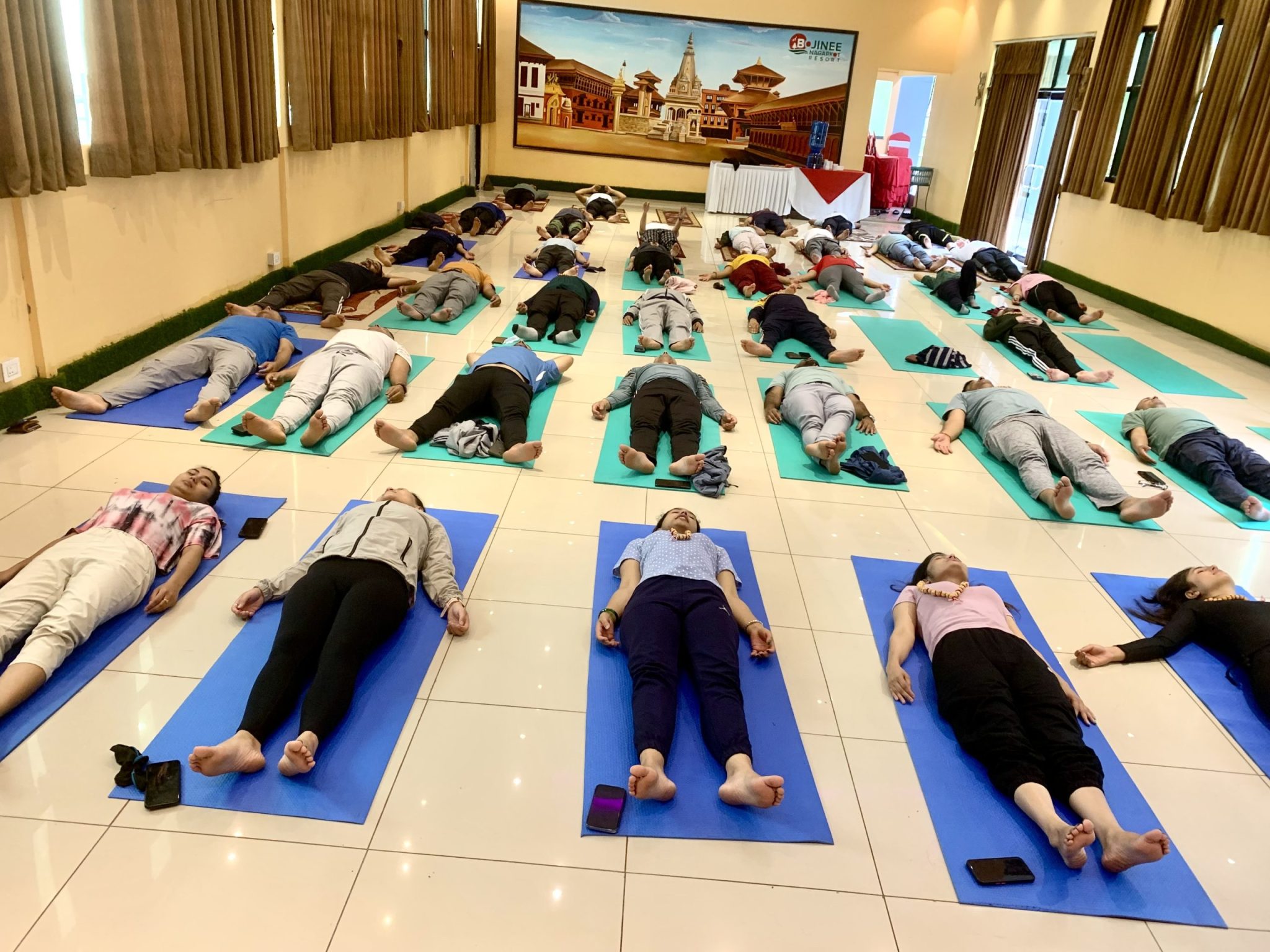
The Primary Series rewards patience more than any other single quality. It’s built to be practiced for years, not mastered in a month, and that’s precisely what makes it such a strong foundation for anyone serious about yoga — whether the goal is a personal practice, a teaching career, or simply a structured way to build strength, flexibility, and a calmer mind. It asks for consistency over intensity, breath over force, and a willingness to work with a fixed sequence long enough for it to actually change how you move and think.
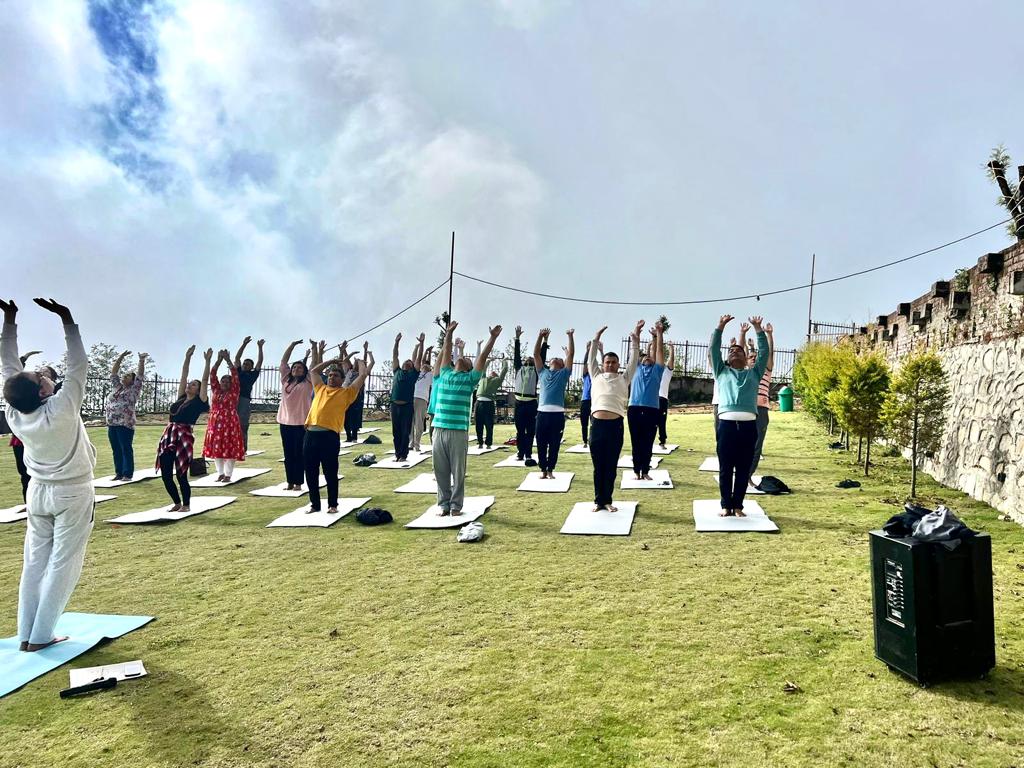
Training it in Nepal adds something a studio back home usually can’t: a slower pace of life, a genuinely spiritual backdrop shaped by centuries of meditation and devotional practice, and a Himalayan morning to move through your Surya Namaskaras in. Whether you arrive as a complete beginner or a practitioner looking to formalize years of self-taught practice into a recognized teaching qualification, the structure of a dedicated Mysore-style training — daily supervised practice, philosophy, anatomy, and a fixed timeline — tends to accomplish in a few weeks what years of occasional studio classes back home often can’t.
If you’re ready to take the next step, Nepal Yoga Institute’s Ashtanga Yoga Teacher Training in Kathmandu is a good place to start, and you can book a place or reach out with questions on their FAQ page before committing.